
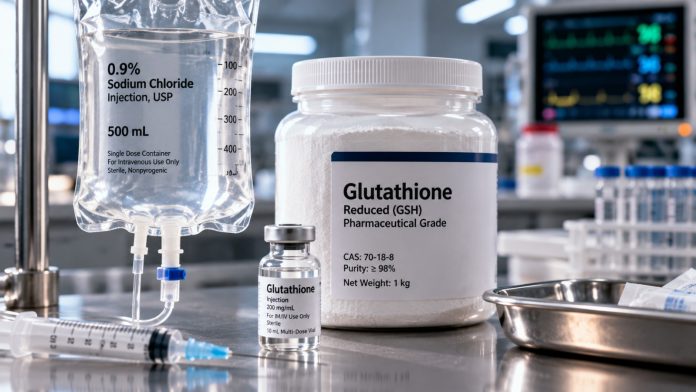
There is a phrase in the FDA’s August warning about injectable glutathione that should stop anyone who works around compounded injectables: “dietary supplement grade.”
The agency says at least 30 patients experienced adverse events after receiving intravenous glutathione, alone or mixed with other ingredients, compounded by pharmacies that had obtained the same lot of glutathione from supplier Medisca. The material was labeled for dietary-supplement use, not for making injectable drugs.
The Patients Behind the Warning
Patients reportedly experienced fever, chills, pain, dizziness and sepsis-like symptoms; some were hospitalized. FDA said the pattern was consistent with excessive endotoxin exposure and noted that two Texas pharmacies conducted recalls involving injectable glutathione with elevated endotoxin levels.
On September 13, FDA posted Centric Compounding’s recall of six lots of glutathione, Myers’ Cocktail and Tri-Immune Boost injectable vials because of elevated endotoxin.

When a product is injected, “same ingredient” does not mean “same standard.”
The Wrong Grade, the Wrong Route
The story is important because consumers tend to think about quality in terms of identity and purity: Is the molecule really glutathione? Is it 99% pure?
Those questions matter, but injectable quality is a much larger system. A material acceptable for oral or dietary-supplement use is not automatically appropriate for injection.
Injectables bypass barriers that normally protect the body from contaminants. Endotoxins — components associated with certain bacteria — can provoke severe systemic reactions even when the active ingredient itself is chemically correct.
Testing Alone Is Not Enough
FDA’s guidance went further than telling pharmacies to test the finished vial. The agency explicitly warned that compounders should not rely on testing alone and said quality has to be built into sourcing, preparation and release.
It urged suppliers and repackagers to identify upstream API manufacturers on labels and certificates of analysis and to state clearly what uses an ingredient is and is not appropriate for.
A certificate is not a magic shield.
Why This Matters Beyond Glutathione
That point should resonate far beyond glutathione. The exploding market for peptides, wellness injections and compounded metabolic drugs has trained customers to ask for COAs, but a certificate is not a magic shield.
Chain of custody matters. Manufacturing grade matters. Sterility assurance matters. Endotoxin control matters. The laboratory result is one piece of a quality system, not the entire system.
The Narrower — and Stronger — Lesson
There is no need to sensationalize what happened. FDA has not said every compounded glutathione product is unsafe, and the agency’s notice concerns specific sourcing and adverse-event reports.
The useful lesson is narrower and stronger: when a product is injected, “same ingredient” does not mean “same standard.”
Thirty patients learned that distinction in the least academic way possible.