
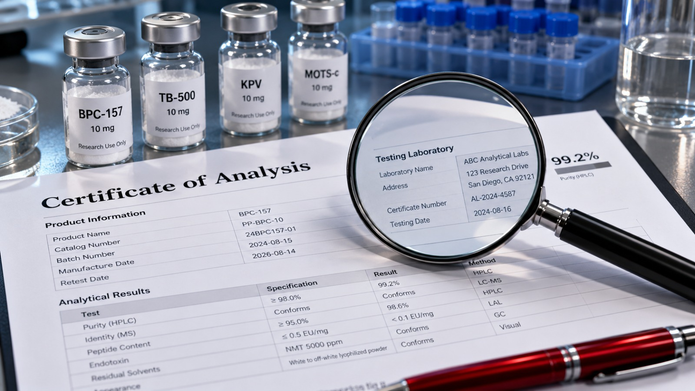
“Third-party tested” may be the most overworked phrase in the research-peptide business.
It appears on homepages, product pages, badges, banners and social posts. It sounds reassuring because it compresses a complicated quality question into three comforting words.
But a growing group of peptide-market transparency trackers is doing something the industry has historically avoided: counting the receipts.
The numbers are uncomfortable.
Thousands of Certificates. How Much Can Actually Be Checked?
PeptideComp’s Testing Transparency Index, most recently generated on October 27, says its active dataset includes 102 approved vendors and 3,924 public COA records.
Seventy-eight vendors have public testing records under its methodology, but only 7.6% purity coverage is recorded across the active dataset and just 9.1% of reports are dated.
Those figures do not prove that products without accessible records are bad. They demonstrate something narrower and arguably more important: much of the market remains difficult for an outsider to independently inspect.

Different Indexes Keep Finding the Same Gap
Other independent indexes are attacking the same problem from different angles.
PepIndex scores vendors using sourced evidence across testing transparency, documentation, track record, business transparency and other criteria. Its methodology explicitly distinguishes information that has a checkable source from unsupported claims.
Peptide Grades reported in its 2026 market analysis that 88 of 95 vendors showed some form of COA access. But only 48 of those 95 published COAs fully and openly, while 68 identified a testing laboratory.
Having a certificate and having verifiable evidence are not necessarily the same thing.
This Is Where Transparency Theater Lives
A company can technically “have testing” while making it difficult for a reader to determine whether the certificate applies to the actual batch being sold, when it was tested, who performed the test and whether the laboratory itself can be identified.
A generic purity percentage therefore tells only part of the story. Batch relevance, testing date, laboratory identity, analytical method and the ability to inspect the underlying record all matter.

Transparency Is Not the Same as Product Quality
None of these indexes should be treated as gospel. Their methodologies differ, their datasets can be incomplete and a transparency score is not the same thing as independent proof that the vial arriving in someone’s hands contains what a website claims.
PeptideComp itself says its index measures evidence transparency rather than medical effectiveness, safety or vendor endorsement. Peptide Grades similarly describes its findings as disclosure signals rather than assays of individual products.
The Market Is Moving From Claims Toward Evidence
But that is precisely why this trend matters.
The peptide market is beginning to move from trust-me marketing toward inspectable evidence. Once readers learn to ask for batch relevance, dates, named laboratories, assay results and records they can actually verify, a generic “99% purity” badge starts looking considerably less impressive.
The next competitive battlefield in peptides may not just be price. It may be proof.
And for an industry built around research, that seems like a remarkably reasonable place to end up.