
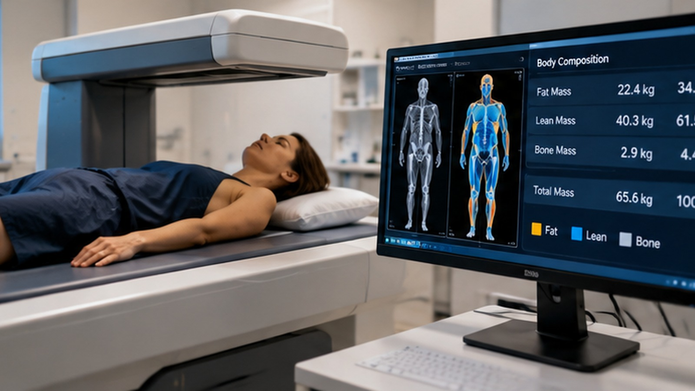
A bathroom scale is an extraordinarily crude scientific instrument. It cannot tell fat from muscle, fluid from tissue or healthy change from harmful change. Yet for most of the modern obesity-drug boom, the scale has been king.
Regeneron’s trevogrumab program is an attempt to make that measurement more sophisticated.
What the Muscle-Preservation Numbers Actually Mean
Trevogrumab is an antibody that inhibits myostatin, a signaling protein that restrains skeletal-muscle growth. In Phase 2 testing alongside semaglutide, Regeneron reported that the 75-mg dose reduced DXA-measured lean-mass loss by 42.5% relative to semaglutide alone at 52 weeks. In a predefined MRI substudy, the same dose prevented 68.9% of the thigh-muscle-volume loss otherwise seen with semaglutide alone at 52 weeks, and 72.7% at 26 weeks. These measurements are not interchangeable: lean mass and thigh-muscle volume describe different aspects of body composition.
The lower-dose trevogrumab combinations preserved lean mass without meaningfully increasing the weight loss achieved with semaglutide alone. A more complex combination involving garetosmab produced additional preservation but enough adverse effects that the company discontinued that strategy. Two participants in the triple-combination group died, although Regeneron said it had not identified a causal association between the treatment and those deaths.
Losing Lean Mass Is Not the Same as Losing Function
The underlying scientific problem is real but easy to oversimplify. Significant weight loss, whether achieved through diet, surgery or medication, typically includes some lean-mass reduction. That does not mean GLP-1 therapy uniquely “eats muscle,” a phrase that has become common in social-media fear marketing. The meaningful questions are how much lean tissue is lost, whether the proportion differs from other weight-loss methods, which patients are most vulnerable and whether preserving more tissue improves strength and function.
Myostatin inhibition offers a biologically plausible way to intervene. Myostatin belongs to the TGF-beta superfamily and acts as a negative regulator of muscle growth. Blocking it can shift the balance toward maintaining or increasing skeletal muscle. But increasing or preserving measured lean mass is not automatically the same thing as improving health. Clinical development has to connect body-composition changes with outcomes people can feel: walking speed, strength, independence, falls, metabolic health and quality of life.
Why Older Adults Have More at Stake
That distinction will become especially important if these combinations move toward older adults. An otherwise healthy 30-year-old with obesity and substantial muscle reserve is not the same clinical problem as a 75-year-old with sarcopenia, frailty risk and limited functional reserve. The latter may have far more to lose from losing the wrong tissue.

Beyond the Number on the Scale
The scientific evolution here is encouraging. First-generation obesity trials proved that pharmacology could produce large, durable reductions in body weight. Next-generation trials can ask a better question: can we selectively improve body composition rather than merely shrink the organism?
That will require more than antibodies. Protein intake, resistance exercise and the pace of weight reduction remain relevant.
Drugs should not erase lifestyle physiology from the conversation simply because they are easier to patent.
But trevogrumab has pushed an important concept into the center of drug development. Its results remain investigational, and whether the preservation of lean mass translates into better physical function and long-term health still needs to be established.
Weight loss is not a tissue diagnosis. If obesity medicine is going to become chronic medicine for tens of millions of people, the field needs to care not just about how much mass disappears, but what remains when it does.


