
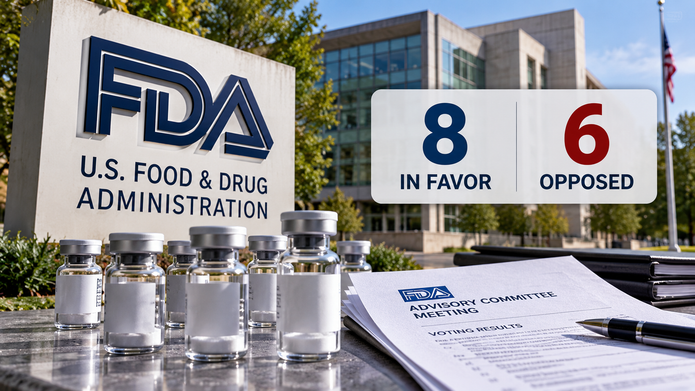
Eight to six.
That number has traveled around the peptide internet as if it were a product approval code.
It is not.
What the Advisory Committee Actually Voted On
On July 23–24, 2026, the FDA’s Pharmacy Compounding Advisory Committee reviewed seven nominated peptide bulk drug substances in the context of the 503A Bulks List. For several substances, including BPC-157, KPV and TB-500, the committee recommended inclusion by eight votes to six, with one abstention.
The committee also recommended MOTS-c, Semax and Epitalon, although the vote counts differed. Emideltide, also known as DSIP, was the only substance that did not receive a favorable recommendation.
The process matters because the 503A Bulks List can determine which bulk substances traditional compounding pharmacies may use under specified conditions when there is no applicable USP/NF monograph and the substance is not a component of an FDA-approved drug.
But an advisory committee does not approve drugs.
A Recommendation to Compound Is Not Approval to Market a Drug
FDA approval is a separate regulatory process built around an application containing evidence about safety, efficacy, manufacturing and labeling for a specific product and indication. A recommendation about whether a bulk substance should be eligible for compounding is answering a different question.
Committee recommendations are non-binding. The FDA retains regulatory decision-making authority, and the formal 503A Bulks List is developed through rulemaking. A favorable committee vote does not itself add a substance to that list or establish that a particular peptide preparation is safe and effective.
The October 28 Policy Changed Enforcement, Not FDA Approval
There has, however, been a genuine regulatory development since the July votes.
On October 28, 2026, the Department of Health and Human Services issued an interim enforcement-discretion policy covering BPC-157, KPV, TB-500, MOTS-c, Semax and Epitalon. Under specified conditions, HHS says it does not intend to take enforcement action against qualifying state-licensed pharmacies, federal facilities or licensed physicians compounding products using these substances while the FDA continues its formal review.
The conditions are substantial. They include requirements involving ingredient identity and quality, manufacturing sources, certificates of analysis, permitted formulations, labeling, patient-specific prescriptions and reporting of serious adverse events and product-quality problems. The policy also restricts the specific forms and routes of administration covered by the enforcement discretion.
That is a meaningful change in federal enforcement policy. It is not an FDA approval, an unrestricted authorization to sell peptides or a declaration that these substances have been demonstrated safe and effective for their marketed uses. Final decisions about the 503A Bulks List remain separate.
The Peptide Market Keeps Confusing Different Kinds of Permission
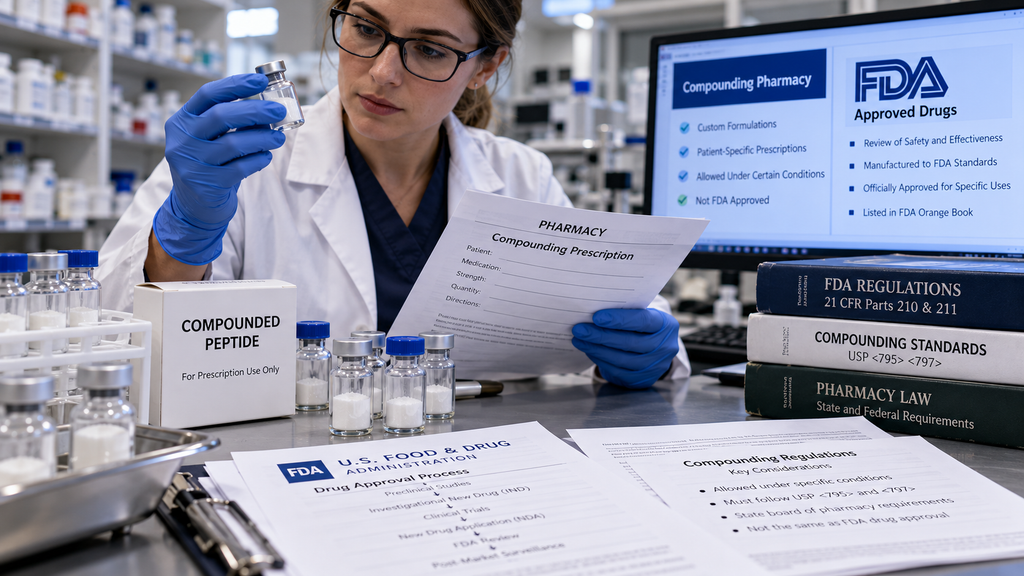
This distinction has become especially important because the peptide market tends to collapse several separate concepts into one word: legal.
Is a molecule FDA approved? Can it be compounded under a particular statutory pathway? Does an interim enforcement policy cover it? Can it be sold as a research chemical? Can a physician prescribe a compounded preparation? Is a particular marketing claim lawful?
Those are not interchangeable questions.
The committee vote is still meaningful. Regulators heard evidence, debated the nominations and, in several cases, recommended inclusion rather than exclusion. The subsequent HHS policy demonstrates that an advisory recommendation can have real regulatory consequences even before final rulemaking is completed.
What neither development does is establish that BPC-157, TB-500, KPV, MOTS-c, Semax or Epitalon is an FDA-approved drug.
The Evidence Is Narrower Than the Headlines Suggest
The science is also narrower than the social-media interpretation. Committee review involved nominated uses and specific evidence packages. A favorable recommendation should not be stretched into an endorsement of every experimental use associated with a molecule.
Nor should an enforcement-discretion policy be mistaken for a clinical-trial result. Compounded medicines are not reviewed by the FDA for safety, effectiveness or quality before marketing in the same way as FDA-approved drugs. Questions about clinical benefit, adverse effects and long-term outcomes remain important regardless of a change in enforcement posture.
Grey Pepper will happily cover a genuine regulatory shift when it occurs.
But the first obligation is to describe the shift accurately.
Eight to six is a vote.
It is not an approval letter.


