
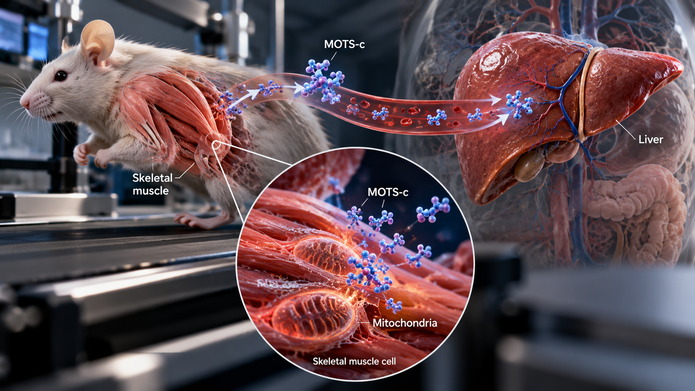
Exercise helps metabolic health, but the signals that travel from working muscle to other organs are still being mapped. A paper published October 22 in Scientific Reports offers one candidate messenger: MOTS-c, a mitochondrial-derived peptide.
Researchers led by Rui Li and colleagues studied whether aerobic exercise changes skeletal-muscle MOTS-c and whether that signal contributes to improved fatty-liver biology. Their findings in diabetic mice and liver-derived cells suggest a connection involving AMPK and ACE2.
This is a mechanistic animal-and-cell study, not a clinical demonstration that injecting MOTS-c treats human liver disease.
The Peptide Carrying Exercise’s Hidden Message
The investigators used a mouse model combining metabolic dysfunction-associated steatotic liver disease, or MASLD, with diabetes. They compared exercise training, administered MOTS-c and control conditions over a four-week intervention.
In the disease model, MOTS-c expression in skeletal muscle and circulating measurements was reduced, while aerobic exercise restored it. Both exercise and peptide treatment were associated with lower liver fat accumulation and improvements in glucose-related measures.
The researchers also observed reduced expression of genes involved in fat synthesis and inflammation.
The results support the possibility that MOTS-c participates in communication between working muscle and the liver. However, the researchers did not selectively eliminate muscle-derived MOTS-c, so the experiments do not definitively establish that this specific signal is necessary for all of exercise’s liver benefits.
The Liver Changed. The Scale Barely Did.
One of the most interesting details is what did not change.
During the four-week intervention, body weight did not fall significantly in the way a simplistic weight-loss narrative might predict. Liver-related measures nevertheless improved.
That matters because metabolic benefits can sometimes occur without large changes on a scale. The authors discuss exercise as a possible route to better hepatic metabolism independent of weight reduction.
The researchers observed reduced hepatic triglycerides and improvements in tissue staining associated with fat accumulation. They also reported changes in glucose tolerance, insulin sensitivity and molecular markers of lipid metabolism.
These findings concern liver fat and metabolic dysfunction, not proven reversal of liver fibrosis. The experimental model did not exhibit substantial liver scarring.

The work does not establish that the same magnitude or mechanism occurs in people. Still, it offers a useful reminder that changes in liver biology and changes in body weight are not always interchangeable outcomes.
The Genetic Experiment That Tested the Theory
To explore how the signal might operate, the team investigated ACE2, a protein with roles in the renin-angiotensin system and broader tissue biology.
MOTS-c treatment and exercise increased hepatic ACE2 expression in the mouse model. When researchers used mice lacking ACE2, many of the peptide’s protective effects were diminished.
In HepG2 cells, an inhibitor of AMPK reduced the peptide-associated increase in ACE2.
Together, these interventions strengthen the case for an AMPK-ACE2 pathway rather than merely an observed correlation. AMPK is involved in cellular energy regulation, while ACE2 participates in signaling processes that can influence inflammation and metabolism.
The experiments suggest that the proposed pathway contributes to MOTS-c-associated changes in hepatic fat synthesis and inflammation. They do not establish every intermediate molecular step or prove that the same pathway produces clinically meaningful effects in humans.
Exercise Is Not a Peptide in a Vial
Yet the experiments also reveal a boundary.
Exercise retained some effects in ACE2-deficient mice that exogenous MOTS-c did not, suggesting that physical activity works through multiple mechanisms.
A peptide cannot be assumed to reproduce the full biological impact of exercise simply because one exercise-responsive signal is involved.
Identifying one molecular message from exercise is not the same as recreating exercise itself.
The researchers acknowledge that MOTS-c is only part of a complex physiological network. Their model also lacks certain genetic tools that could establish more precisely how essential endogenous MOTS-c is to the observed effects.
This distinction is especially important because MOTS-c has become familiar in commercial peptide discussions.
A study showing reduced steatosis in mice does not validate consumer formulations, injection practices or claims of liver regeneration. Research-grade material, compounded products and approved medicines are different regulatory and evidentiary categories.
The October 22 publication advances biological understanding. It should not be turned into a product testimonial or clinical treatment promise.
A Promising Mechanism Still Waiting for Human Proof
Small animal-group sizes and the use of a specific diabetes-associated liver model limit generalizability. The main experimental groups contained approximately five mice each, while the ACE2-knockout groups contained approximately six, with sample sizes varying across individual analyses.
HepG2 cells are useful for probing pathways, but they are not equivalent to a living human liver. The study also lacks human intervention data.
Even a plausible molecular pathway cannot establish appropriate human dosing, delivery, pharmacokinetics or long-term safety. The investigators discuss the need for further research and the limitations of administering an experimental peptide.
The real scientific achievement is the structure of the experiment: exercise, muscle peptide expression, liver signaling and a genetic knockout used to test the pathway.
Future studies can ask whether the same mechanism is present in humans, whether it predicts disease outcomes and whether targeting it adds value beyond established care.
For now, the finding is a new piece of the exercise-to-liver communication puzzle, not an exercise substitute in a vial.
Source: Li R, Li F, Chen Q, et al. Aerobic exercise induced skeletal muscle MOTS-c secretion: A novel therapy for MASLD via hepatic ACE2 regulation. Scientific Reports. Published October 22, 2026. DOI: 10.1038/s41598-026-60273-8.