
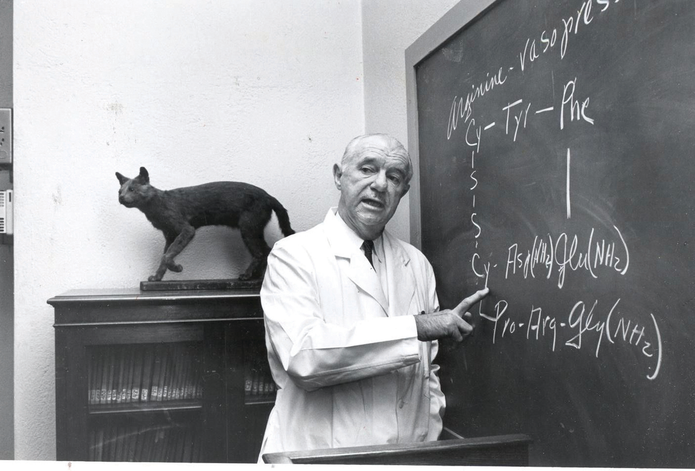
Before a peptide could become an engineered therapeutic platform, chemists had to answer a basic question: could a biologically active hormone be constructed from its amino-acid parts?
Vincent du Vigneaud helped turn that ambition into experimental reality.
His work on sulfur-containing compounds and the synthesis of the peptide hormone oxytocin earned the 1955 Nobel Prize in Chemistry. It is a documented historical story, not October 2026 news.
Its relevance lies in a lesson that still governs modern peptide development: molecular identity and biological activity must be demonstrated, not assumed.
The Breakthrough That Changed Peptide Chemistry in 1953
Oxytocin is a small peptide hormone whose biological effects were known long before chemists could readily build its structure.
Extracting a substance from tissue and observing an effect is one kind of evidence. Identifying its sequence, synthesizing it and reproducing its properties is another.
Du Vigneaud and his collaborators worked through the chemical obstacles that separated those tasks.
In 1953, the researchers reported the synthesis of biologically active oxytocin, marking the first synthesis of a polypeptide hormone. A detailed account of the synthetic work followed in 1954.
Their achievement helped establish that a hormone’s activity could arise from a defined arrangement of amino acids rather than an irreproducible property of a natural extract.
That was a fundamental change in what scientists could attempt. Once a hormone could be constructed and tested, its molecular structure became something researchers could investigate experimentally rather than merely describe.
Why a Tiny Sulfur Bridge Was So Important
Sulfur chemistry was central to the breakthrough.
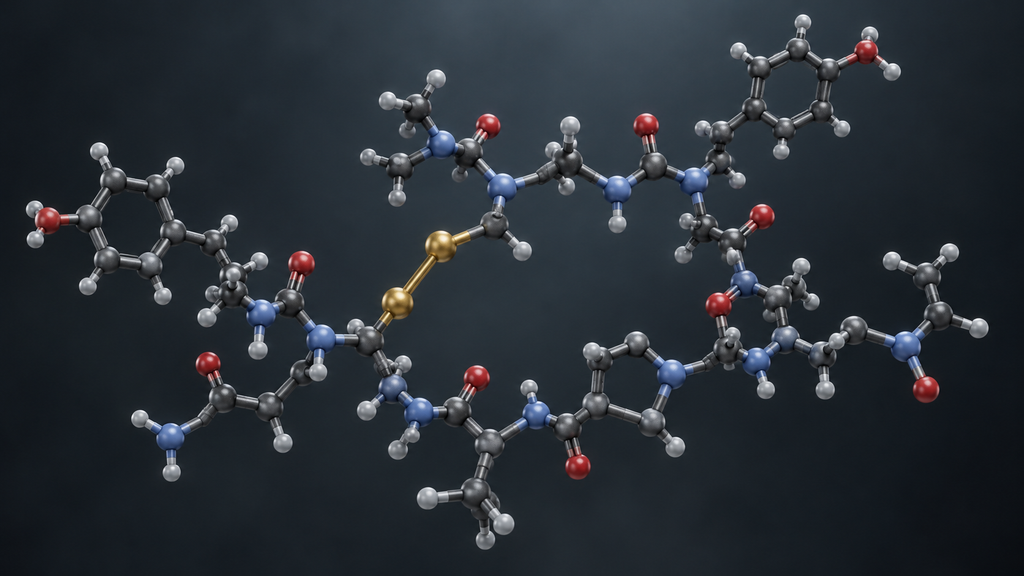
Oxytocin contains nine amino-acid residues, including two cysteine residues connected through a disulfide bond. This connection creates the molecule’s characteristic cyclic structure.
Creating the correct peptide chain was not enough. The sulfur-containing groups also had to be managed during synthesis and then restored to the appropriate relationship.
In his Nobel lecture, du Vigneaud described protective chemical strategies and the reduction and oxidation steps used to regenerate biologically active material.
These technical details mattered because an incorrect connection can produce a chemically similar but functionally different molecule.
The experiment showed why peptide chemistry demands precision at more than one level: the sequence must be correct, the chemical bonds must be arranged appropriately and the resulting molecule must demonstrate the expected biological properties.
The Nobel Prize Recognized More Than One Hormone
The Nobel committee recognized du Vigneaud’s broader work on biologically important sulfur compounds, not merely a single synthesis demonstration.
His research also involved vasopressin, another peptide hormone with a related molecular architecture but distinct physiological actions.
Oxytocin is associated with uterine contractions and milk ejection. Vasopressin plays an important role in water balance and other physiological processes.
Their related structures offered an early illustration of structure-activity relationships: small changes in a peptide’s molecular sequence or configuration can profoundly alter its biological behavior.
Modern medicinal chemistry still exploits that principle when scientists alter amino-acid residues to change potency, stability, receptor selectivity or other pharmacological properties.
The achievement was therefore larger than reproducing a single natural hormone. It provided a foundation for understanding how molecular structure influences biological function.
Behind the Nobel Prize Was a Team of Chemists
The story is also a reminder that science advances through teams.
Du Vigneaud was the named Nobel laureate, but the experiments were conducted with collaborators and students. The published synthesis included contributions from Charlotte Ressler, John M. Swan, Carleton W. Roberts, Panayotis G. Katsoyannis and Samuel Gordon.
The prize citation does not make every laboratory contribution his alone.
In his 1955 Nobel lecture, du Vigneaud explicitly acknowledged the graduate students and postdoctoral researchers who had accompanied him through years of experimental work.
The historical record should not be flattened into the image of one person working in isolation.
Chemistry at this level required purification, analytical measurements, repeated synthesis and biological testing across many attempts.
The triumph was not simply that scientists made a peptide. It was that they could construct a defined hormone and demonstrate that the synthetic material reproduced the properties of its natural counterpart.
What Modern Peptide Science Still Owes This Discovery
Today peptide synthesis can appear almost routine to readers accustomed to catalogs and custom-order laboratories.
Automated instruments and modern protecting-group chemistry have transformed the work, but they have not removed the need to verify sequence, identity, purity, structural characteristics and contaminants.
Du Vigneaud’s era makes the underlying challenge visible.
A successful chemical reaction is not the same as a safe medicine, and a molecular name on a container is not evidence that its contents have the intended identity or activity.
The clinical significance of oxytocin and vasopressin developed through distinct histories of physiology, pharmacology and medical use.
Du Vigneaud’s achievement should not be treated as proof that every synthetic peptide will become a therapeutic.
Instead, it established a foundational possibility: researchers could make and rigorously compare a biologically active peptide with its natural counterpart.
That possibility opened a vast landscape of experimental design while preserving the burden of evidence for each new candidate.
The lesson of his 1955 Nobel Prize is not nostalgia. It is a standard.
Peptide science becomes credible when chemistry and biology meet in verifiable experiments.
Long before today’s commercial excitement, du Vigneaud showed why the order of amino acids, the chemistry of bonds and the proof of activity belong in the same story.
Every modern peptide program still begins with that demand for precision.