
The phrase “orphan drug designation” can sound like an approval to someone reading a biotech headline at speed. It is not. On October 29, 2026, Bicycle Therapeutics highlighted an FDA orphan designation for nuzefatide pevedotin, an investigational bicyclic-peptide drug conjugate being studied in pancreatic cancer. The designation was granted in September 2026; the October news was the company’s updated development picture, not a new demonstration that the treatment extends survival.
What FDA Orphan Status Actually Means
Under the FDA orphan-drug framework, designation generally concerns a condition affecting fewer than 200,000 people in the United States. Development incentives may include qualified clinical-trial tax credits, certain user-fee exemptions, and potential market exclusivity if a product is eventually approved for the designated use.
The word potential is essential. Seven years of orphan-drug exclusivity is not automatically earned by designation, and a candidate can receive orphan status and still fail during clinical development. Nuzefatide pevedotin has not received FDA marketing approval for pancreatic cancer.
How a Bicyclic Peptide Targets EphA2
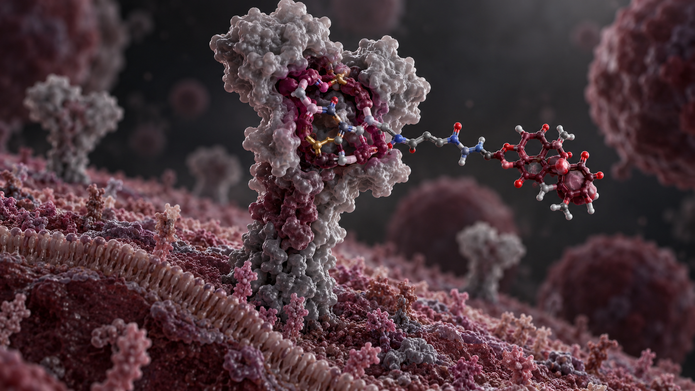
Nuzefatide pevedotin is designed to bind EphA2, a protein target associated with some tumors. Its targeting vehicle is not a conventional antibody. Bicycle Therapeutics’ platform uses short synthetic peptides constrained into two loops by a chemical scaffold. That geometry is intended to provide selective target recognition while keeping the targeting construct relatively small.
In a drug conjugate, targeting and payload are joined in one construct. The ambition is to deliver a toxic anticancer component more precisely than an untargeted drug. Whether adequate amounts reach pancreatic tumor cells, and with what safety trade-offs, remains a clinical question.
Why Pancreatic Cancer Remains So Difficult to Treat
Pancreatic ductal adenocarcinoma is a particularly difficult proving ground. Patients with recurrent disease often face limited options, and promising laboratory mechanisms have repeatedly failed to translate into durable clinical gains.
The fact that a target can be recognized on tumor cells does not guarantee that enough active drug reaches the right cells, penetrates the dense tumor environment, or spares normal tissue. Each step between binding and meaningful benefit must be tested rather than inferred from an appealing molecular illustration.
The Phase 2 Trial That Must Deliver the Evidence
Bicycle said it is actively enrolling adults with recurrent pancreatic ductal adenocarcinoma in a Phase 2 trial assessing efficacy, safety, and pharmacokinetics. It expects further updates in 2027. That is the relevant next checkpoint.
The company did not announce an FDA marketing approval or a completed pivotal survival result in its October 29 release. The designation provides development incentives; it does not replace the ordinary obligation to demonstrate safety and effectiveness.
Bicycle’s Broader Pipeline and Financial Stakes
Bicycle’s wider portfolio illustrates why peptide drug conjugates attract attention. The company is also advancing radioconjugates, which couple targeting chemistry to a radioactive payload.
Its October update identified BT1702, aimed at MT1-MMP, as a candidate for a first company-sponsored radioligand trial expected in the second half of 2027. The technology may allow several kinds of payload to share a targeting strategy, but the performance of one candidate cannot be assumed from another.
Bicycle reported approximately $469.9 million in cash and equivalents at September 30, 2026, and projected runway into 2030. It also described reprioritization of other programs, including zelenectide pevedotin.
That combination is typical of clinical-stage biotechnology: maintaining enough capital to reach decisive experiments while deciding which scientific bets deserve further funding. A designation can help a development plan, but it cannot resolve every portfolio tradeoff.
What Researchers Need to Prove Next
The next clinical data will need to answer questions a corporate update cannot. How many patients respond? How long do responses last? What adverse effects accompany the payload? Are outcomes consistent across relevant patient groups? Does the targeted construct offer a meaningful advantage over available therapies or other investigational strategies?
Without those details, “promising” is a description of a hypothesis, not a clinical verdict.
The October 29 announcement is also a reminder that peptide medicine is not synonymous with weight management. Some of the most interesting work involves using peptides as precise addresses for other therapies.
Their value may lie less in acting as hormones themselves than in delivering drugs or radioactivity to difficult biological targets. This creates a different development and safety problem from an obesity agonist, even though both fall under the broad peptide label.
The responsible conclusion is deliberately narrow. An EphA2-targeting bicyclic peptide conjugate has regulatory-development recognition and an active Phase 2 program in a devastating cancer. That is worth watching.
It is not evidence that pancreatic cancer has been solved, nor that orphan designation is a surrogate for patient benefit. The decisive story will arrive when rigorous clinical results are available.


