
Long before opioid receptors became a familiar topic in public-health debates, researchers faced a basic puzzle: why would the brain contain binding sites for drugs derived from opium?
One answer arrived from a research team in Aberdeen in 1975.
John Hughes, working with Hans Kosterlitz and colleagues, helped identify two short peptides that naturally activate opioid receptors.
The finding changed pain science by showing that the body manufactures its own morphine-like chemical messengers.
Each molecule contained only five amino acids. Yet identifying their sequences helped establish a new understanding of how the nervous system regulates signaling associated with pain and other physiological functions.
Why Would the Brain Have Receptors for Morphine?
In the early 1970s, opioid pharmacology faced a question that seemed almost backward.
Researchers had evidence that the brain contained specific molecular binding sites for opiate drugs. High-affinity binding experiments reported in 1973 helped establish that these interactions involved identifiable receptors rather than entirely nonspecific drug effects.
But if receptors existed in the nervous system, why would evolution have produced them?
They were unlikely to exist simply so that externally administered morphine could activate them.
A more compelling possibility was that the body produced its own signaling molecules capable of acting at those same receptors.
John Hughes and Hans Kosterlitz were among the investigators exploring that hypothesis.
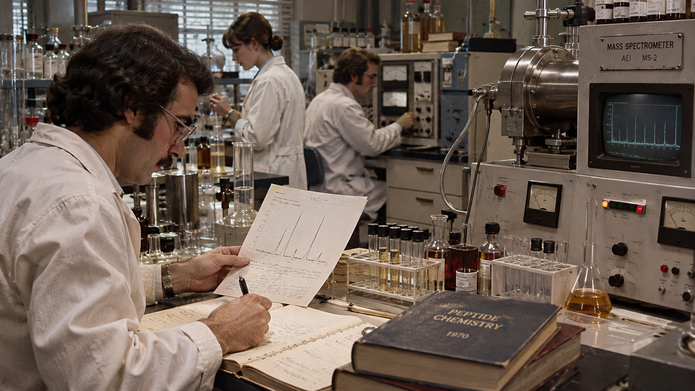
At Aberdeen, research involving brain extracts and pharmacological assays began to reveal substances with morphine-like activity.
In May 1975, Hughes published an investigation describing the isolation of a low-molecular-weight substance from brain tissue that produced opioid-like responses in experimental preparations.
The substance’s activity could be antagonized by drugs such as naloxone, an important indication that it was interacting with an opioid-related pharmacological system.
Those results helped establish that the brain contained an endogenous opioid-like substance. But determining its precise chemical identity required further work.
Two Molecules, Each Just Five Amino Acids Long
The landmark structural discovery appeared in Nature on December 18, 1975.
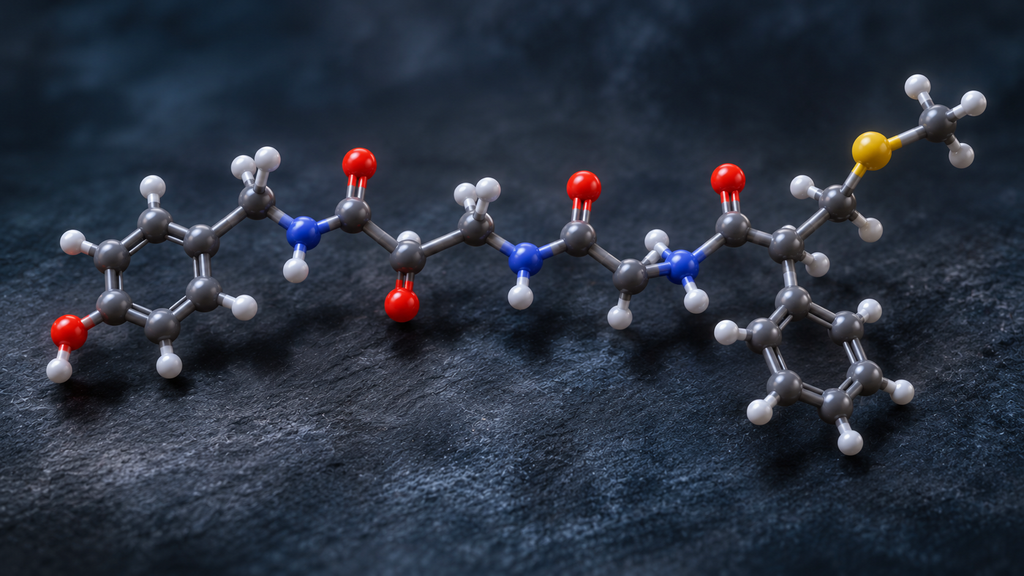
The researchers identified two related pentapeptides: methionine-enkephalin and leucine-enkephalin.
The word pentapeptide means a peptide consisting of five amino-acid residues.
Methionine-enkephalin has the sequence Tyr-Gly-Gly-Phe-Met, while leucine-enkephalin has the sequence Tyr-Gly-Gly-Phe-Leu.
These abbreviations represent tyrosine, glycine, phenylalanine, methionine and leucine. Both peptides share the same first four residues, with a different amino acid at the fifth position.
That small difference matters chemically, but the larger discovery was that such short molecules could activate a receptor system associated with the effects of powerful analgesic drugs.
Enkephalins are not morphine molecules produced naturally by the body. They are chemically distinct peptides that exhibit opioid-like activity because they interact with opioid receptors.
Their discovery demonstrated that the nervous system uses its own molecular messengers to regulate biological processes that external drugs can also influence.
In a field where molecular size can seem connected to biological importance, enkephalins offered a striking counterexample.
Five amino acids were sufficient to reveal an important part of endogenous opioid signaling.
How the Aberdeen Team Proved What It Had Found
The discovery was not based on a single observation or a fortunate guess.
The original Nature paper lists six authors: J. Hughes, T. W. Smith, H. W. Kosterlitz, L. A. Fothergill, B. A. Morgan and H. R. Morris.
Their combined work brought together pharmacology, purification techniques, peptide chemistry and analytical instrumentation.
Biological extracts contain many substances, including compounds capable of producing misleading signals in experimental assays.
To identify an active substance convincingly, researchers must separate it from surrounding material, determine its chemical properties and show that the proposed structure accounts for the observed activity.
The team used amino-acid sequence analysis, including the dansyl-Edman procedure, alongside mass spectrometry.
They then synthesized the proposed peptides and compared them with the naturally isolated material.
That comparison strengthened the identification. The researchers were not merely reporting that a mysterious brain extract behaved like an opioid; they had assigned chemical sequences to the active peptides.
The work depended on experimental persistence and collaboration across different scientific specialties.
Today, a five-residue peptide sequence may look simple on a computer screen. In 1975, establishing those residues convincingly from biological material required considerable technical effort.
The achievement illustrates how much evidence can sit behind a short line of biochemical notation.
The breakthrough was not simply finding a substance that acted like morphine. It was identifying the body’s own chemical messengers that could produce opioid-like activity.
What Enkephalins Changed About Pain Science
The discovery helped change how researchers understood the relationship between medicines and the nervous system.
Rather than treating the effects of opioid drugs as entirely foreign interventions, scientists could investigate how external substances interact with signaling pathways that already perform physiological functions.
Enkephalins became part of a broader picture of endogenous opioid signaling, alongside other opioid peptides identified and characterized through subsequent research.
Those systems participate in pain modulation and interact with neural processes involved in emotion, stress and other functions.
The discovery also created new questions.
Where are these peptides produced? How are they released? How long do they remain active? Which receptors do they preferentially engage, and how do different tissues respond?
Each question opened another area of research rather than providing an immediate clinical answer.
John Hughes continued working in molecular neurobiology and opioid pharmacology. According to the Royal Society, his later research included investigating new ligands and peptide-like compounds to better understand drug effects and opioid signaling.
He was elected a Fellow of the Royal Society in 1993.
That recognition belongs within a career extending well beyond one famous paper.
The discovery also belongs to a larger scientific community. Other laboratories helped establish opioid receptors before the enkephalin sequences were identified, and subsequent investigators expanded understanding of the endogenous opioid system.
The 1975 publication was a landmark within an evolving field, not the work of one scientist acting alone.
The Discovery Did Not Solve Pain. It Changed the Questions.
Identifying natural opioid peptides did not mean that pain could suddenly be controlled without risk.
Pain is influenced by multiple neural pathways, inflammatory processes, tissue states and psychological and environmental factors.
The body’s opioid signaling system is one part of that complicated biology.
Nor does the presence of endogenous opioid peptides make externally administered opioid drugs harmless.
Different opioid compounds can produce different patterns of receptor activation, exposure and physiological effects. Some medicines carry substantial risks involving tolerance, dependence and respiratory depression.
The scientific achievement of 1975 was therefore foundational rather than immediately therapeutic.
By identifying endogenous opioid ligands, researchers gained a stronger framework for studying receptor biology, pain signaling and the actions of psychoactive drugs.
It also demonstrated an approach that continues to shape modern peptide science: identify a signaling molecule, establish its sequence, investigate the receptor interactions and determine what biological consequences follow.
The same broad logic appears in research involving neuropeptides, metabolic hormones and receptor-targeted therapeutics, although the biological systems and clinical challenges differ substantially.
This is an evergreen historical story, not an October 2026 research announcement.
Its significance lies in showing how scientists moved from recognizing the effects of opioid drugs to identifying part of the molecular language naturally used by the body.
John Hughes and his colleagues helped turn that idea into chemical evidence.
Five amino acids were enough to help redraw the scientific understanding of pain and brain chemistry.
Sources: Hughes J, Smith TW, Kosterlitz HW, Fothergill LA, Morgan BA, Morris HR. Identification of two related pentapeptides from the brain with potent opiate agonist activity. Nature. 1975;258(5536):577–580. DOI: 10.1038/258577a0.
Additional historical references: Hughes’s May 1975 endogenous opioid investigation and the Royal Society biography of Professor John Hughes FRS.