

Compounded GLP-1 medicines occupy an unusual position in the American drug market: familiar active ingredients, individualized legal exceptions and a commercial ecosystem that expanded while brand-name supplies were constrained.
A federal antitrust lawsuit tried to turn that uneasy arrangement into a competition case against two of the world’s largest pharmaceutical companies.
On October 23, Law360 reported that a Texas federal judge had refused to reopen the dismissed lawsuit brought by Strive Specialties against Eli Lilly and Novo Nordisk. The underlying order, dated October 20, rejected Strive’s effort to alter the judgment, obtain reconsideration or secure another opportunity to amend its claims.
The development is not a sweeping judicial endorsement of every pharmaceutical business practice. It is a narrower procedural result in a specific case, and the underlying dismissal points toward the most consequential question: whether compounded preparations and FDA-approved products belong in the same legally relevant market.
That question sounds abstract. It can determine whether an antitrust complaint survives long enough to test allegations of anticompetitive conduct.
Strive Challenged the GLP-1 Giants Over Access to the Market
Strive Specialties filed its original complaint on January 14, 2026, in the U.S. District Court for the Western District of Texas.
The pharmacy alleged that Eli Lilly and Novo Nordisk used their market positions and relationships with telehealth providers to restrict access to lower-cost, individualized compounded GLP-1 medicines.
Strive also challenged commercial arrangements that it alleged discouraged telehealth platforms from working with compounding pharmacies.
The defendants disputed the claims and sought dismissal.
A complaint is an allegation, not a finding of wrongdoing. The presence of a business relationship, even one involving a powerful pharmaceutical manufacturer, does not by itself establish an unlawful agreement.
On August 3, Senior U.S. District Judge Micaela Alvarez dismissed Strive’s claims with prejudice. The court found that the pharmacy had failed to plead a legally sufficient product market and a cognizable antitrust injury.
Strive subsequently sought reconsideration, an altered judgment or permission to amend. The October 20 order left the dismissal in place.
That procedural history matters. The October development was not the beginning of the case, a new trial verdict or an appellate decision. It was an unsuccessful effort to revisit an existing district-court judgment.
Why the Definition of the GLP-1 Market Became Decisive
The central problem for Strive was structural.
Antitrust law examines competition within a legally relevant market. Defining that market requires more than demonstrating that two products share an ingredient, address similar medical conditions or are sold at different prices.
Courts consider whether products are reasonably interchangeable and whether customers can substitute one for another when prices change.
Strive proposed a broad national market for GLP-1 weight-management medicines and a narrower cash-pay submarket.
The court focused on the distinction between individualized compounded medicines and the FDA-approved products manufactured by Lilly and Novo Nordisk.
A compounded drug generally enters the treatment pathway under a different regulatory framework, including circumstances where a commercially available medicine cannot meet an individual patient’s medical needs.
That distinction mattered to the judge because the pharmacy’s products could not simply be treated as ordinary consumer substitutes for branded medicines.
The court also found that Strive had not adequately explained how consumers would switch between the products in response to price changes, a concept known as cross-elasticity of demand.
A lower price alone did not establish that the two categories competed within the same legally cognizable product market.
The ruling was specific to the allegations and legal framework in this case. It should not be transformed into a universal economic conclusion that compounded and branded medicines can never affect one another’s commercial prospects.
The Court Also Distinguished Harm to a Competitor From Harm to Competition
Market definition was not the only reason Strive’s complaint failed.
The court separately concluded that the pharmacy had not adequately alleged antitrust injury.
That distinction is important because antitrust law is concerned with protecting the competitive process, not guaranteeing that an individual business can maintain its customers, distribution relationships or market share.
Strive described alleged exclusion from commercial channels, reduced access to patients and obstacles to scaling its operations.
The judge found those allegations insufficient to establish the kind of harm to competition required for the claims, particularly given the deficiencies in the proposed product market.
The court also rejected claims under the Clayton Act that challenged alleged exclusive-dealing arrangements.
Without a sufficiently established market relationship between the competing products, the asserted foreclosure of competition could not support those claims as pleaded.
A company’s alleged loss of business does not, by itself, establish an antitrust violation.
The dismissal therefore concerned the legal sufficiency of Strive’s case, not a completed trial finding that every challenged commercial arrangement was lawful or that every allegation was factually false.
Compounding Is a Medical Exception, Not an Automatic Generic Alternative
For patients, the court’s reasoning may feel disconnected from a practical concern: the cost of GLP-1 treatment.
Brand-name products can remain expensive or difficult to obtain even as manufacturers expand direct-pay programs, distribution partnerships and other purchasing options.
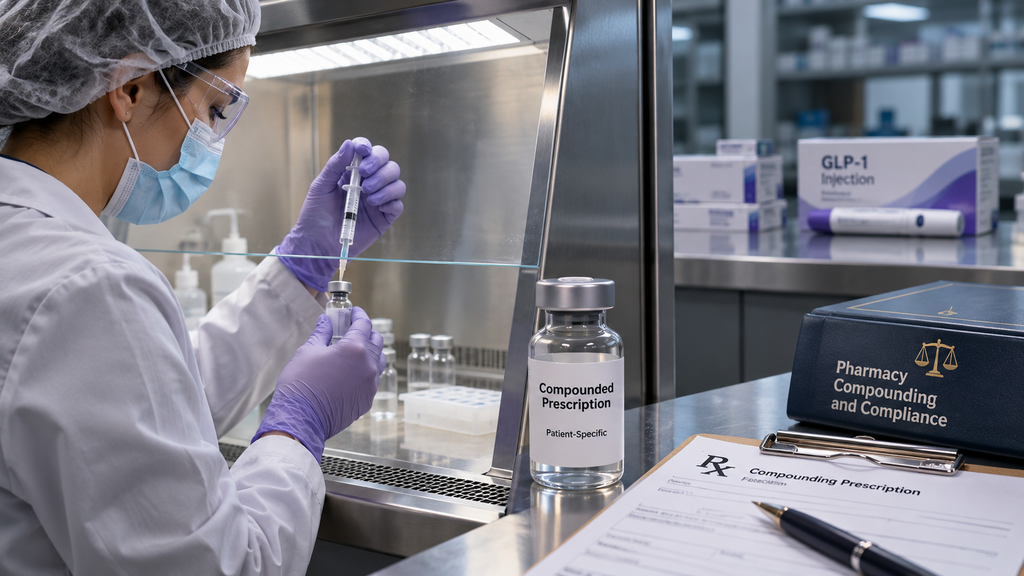
Individualized compounding can address legitimate clinical needs, but it does not operate under the same approval framework as a branded medicine or an FDA-approved generic.
Under Section 503A of the Federal Food, Drug, and Cosmetic Act, qualifying patient-specific compounding is subject to conditions that include limits on routinely producing essentially copies of commercially available medicines.
A separate statutory framework, Section 503B, governs registered outsourcing facilities.
Drug-shortage circumstances can affect which preparations are permitted under those frameworks, but the resolution of a shortage can change the applicable restrictions.
That regulatory system does not make all compounding illegal. It also does not allow every lower-cost preparation to be marketed as an equivalent alternative to an approved product.
The FDA has repeatedly emphasized that compounded medicines are not FDA-approved and do not undergo the same premarket review for safety, effectiveness and quality.
Those distinctions matter independently of the antitrust case.
Telehealth platforms add another layer of complexity.
Online prescribing networks, advertising, pharmacy relationships and subscription systems can direct substantial patient demand toward particular treatment and dispensing pathways.
Manufacturers likewise have commercial and regulatory incentives to defend approved products developed through extensive clinical testing.
Those interests can coexist with legitimate business arrangements, competitive disputes and allegations that require legal scrutiny.
Neither commercial influence nor a company’s desire to protect its market automatically proves an unlawful conspiracy.
What the Dismissal Means for the Wider GLP-1 Market
The October order does not mean that all compounded GLP-1 medicines are illegal.
It does not resolve every separate dispute involving pharmaceutical advertising, patents, telehealth arrangements or pharmacy practices.
Nor does it prevent future antitrust scrutiny based on different allegations and a legally sufficient market theory.
The decision also should not be portrayed as a final appellate judgment. It was a district-court ruling on a post-judgment motion, leaving the earlier dismissal with prejudice in place.
The larger commercial question remains significant.
Patients may view branded products, compounded preparations, direct-pay programs and telehealth services as parts of one practical search for affordable treatment.
But the law can distinguish these products and services according to regulatory authorization, medical necessity and the conditions governing their distribution.
That divide affects how pharmaceutical competition can be challenged in court.
The GLP-1 industry is therefore not only a contest over which molecule produces the greatest weight reduction. It is also a contest over what kinds of products the law recognizes as alternatives, who may distribute them and what evidence plaintiffs must provide to demonstrate anticompetitive conduct.
In Strive’s dispute with Lilly and Novo Nordisk, the legal definition of the market mattered before the alleged commercial conduct could be fully tested.
The lasting lesson is that products patients may compare in everyday purchasing decisions are not necessarily interchangeable under pharmaceutical regulation or antitrust law.
Primary court record: Strive Specialties Inc. v. Eli Lilly & Co., Opinion and Order, August 3, 2026. U.S. District Court for the Western District of Texas, No. 5:26-cv-00155.
October development: Law360, Eli Lilly, Novo Nordisk Antitrust Suit Remains Dismissed. Published October 23, 2026.
Court docket: Strive Specialties Inc. v. Eli Lilly & Company et al., Western District of Texas.
Regulatory context: U.S. Food and Drug Administration. Compounding and the FDA: Questions and Answers.


