
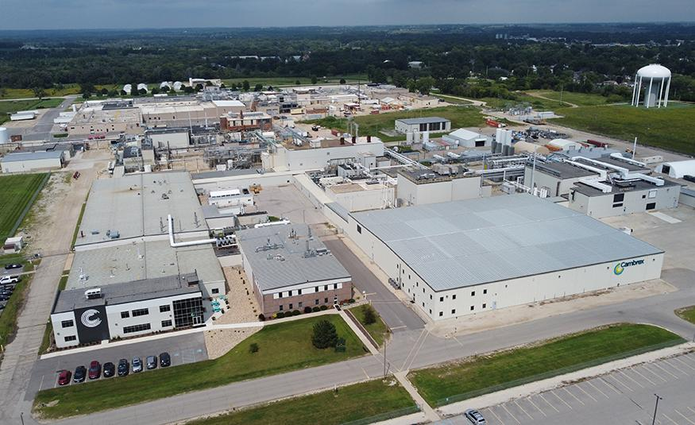
One of the more revealing announcements in the peptide economy this week did not come from a weight-loss trial. It came from a construction site in Charles City, Iowa. On October 30, Cambrex said it had broken ground on a $120 million expansion designed to support commercial production of small-molecule active pharmaceutical ingredients and synthetic peptides. The headline number is large enough to attract attention, but the more interesting question is what manufacturers think drug developers will need when the current wave of clinical excitement becomes a long-term supply obligation.
160,000 Liters of New Capacity, but Not Until 2028
The company says the project will add 160,000 liters of manufacturing capacity and increase the site’s total capacity by about a quarter, to nearly one million liters. Cambrex expects the expansion to be completed in the fourth quarter of 2028. Those are the company’s projections, not evidence that all the new capacity has already been commissioned or contracted. A groundbreaking is the beginning of an execution problem: equipment must be installed, validated, staffed and operated within a quality system that can withstand regulatory scrutiny. Capacity announced on paper and capacity capable of consistently producing commercial batches are not interchangeable.
Why Peptide Manufacturing Is Harder Than It Looks
Peptides have become unusually visible because of the success of incretin medicines. Yet the production challenge extends beyond obesity. Synthetic peptides can require many sequential chemical transformations, tight control of impurities, difficult purification and careful management of yield as sequences become longer or more complex. A facility that can manufacture the active ingredient reproducibly, document each critical step and transfer a process from development into commercial scale may become as important to a sponsor as the molecule’s initial efficacy signal.
A $120 Million Bet That Goes Beyond GLP-1 Drugs
This is why the expansion is not simply another wager that patients will keep asking for GLP-1 therapies. Cambrex’s stated remit includes both synthetic peptides and small-molecule APIs. That mix gives the facility exposure to multiple pipelines and product types, but it also means investors and customers should resist assigning the entire $120 million to peptide capacity. The announcement does not provide a peptide-only investment breakdown, a list of signed customer contracts or a forecast of output measured in peptide doses.
Why American Manufacturing Capacity Matters
The United States is also a consequential location. Drug sponsors have spent years balancing manufacturing economics, technical specialization, supply resilience and regulatory oversight across global networks. Domestic capacity can reduce some cross-border dependencies, but geography alone is not a certificate of purity or reliability. The quality of analytical methods, batch records, raw materials, deviation investigations and validated processes determines whether a site can supply medicines safely. Those operational details are less photogenic than a ribbon-cutting, but they are where commercial confidence is earned.
The Real Test Begins After the Groundbreaking
Expansion also carries a commercial risk that enthusiastic coverage often overlooks. The industry can build too much of the wrong kind of capacity. A reactor or purification train suited to one chemistry may not translate effortlessly to another. Sponsors can change formulations, clinical programs can fail, and demand forecasts can prove too optimistic. Manufacturers therefore need more than a fashionable category; they need diversified customer relationships and processes that can accommodate the next generation of molecules without perpetual redesign.
The strategic signal is still meaningful. Drug developers are increasingly competing not only to discover effective compounds but to secure reliable paths from synthesis to finished medicine. The companies that solve scale-up, consistency and delivery may capture value that is invisible in clinical-trial headlines. Cambrex’s project is an unusually tangible example of that shift: a capital commitment to the infrastructure behind peptide medicine, with the difficult work of execution still ahead.
The test will come after the ceremonial photographs. Watch for commissioning milestones, validated production, regulatory inspection outcomes, and evidence of commercial customer demand. Those developments will tell readers whether this $120 million announcement was a timely investment in an enduring market or an expensive bet on a moment of extraordinary enthusiasm.
Source: Cambrex — $120 Million Charles City Expansion Announcement, October 30, 2026.