
Peptide coverage has become so dominated by weight-loss injections that another part of the industry is easy to miss: materials made from peptides rather than drugs designed to stimulate a receptor. In May 2026, MiMedx announced the U.S. commercial launch of G4Derm Plus, a flowable wound-management matrix that uses self-assembling peptide technology. It is an older product-launch story revisited here as an explainer, not a newly announced November development.
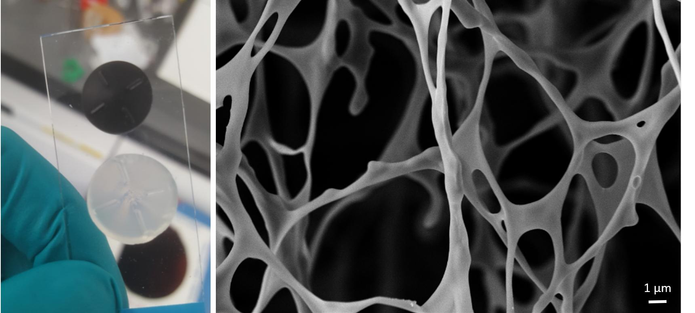
The product’s basic premise is architectural. Certain peptide sequences can organize themselves into larger structures when placed in the right environment. Instead of functioning primarily as circulating hormone mimics, they can create a three-dimensional scaffold intended to resemble aspects of the extracellular matrix, the supportive environment surrounding cells. For difficult wounds, a material that conforms to irregular tissue surfaces may offer a different design approach from a conventional dressing.
A Peptide Wound Matrix Reaches the U.S. Commercial Market
On May 8, 2026, MiMedx announced the commercial launch of G4Derm Plus, reporting that initial product sales had already been delivered to customers across the United States. The company had acquired exclusive U.S. distribution rights for the product, adding synthetic peptide technology to its portfolio of surgical and wound-care products.
G4Derm Plus was developed by Gel4Med, the company identified in the product’s FDA clearance documentation. That distinction matters because the underlying technology and its regulatory clearance predate MiMedx’s 2026 distribution announcement.
The FDA originally cleared G4Derm / G4Derm Plus Synthetic Wound Matrix on October 11, 2023, through the 510(k) pathway under submission K222025. The May 2026 news therefore concerned commercial distribution, not a newly issued regulatory clearance.
MiMedx describes G4Derm Plus as an acellular, resorbable flowable matrix designed for complex wound management. The company says the peptide scaffold encourages tissue regrowth and provides a barrier against external contamination. Its commercial arrival illustrates a different use for peptides from the injectable drug candidates that dominate much of the industry’s public discussion.
How Self-Assembling Peptides Become a Three-Dimensional Scaffold
Unlike a conventional peptide drug designed to activate a biological receptor, G4Derm Plus uses synthetic peptides as structural building blocks. The FDA’s device summary describes a network of interwoven fibrils formed from individual peptide molecules, creating a three-dimensional hydrogel scaffold with features resembling the body’s extracellular matrix.
The product is supplied as a sterile, biodegradable hydrogel in a prefilled syringe for topical application. According to the FDA documentation, the aqueous formulation contains synthetic peptides and is composed of at least 98 percent sterile water. It is neither an injectable hormone therapy nor a product derived from donated human or animal tissue.
The matrix is intended to conform to wound surfaces, including irregular or difficult-to-access areas. Its structure helps maintain a moist wound environment while providing a physical barrier between the wound bed and external conditions. A secondary wound dressing is used with the hydrogel under the cleared instructions.
That approach is interesting because the material’s physical architecture is central to its proposed function. The peptide is not simply a molecule expected to circulate through the body. It helps form a local scaffold designed to support wound management.
MiMedx also describes the material as supporting granulation tissue formation, revascularization and re-epithelialization. Those are important biological processes involved in wound repair, but promotional descriptions of the intended mechanism should not be confused with direct evidence of superior clinical outcomes in a particular patient population.
FDA Clearance Establishes a Device Pathway, Not Superior Healing Outcomes
The regulatory distinction is more than bureaucratic. A 510(k) clearance generally concerns whether a medical device is substantially equivalent to a legally marketed predicate device for its intended use. It is not equivalent to the FDA approval process for a new therapeutic drug, nor does it automatically establish superior outcomes against competing wound treatments.
The FDA documentation identifies G4Derm Plus as a synthetic wound matrix intended for local wound management. Its professional-use indications include partial- and full-thickness wounds, pressure and diabetic ulcers, lower-extremity ulcers, surgical wounds and certain burns. The clearance also covers over-the-counter use for superficial wounds, abrasions and minor burns.
There is supporting evidence behind the clearance. The FDA’s published summary describes biocompatibility assessments, human skin-irritation testing, in-vitro antibacterial-barrier testing and preclinical performance testing in a porcine wound-healing model. These investigations supported the device’s substantial-equivalence determination.
But the type of evidence matters. A human skin-irritation test is not a randomized wound-healing trial. An animal model cannot by itself establish how well a product will perform across different human wounds. And laboratory evidence of a barrier against bacterial penetration is not the same as demonstrating fewer clinically diagnosed infections.
The May 2026 launch announcement did not present randomized comparative human trial results showing faster wound closure, fewer infections or shorter hospital stays against a defined competing treatment.
That does not invalidate the product’s regulatory clearance. It means that clearance, clinical performance and comparative effectiveness should be discussed as related but distinct questions.
Premier and Vizient Open Purchasing Pathways, but Clinical Adoption Is Another Test
MiMedx also announced access through Premier and Vizient group purchasing arrangements. These agreements are commercially important because participating hospital systems can use established purchasing channels to obtain products that would otherwise require additional procurement work.
For a specialized wound-care product, distribution can matter almost as much as molecular design. Hospital systems need dependable supply chains, clinician training, inventory procedures, reimbursement information and economic justification before adding unfamiliar materials to established wound-management practices.
An elegant material can fail commercially if clinicians cannot obtain it, fit it into existing workflows or justify its cost relative to available alternatives. A flowable product may offer advantages in handling irregularly shaped wounds, but those possible benefits need to be assessed alongside clinical performance, application requirements and cost.
Purchasing access also should not be mistaken for widespread adoption. MiMedx reported initial sales and distribution arrangements, but the announcement did not quantify how many hospitals had begun using the product, how many patients had received it or whether measured patient outcomes had improved.
The distinction is particularly important in healthcare markets, where commercial availability, purchasing eligibility and demonstrated clinical value are separate stages of adoption.
What the Evidence Still Needs to Show About Peptide-Based Wound Care
Self-assembly creates scientific questions beyond the initial demonstration of a three-dimensional scaffold. How reproducible is the material’s structure when wound fluid, pH and tissue conditions vary? How long does the matrix persist? What happens as it resorbs? How does it interact with inflammation, bacterial contamination or other materials used on the same wound?
Those questions are testable, and their answers can differ across wound types and patient populations. Claims that a peptide scaffold resembles natural extracellular matrix should not be mistaken for proof that it restores normal tissue architecture in every clinical setting.
There is also an important difference between preventing bacterial penetration in a laboratory test and reducing infection rates among patients. Wounds are biologically complex environments, and infection risk depends on many factors beyond the properties of a single dressing.
The launch nevertheless reveals a valuable commercial category. Peptides are not limited to injectable hormones or speculative wellness products. They can be engineered as structural materials, diagnostic agents, targeting components and drug-delivery systems. Each category brings different manufacturing, clinical and regulatory questions.
For editors, clinicians and hospital buyers, the next useful evidence would include published comparative wound-healing studies, structured adverse-event reporting, real-world outcomes in clearly defined patient groups and transparent economic analyses. Such data could help establish whether G4Derm Plus provides meaningful clinical advantages over established wound-management products.
The product’s arrival in the U.S. commercial wound-care market is newsworthy. Whether it produces better outcomes for specific wounds is a separate question that deserves rigorous investigation.
G4Derm Plus illustrates how peptide technology can move beyond pharmacology and into materials engineering. Its most important scientific claim is not that every wound will heal faster. It is that synthetic peptides can be designed to organize into a useful local scaffold. The clinical value of that design must ultimately be judged by evidence, not by its novelty alone.
Original announcement: MiMedx Announces Launch of G4Derm Plus, published May 8, 2026.
FDA regulatory record: G4Derm / G4Derm Plus Synthetic Wound Matrix, 510(k) K222025, originally cleared October 11, 2023.
FDA scientific documentation: 510(k) Summary and Clearance Documentation, including device characteristics, indications and safety/performance testing.


