
One of the most consequential discoveries in peptide biology began with a receptor whose natural messenger was missing. Scientists knew that certain synthetic compounds could stimulate growth hormone release by activating a receptor called GHS-R. What they did not know was which molecule in the body normally switched that receptor on. The answer would connect the stomach to endocrine signaling and eventually help reshape the biology of appetite.
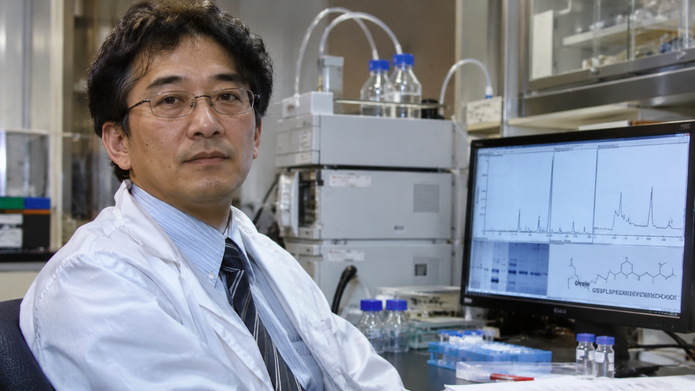
In a Nature paper published December 9, 1999, Masayasu Kojima and colleagues reported the isolation of ghrelin, a growth-hormone-releasing peptide found in the stomach. The study listed collaborators including Hiroshi Hosoda, Yukari Date, Masamitsu Nakazato, Hisayuki Matsuo and Kenji Kangawa. Scientific discoveries are collective, and the paper’s author list matters. The headline association with Kojima should not erase the experimental and intellectual contributions of the wider team.
The finding would eventually become foundational to research on appetite and energy balance. But the original discovery was not a study of obesity or hunger. It was an investigation into an unidentified biological signal that controlled an important hormone receptor.
The Growth-Hormone Receptor That Was Waiting for Its Natural Ligand
Before ghrelin was identified, researchers had already developed synthetic compounds known as growth hormone secretagogues. These substances could stimulate the pituitary gland to release growth hormone by acting through a receptor called the growth hormone secretagogue receptor, or GHS-R.
The receptor belonged to the family of G-protein-coupled receptors, proteins that allow cells to detect chemical messages and translate them into biological responses. But GHS-R presented a puzzle. Scientists knew that laboratory-designed molecules could activate it, yet the corresponding natural messenger had not been established.
Such receptors are often called orphan receptors. The term does not mean that they lack biological importance. It means that their endogenous, or naturally occurring, ligands have not yet been identified.
Kojima and his colleagues approached the problem through a strategy sometimes called reverse pharmacology. Instead of beginning with a known hormone and searching for its receptor, they began with the receptor and searched biological material for a substance capable of activating it.
The task required careful biochemical purification and functional testing. A biological extract might contain thousands of molecules, but only a small fraction could produce the specific receptor response the researchers were seeking. By repeatedly separating material and testing biological activity, scientists could narrow the search toward the active component.
The surprising result was not merely the identity of the ligand. It was where the strongest source of that ligand was found.
The Search Led to the Stomach, Not the Brain
Growth hormone regulation had traditionally been discussed largely through signals originating in the hypothalamus and acting on the pituitary gland. That framework made the brain an intuitive place to investigate for another natural growth-hormone-releasing messenger.
Instead, the researchers succeeded in purifying the active peptide from rat stomach tissue. They named the newly identified hormone ghrelin, drawing on a linguistic root associated with growth.
The December 1999 paper established that the purified molecule specifically activated GHS-R and stimulated growth hormone release in the experimental systems examined. The researchers also identified the corresponding human ghrelin sequence, confirming that the biological system extended beyond the initial rat experiments.
This was a change in scientific perspective. The stomach was already understood as an organ involved in digestion and the secretion of hormones, but ghrelin demonstrated another way it could participate in a signaling system associated with the pituitary and endocrine regulation.
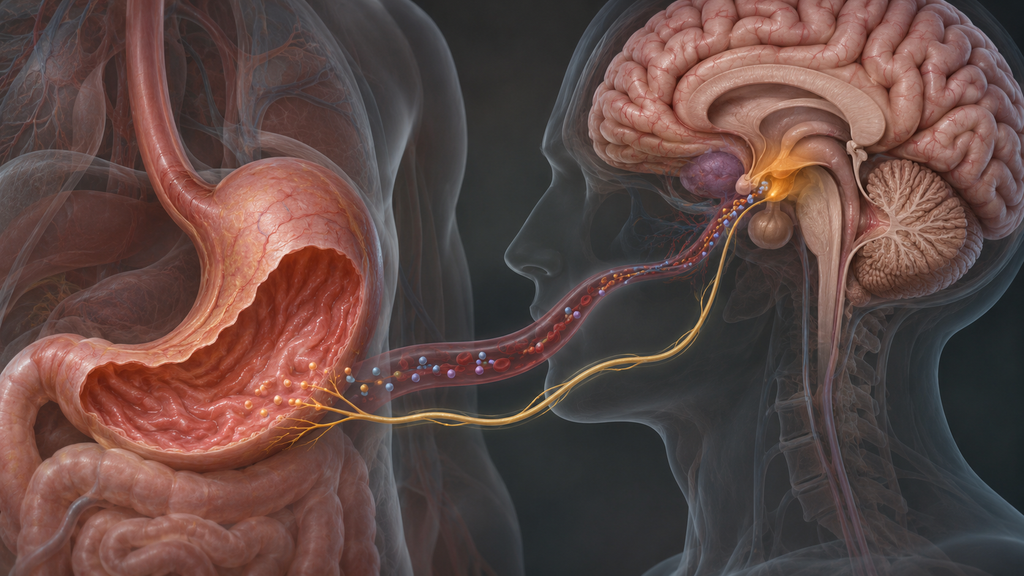
Later work established that ghrelin is produced prominently by specialized endocrine cells in the stomach and participates in communication among the gastrointestinal system, brain and other tissues.
The discovery did not replace existing knowledge of hypothalamic growth-hormone regulation. Instead, it expanded the map. The pituitary could respond to another physiological messenger, one strongly associated with a tissue outside the traditional brain-centered account of growth hormone control.
That finding illustrates why the location of a molecule can be as important as its chemical identity. Researchers had set out to find a ligand for a receptor. They uncovered a connection between organ systems that would become central to a much larger field of research.
A 28-Amino-Acid Peptide With an Essential Chemical Modification
Ghrelin was unusual in both origin and chemistry. The investigators identified a peptide containing 28 amino acids, with a fatty-acid modification that proved essential to the biological activity examined in their study.
The modification was particularly specific. An eight-carbon fatty-acid group, known as an n-octanoyl group, was attached to the serine residue at position three of the peptide chain.
That small chemical detail was not decorative. The original experiments showed that O-n-octanoylation at serine three was essential for the peptide’s growth-hormone-releasing activity through the identified receptor.
In a 2001 scientific review, Kojima, Hosoda, Matsuo and Kangawa discussed the importance of this unusual acylation and its relationship to ghrelin’s receptor-mediated activity. The modification helped explain why simply knowing a peptide’s amino-acid sequence was not enough to understand its function.
Peptide hormones can undergo chemical modifications after their initial synthesis. These changes may alter receptor binding, stability, distribution and biological activity. Ghrelin provided a striking example of how a small modification could be central to a hormone’s function.
The distinction also became important for later investigations of acylated and unacylated ghrelin forms. Different molecular forms should not automatically be treated as biologically interchangeable, even when they share most of the same amino-acid sequence.
How a Growth-Hormone Discovery Became Central to Hunger Research
The connection between ghrelin and appetite emerged more clearly after the original discovery. The December 1999 paper established the peptide’s identity and growth-hormone-releasing activity. It did not establish the full physiological role that would later make ghrelin widely known as a hunger-associated hormone.
In October 2000, Matthias Tschöp, David Smiley and Mark Heiman reported that ghrelin administration influenced body weight, fat utilization and feeding-related outcomes in rodents. Their experiments also found that circulating ghrelin concentrations responded to nutritional state, increasing during fasting and decreasing after feeding or glucose administration in the tested animals.
Additional work followed. In January 2001, Masamitsu Nakazato and colleagues published research demonstrating a role for ghrelin in hypothalamic control of feeding. Their experiments showed that administration of ghrelin within the brain stimulated food intake and increased body-weight gain in rats.
Later in 2001, other investigators reported appetite-stimulating effects of administered ghrelin in humans. Together, these studies extended the significance of the original growth-hormone discovery into the regulation of eating behavior and energy balance.
Those later contributions matter to the historical record. Kojima and his colleagues identified the hormone and its receptor-mediated growth-hormone activity. Subsequent research teams established much of the evidence linking ghrelin to feeding and body weight.
That history is easy to flatten in an era when almost every metabolic peptide is discussed in relation to obesity drugs. Ghrelin is frequently associated with hunger signaling, but its physiology is more complex than an on-off switch for appetite.
Hormone levels vary with nutritional state, receptor pathways can have multiple effects and the same signaling system may influence different tissues. Research over subsequent decades connected ghrelin signaling with gastrointestinal functions, endocrine regulation, metabolism and other biological processes.
Understanding ghrelin therefore requires separating the initial molecular discovery, the later physiological experiments and the much broader medical questions that followed.
What Kojima’s Ghrelin Discovery Still Teaches Peptide Science
The ghrelin story shows the value of investigating what scientists call an orphan receptor. When a receptor is known but its natural ligand is not, researchers can work backward from receptor activity to identify a previously unrecognized messenger.
That strategy has helped reveal biological signaling systems that might otherwise have remained hidden. It requires biochemical purification, careful functional assays and a willingness to follow evidence toward a tissue or molecule that may not fit the original expectation.
The discovery also demonstrates that peptide science is not simply the study of amino-acid sequences. The three-dimensional organization of a molecule, its chemical modifications, the location where it is produced and the receptors it activates can all influence biological activity.
Ghrelin’s fatty-acid modification became an enduring example of that principle. A relatively small chemical addition at a specific amino-acid position proved essential for the growth-hormone-releasing receptor activity studied by the original team.
There is also a lesson about the relationship between discovery and treatment. Identifying a natural hormone creates possibilities for understanding disease and developing medicines, but it does not establish that manipulating the hormone will be simple or clinically beneficial.
Readers encountering ghrelin-related supplements, peptides or drug-development claims should separate the historical discovery from clinical proof. Knowing that a peptide exists and activates a receptor does not demonstrate that externally administered versions are safe, effective or approved for a particular condition.
The route of administration, dose, molecular modification, metabolism, target tissue and patient population all change the medical question. A fundamental biological discovery may support decades of research without producing a straightforward treatment for every process in which the hormone participates.
Kojima later reflected on the discovery in a personal scientific retrospective published in 2008. The historical record shows how an investigation of a receptor with no identified natural ligand led to a hormone whose relevance extended far beyond the original growth-hormone question.
Kojima and his colleagues provided something more durable than a marketing claim. They identified a real molecular messenger and showed that the stomach participates in a hormonal dialogue once framed more narrowly around the brain and pituitary.
The next time a metabolic drug promises to manipulate appetite, it is worth remembering how much of that field began with scientists finding a peptide whose receptor was waiting for a name.
Original research: Kojima M., Hosoda H., Date Y., Nakazato M., Matsuo H. and Kangawa K. Ghrelin is a growth-hormone-releasing acylated peptide from stomach. Nature, volume 402, pages 656–660, December 9, 1999.
Scientific review: Kojima M., Hosoda H., Matsuo H. and Kangawa K. Ghrelin: discovery of the natural endogenous ligand for the growth hormone secretagogue receptor. Trends in Endocrinology & Metabolism, April 2001.
Subsequent appetite research: Tschöp M., Smiley D.L. and Heiman M.L. Ghrelin induces adiposity in rodents. Nature, October 19, 2000. Nakazato M. et al. A role for ghrelin in the central regulation of feeding. Nature, January 11, 2001.
Historical perspective: Kojima M. The discovery of ghrelin—a personal memory. Regulatory Peptides, January 2008.