

Semaglutide is approved to reduce the risk of kidney disease worsening in adults with type 2 diabetes and chronic kidney disease, but the question of how Ozempic kidney protection actually works has remained difficult to answer. Is the benefit primarily connected to weight loss, lower blood sugar, reduced blood pressure or changes occurring within the kidney itself?
The REMODEL trial, published in Nature Medicine on October 1, 2026, set out to investigate that question directly. Researchers combined advanced kidney MRI with biopsies and molecular profiling in humans, looking for changes that conventional blood and urine tests cannot fully explain.
Its main imaging endpoints did not show statistically significant treatment differences. But several secondary and exploratory findings pointed toward changes in kidney vascular resistance, tissue characteristics, surrounding fat and the molecular behavior of cells lining the kidney’s filtering blood vessels.
This is human evidence from a randomized, placebo-controlled study funded by Novo Nordisk. It is also a relatively small mechanistic investigation, not a trial designed to establish whether semaglutide prevents dialysis or kidney failure. Larger studies had already addressed the clinical outcomes. REMODEL was designed to investigate why those benefits might occur.
Why Researchers Needed to Look Inside the Kidney
The clinical case for semaglutide’s kidney benefits was established before REMODEL was published. In 2024, the FLOW trial reported that once-weekly semaglutide reduced major kidney and cardiovascular events in people with type 2 diabetes and chronic kidney disease.
FLOW enrolled 3,533 participants and followed them for a median of approximately 3.4 years. The primary composite endpoint included major deterioration in kidney function, kidney failure and death from kidney-related or cardiovascular causes.
Semaglutide reduced the relative risk of that composite outcome by 24% compared with placebo. These findings supported the FDA’s January 2025 decision to expand Ozempic’s approved indications to include reducing the risk of sustained kidney-function decline, kidney failure and cardiovascular death in adults with type 2 diabetes and chronic kidney disease.
But demonstrating that a medicine reduces clinical events is not the same as identifying its biological mechanism. A large outcomes trial can establish that fewer participants experience certain complications without revealing exactly which cellular changes produced the benefit.
That uncertainty matters for drug development. If semaglutide protects kidneys through more than improved blood sugar or body weight, researchers need to understand those additional pathways before assuming that other metabolic medicines will provide equivalent kidney benefits.
Real-world comparisons of incretin treatments have expanded the discussion of benefits beyond glucose regulation, including cardiovascular outcomes examined in Grey Pepper’s coverage of Ozempic and Mounjaro. However, observational studies cannot directly establish the tissue mechanisms responsible for those effects.
REMODEL approached the kidney question from a different direction. Led by nephrologist Katherine Tuttle and colleagues, the study randomized 106 adults with type 2 diabetes and chronic kidney disease to semaglutide or placebo in a 2-to-1 ratio.
Participants received weekly injections, with semaglutide gradually increased to 1 mg, over a 52-week treatment period. The multicenter trial included 28 sites across eight countries.
The investigators used multiparametric MRI to evaluate kidney physiology. A smaller group also underwent paired kidney biopsies before and after treatment, allowing researchers to investigate cellular structures and patterns of gene expression within the tissue itself.
The distinctive feature was this combination of functional imaging, microscopy and molecular analysis. Rather than relying only on changes in blood tests or estimated filtration rates, researchers attempted to observe how kidney tissue responded to a GLP-1 receptor agonist over time.
The Primary MRI Endpoints Missed
REMODEL’s three coprimary imaging outcomes concerned kidney oxygenation, global perfusion and tissue characteristics associated with inflammation.
Oxygenation was assessed using blood oxygen level-dependent MRI, which estimates changes related to oxygen availability in kidney tissue. Global perfusion measured blood flow through the organ, while T1 mapping assessed MRI tissue properties influenced by inflammation, fibrosis and other physiological processes.
After 52 weeks, none of these coprimary outcomes differed significantly between the semaglutide and placebo groups.
That is a genuine negative result. The trial did not demonstrate that semaglutide improved these particular measures of oxygenation, overall kidney perfusion or T1-derived tissue characteristics during the study period.
It does not, however, prove that oxygenation or blood flow are irrelevant to semaglutide’s kidney benefits. A nonsignificant finding may reflect the absence of a meaningful effect, but it can also reflect limited statistical power, variation in measurements or biological changes too small to detect reliably in the studied population.
This distinction is particularly important in a 106-person mechanistic trial. The investigators acknowledged that the study may not have had sufficient power to detect modest differences in some imaging outcomes.
The first answer from REMODEL, therefore, was not that oxygen-related mechanisms had been ruled out. It was that the investigators did not demonstrate the anticipated effects on their primary MRI measurements.
The more interesting signals emerged from other measurements that examined different aspects of kidney physiology.
Where the Signals Appeared: Blood Vessels, Fibrosis and Kidney Fat
Several secondary and exploratory outcomes favored semaglutide. The most informative results involved renal vascular resistance, MRI characteristics associated with fibrosis, fat surrounding the kidneys and urinary markers of kidney damage.
The renal artery resistive index was approximately 4% lower with semaglutide than with placebo. The estimated treatment ratio was 0.96, with a 95% confidence interval of 0.93 to 0.99.
This measure reflects aspects of vascular resistance within the kidney. Its reduction supports the possibility that semaglutide improves certain features of renal blood-vessel function, even though the trial did not demonstrate a significant change in global kidney perfusion.
The difference is physiologically important. Resistance within a vascular system and total blood flow through an organ are related, but they are not interchangeable measurements. A change in one does not require a statistically detectable change in the other.
Another secondary finding involved the apparent diffusion coefficient, or ADC, an MRI measure influenced by the movement of water molecules through tissue.
Cortical ADC was higher with semaglutide than with placebo, with an estimated treatment ratio of 1.05. The researchers interpreted the finding as consistent with attenuation or stabilization of progressive fibrosis, the scarring process associated with worsening chronic kidney disease.
That does not establish that existing kidney scars disappeared. ADC is an imaging marker influenced by tissue structure, not a direct quantitative measurement of scar removal. The finding supports a possible antifibrotic mechanism that requires further confirmation.
The fat measurements were also noteworthy. Compared with placebo, semaglutide was associated with 25% lower perirenal fat volume and 13% lower renal sinus fat volume after 52 weeks.
Perirenal fat surrounds the kidneys, while renal sinus fat occupies a region containing important blood vessels, collecting structures and supporting tissue. Excess fat in these compartments may influence local physiology, although its precise causal role in kidney disease remains under investigation.
The kidney-fat differences were proportionally larger than the approximately 5% difference in body weight between treatment groups. This raises the possibility that changes in organ-associated fat could contribute to renal benefits.
But the comparison came from only 34 participants with the relevant imaging measurements. It does not establish that the kidney-fat changes occurred independently of systemic weight loss or were responsible for improved kidney outcomes.
Urinary albumin-to-creatinine ratio was approximately 40% lower with semaglutide compared with placebo. Albuminuria is an important marker of damage to the kidney’s filtration barrier and is associated with progression of chronic kidney disease.
The trial also found a 12 mL/min higher 24-hour creatinine clearance in the semaglutide group relative to placebo. However, estimated glomerular filtration rate, calculated using blood-based measures, favored semaglutide without reaching statistical significance.
These findings provide a coherent collection of potential mechanisms. Lower vascular resistance, stabilized tissue-diffusion characteristics, reduced kidney-associated fat and less albuminuria could all be consistent with improved renal health.
Yet the evidence remains partly exploratory. The study’s primary MRI outcomes were negative, and the secondary and exploratory comparisons were not adjusted for multiple testing. Their value lies in identifying biological pathways worth examining further, not proving which mechanism caused the clinical benefits observed in FLOW.
Kidney Biopsies Revealed Changes in the Cells Lining Filtering Blood Vessels
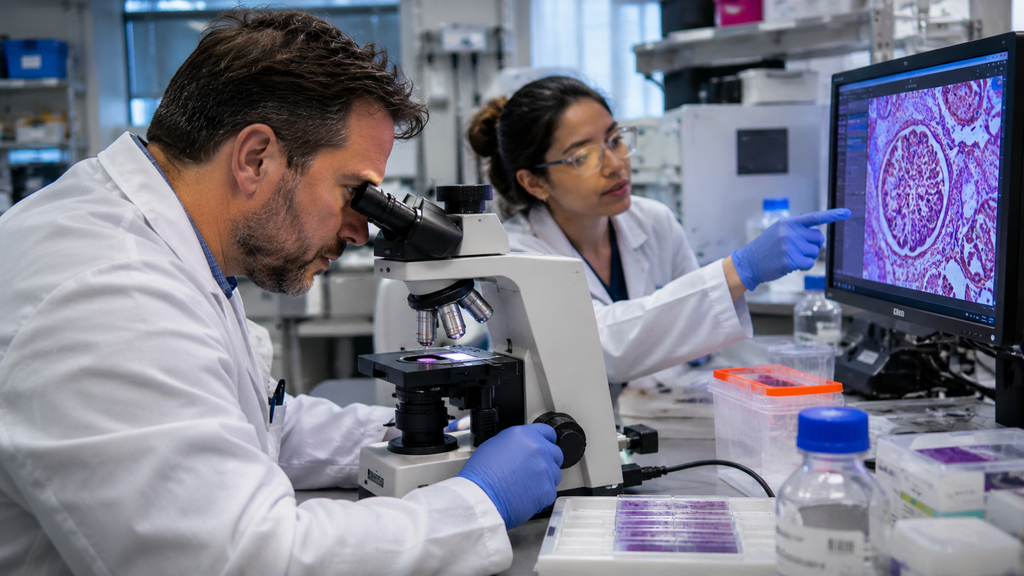
The biopsy component of REMODEL provided a level of biological detail that standard imaging and blood tests cannot deliver.
Of the 106 randomized participants, 33 contributed paired kidney biopsies for histological analysis. Smaller groups provided material suitable for single-nucleus transcriptomics and spatial transcriptomics, with 22 and 13 participants included in those respective analyses.
Single-nucleus transcriptomics measures patterns of gene activity in individual cell nuclei. Spatial transcriptomics adds information about where cells and their molecular signals are located within tissue.
These techniques allow investigators to examine not only whether a kidney appears healthier on an imaging scan, but also whether specific populations of cells show molecular changes consistent with altered physiology.
The most pronounced treatment-associated changes involved glomerular endothelial cells. These cells line the tiny blood vessels within the glomeruli, the filtration structures responsible for helping remove waste products and excess fluid from the blood.
Researchers identified changes in gene-expression programs associated with metabolism, inflammation, fibrosis and cellular integrity. The results were consistent with a shift toward molecular patterns that could support healthier endothelial function.
Spatial analysis also suggested fewer immune cells in close proximity to glomerular endothelial cells following semaglutide treatment. That observation supports the possibility of altered inflammatory activity within the kidney’s microvascular environment.
Separate exploratory tissue analyses found a reduction in the fractional intimal area of the most severely affected small kidney arteries. Intimal thickening is one feature of vascular remodeling that can accompany chronic kidney disease.
These findings align with the secondary MRI signals involving renal vascular resistance and tissue characteristics associated with fibrosis. The imaging and molecular results are therefore biologically consistent, even though they arise from different measurements and participant subsets.
That consistency is one of the study’s strengths. A single molecular signal might be difficult to interpret. Observing related patterns across MRI, histology and gene-expression analysis provides a more informative hypothesis about how semaglutide affects diseased kidneys.
However, biological consistency does not establish causation. The transcriptomic groups were small, and the results do not prove that the observed gene-expression changes caused the improvements in albuminuria or kidney-function measurements.
The study also cannot fully separate direct effects on kidney cells from broader changes in body weight, blood pressure, glucose regulation and other metabolic pathways.
The biopsies therefore sharpen the mechanistic picture without settling every question. They suggest that the kidney’s small blood vessels and endothelial cells may be especially important targets of semaglutide-associated biological changes.
What REMODEL Means for Kidney Research and the Next Generation of GLP-1 Drugs
REMODEL is the kind of study that remains useful after the initial news cycle. Its objective was not to repeat a large clinical outcomes trial, but to identify biological changes that might explain why semaglutide has demonstrated kidney benefits.
The distinction matters because the findings offer clues rather than a complete causal explanation. The primary MRI measurements did not show statistically significant differences. Secondary imaging suggested lower vascular resistance and attenuation of fibrotic progression, while smaller biopsy analyses identified changes in glomerular endothelial-cell programs.
The safety findings also deserve attention. Permanent treatment discontinuation because of adverse events occurred in approximately 12.7% of participants receiving semaglutide compared with 2.9% receiving placebo. Serious adverse-event rates were similar between groups, and no serious biopsy-related adverse events were reported.
The participants were predominantly male, with women representing approximately 24% of the population. The relatively small sample size and specialized research procedures limit how confidently the results can be generalized to every patient with chronic kidney disease.
For clinicians, the most important established conclusion still comes from larger outcomes research: semaglutide has demonstrated kidney benefits in adults with type 2 diabetes and chronic kidney disease. REMODEL does not replace that evidence or independently justify changing treatment decisions on the basis of exploratory biomarkers.
For researchers, the findings point toward several questions worth answering. Could measures of kidney vascular resistance help identify treatment response? Do improvements in endothelial-cell signaling predict longer-term preservation of kidney function? Is reduced fat around the kidney a contributor to protection or primarily a parallel marker of systemic metabolic change?
Combination therapy is another important possibility. Many patients with chronic kidney disease already receive drugs that block the renin-angiotensin system, while SGLT2 inhibitors and finerenone act through other pathways. Determining whether semaglutide adds kidney protection through complementary mechanisms will require appropriately designed studies.
There is also a wider implication for the next generation of incretin medicines. Drugs such as tirzepatide and newer candidates, including enicepatide, may produce substantial improvements in weight and glucose regulation. That does not automatically establish that they reproduce semaglutide’s kidney effects.
Matching another medicine on a scale or blood-glucose measurement is not the same as demonstrating equivalent protection of kidney filtration structures, small blood vessels or long-term renal outcomes.
The next generation of trials may benefit from combining large clinical outcome measurements with more focused investigations of kidney imaging, organ fat, tissue structure and molecular changes. REMODEL demonstrates both the promise and the difficulty of that approach.
Its strongest lesson is not that oxygenation was irrelevant or that blood vessels have been proven to explain everything. It is that a drug’s clinical benefit can involve several interconnected biological processes, and understanding them requires measurements that go deeper than conventional laboratory markers.
Researchers looked inside human kidneys for the mechanism behind semaglutide’s protective effects. Their primary imaging hypothesis was not confirmed. But the vascular, tissue and molecular findings point toward where the next investigations should begin.
REMODEL did not answer all of how Ozempic protects the kidney. It showed where scientists should look next.
Original research: Tuttle K.R., Bjornstad P., Smith C. et al. Effects of semaglutide on kidney disease in type 2 diabetes: a randomized placebo-controlled trial. Nature Medicine, published October 1, 2026.
Clinical trial registration: NCT04865770 — REMODEL trial, ClinicalTrials.gov.
Earlier kidney outcomes research: Perkovic V. et al. Effects of Semaglutide on Chronic Kidney Disease in Patients with Type 2 Diabetes. The New England Journal of Medicine, 2024.
Regulatory documentation: Ozempic U.S. prescribing information and kidney outcomes indication.


