
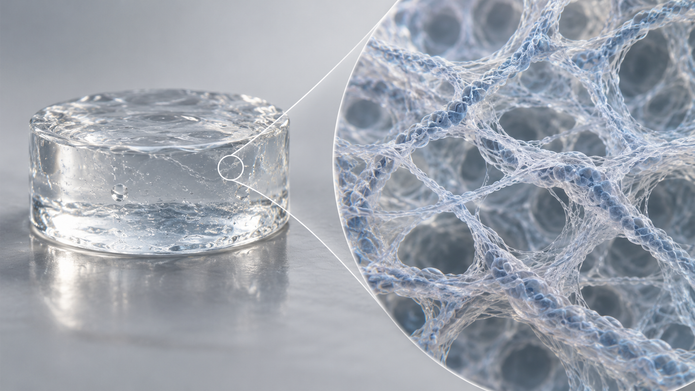
An infected wound does not remain chemically constant while it heals. Its acidity, inflammatory environment and microbial burden change, often at different rates.
A paper published online October 22 in Acta Biomaterialia describes an experimental material designed to respond to that changing setting rather than deliver one static effect.
Yulin Sun and colleagues engineered a peptide-based nanozyme hydrogel with two kinds of enzyme-like activity, controlled in part by the local pH. The work is an inventive materials-science result, not evidence that a commercial wound dressing has been proven effective in patients.
One Peptide Scaffold, Two Chemical Jobs
The team designed an amphiphilic peptide, C16-GAVFFAHHGGEE, capable of assembling into a nanofibrous hydrogel and coordinating copper ions.
The sequence organizes into a beta-sheet-rich structure, creating a scaffold whose chemical behavior depends on its surroundings.
Under acidic conditions, the material showed oxidase-like activity that generated reactive oxygen species with antibacterial effects. Under more alkaline conditions, it displayed hydrolase-like activity capable of acting on prodrugs and influencing inflammatory responses.
In effect, the material was engineered to change its chemical task as the environment changed.
That is the underlying innovation: a single peptide-based structure designed to perform different catalytic functions under different chemical conditions. The reported switching is an experimental property, not evidence that the material has been shown to recognize and respond perfectly to each stage of healing in people.

Why a Wound Dressing That Changes Chemistry Matters
This is a different strategy from simply loading a dressing with a conventional antimicrobial agent.
A static coating may release an ingredient whether the wound needs it or not; a responsive material attempts to link activity to measurable conditions.
That is attractive in principle because infected chronic wounds involve several overlapping problems: bacteria, excessive inflammation, tissue damage and impaired repair.
A system that changes function over time could eventually simplify treatment, although translating such chemistry into predictable bedside behavior is difficult.
The material’s response depends on chemical conditions, particularly pH. Real wounds, however, are not uniform laboratory solutions. Local acidity may vary across the wound surface and change alongside infection, inflammation and tissue repair.
Demonstrating catalytic switching under controlled conditions is therefore an important first step, not proof that the same switching will proceed predictably throughout treatment.
The Twelve-Day Healing Result Needs Context
In laboratory tests, the authors reported cytocompatibility and broad-spectrum antibacterial activity. They also evaluated the material in an infected diabetic wound model.
The paper’s abstract says the treated wounds approached complete closure within twelve days, alongside signs of re-epithelialization, reduced inflammation, collagen deposition and new vessel formation.
These observations are promising within the model.
They should not be rewritten as a twelve-day healing promise for people with diabetic foot ulcers, where vascular disease, neuropathy, infection severity and other factors make outcomes far more complex.
The published results also do not establish that every part of the apparent healing benefit resulted from catalytic switching itself. Material structure, local chemistry, antibacterial effects and the experimental treatment conditions may all influence wound closure.
A material that helps close an experimental wound is not automatically a treatment ready for a patient.
The Copper and Reactive Oxygen Trade-Off
The copper component and reactive oxygen chemistry deserve attention.
Reactive species can kill bacteria, but they can also damage healthy tissue if produced at the wrong place or dose.
A material that performs well under controlled laboratory pH conditions may behave differently in a wound with variable exudate, bacterial communities and changing oxygen supply.
Researchers will need to study degradation products, copper exposure, mechanical durability and reproducibility across manufacturing lots before a practical device can be judged safe.
The design also illustrates how a peptide can function as architecture rather than a hormone or a drug-like signal.
Its amino-acid sequence helps determine assembly, binding and catalytic behavior. The therapeutic concept emerges from the material’s organization and response, not from a single receptor interaction.
That distinction matters in a peptide industry where almost every molecule is marketed with the same vocabulary of recovery and healing. A wound hydrogel is not interchangeable with an injectable peptide blend.
From Clever Laboratory Chemistry to a Medical Device
The published report is early-stage and has limitations typical of biomaterials research.
Animal wound models can reveal mechanisms and comparative signals, but they do not reproduce all aspects of chronic human wounds. Results depend on experimental controls, wound size, infection model and the way closure is measured.
Future work would need standardized toxicology, sterilization methods, storage stability and human trials. Manufacturing consistency would also matter because the peptide sequence, assembly conditions and copper coordination all contribute to the material’s behavior.
No patient benefit is established by the paper alone.
The strongest takeaway is a design principle: use a programmable peptide scaffold to connect chemical activity to a changing biological environment.
If the approach survives rigorous testing, it could inform a generation of adaptive wound materials.
For now, the October 22 study offers a clever demonstration of how molecular sequence, assembly and pH can be engineered together.
It is a scientific lead worth following, not a treatment ready to recommend.
Source: Sun Y, et al. Sequence-Programmed Peptide Nanozyme Hydrogel with Microenvironment-Responsive Dual Catalytic Activity for Infected Wound Healing. Acta Biomaterialia. Published online October 22, 2026. DOI: 10.1016/j.actbio.2026.10.035.


