
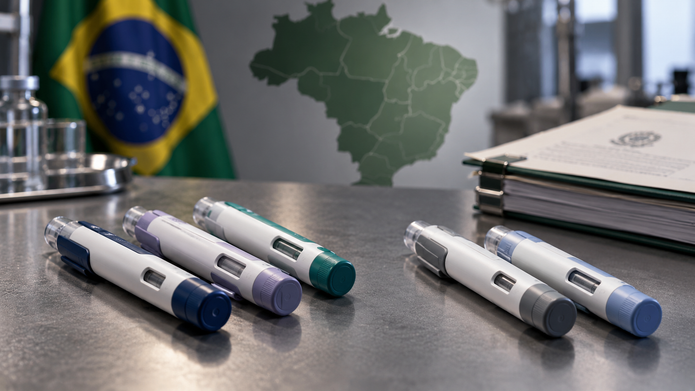
Brazil’s medicines regulator made a quiet but consequential move on October 29: it authorized five additional GLP-1 injection pens. Three are indicated for diabetes and two for obesity, according to the Agência Nacional de Vigilância Sanitária, known as Anvisa.
The agency said the registrations bring its 2026 total to 20 pens. It is a substantial signal of regulatory activity in one of the world’s major pharmaceutical markets, but it is not evidence that 20 products are immediately on pharmacy shelves or suitable for the same patients.
Five Pens, Two Molecules, Different Indications
The approved products have distinct names, molecules and intended uses.
Aribet contains liraglutide for diabetes. Lyrza and Wylovol also contain liraglutide, but are indicated for obesity in conjunction with exercise and dietary changes. Embeltah and Sevema contain semaglutide and are indicated for diabetes.
A consumer who hears “five more weight-loss pens” could easily misunderstand the announcement: the regulator did not describe all five as obesity medicines.
The International Supply Chain Behind the Approvals
The manufacturing geography is just as revealing as the brand list.
Anvisa identifies India’s Biocon as manufacturer for the three liraglutide products registered by Farma Vision. It identifies India’s OneSource Specialty as manufacturer for the semaglutide products registered by Dr. Reddy’s and Aché.
That does not establish that any product is inferior or superior. It does show how a national market for injectable peptide medicines can depend on international production and local registration partners.
Why Brazil Accelerated GLP-1 Reviews
Anvisa explained that it began prioritizing reviews of semaglutide and liraglutide products in August 2025 after a request from Brazil’s Ministry of Health.
The effort was linked to public-system needs and domestic supply concerns. The agency’s October 29 statement refers to Resolution 4.244/2026 and an earlier public call for applications.
Those administrative details reveal a strategic objective: create more authorized options in a market where concentration and supply constraints can limit choice.
Regulatory Approval Is Only the First Gate
Registration, however, is only one gate. Pricing decisions, procurement, manufacturing capacity, distribution agreements, prescribing rules and the ability of a public or private payer to cover a product all affect whether an approval becomes access.
Anvisa has explained that registration does not automatically authorize an immediate commercial launch. The Brazilian medicines-pricing authority, CMED, has a separate role in establishing permitted prices. Manufacturers then determine when to bring registered products to market.
Access through Brazil’s public health system, SUS, involves further assessment and government decisions. A regulator can authorize a medicine without deciding that a national health system will purchase it for every eligible person.
Nor does the existence of a registered brand establish clinical interchangeability across devices, doses or indications.
Consider the difference between liraglutide and semaglutide. Both act on the GLP-1 receptor, but they are not the same molecule, and their usual dosing schedules differ.
Liraglutide has generally been administered daily in relevant approved products, while semaglutide injection is commonly administered weekly. Switching between medicines or devices requires clinical and product-specific consideration.
Anvisa’s announcement is a list of registrations, not a recommendation that a patient exchange one pen for another without medical guidance.
The Real Test Is What Reaches Patients
The move also illustrates a broader shift in the global peptide economy. Pharmaceutical competition is no longer solely about which company invents the newest multi-receptor agonist.
It is also about who can reliably make, register and distribute established molecules under a changing patent and regulatory landscape. For patients living with diabetes or obesity, an additional authorized option may matter more in the near term than an experimental molecule that is years from routine use.
That said, a larger list of authorized brands can create a communications problem. Advertising and social media frequently flatten distinctions between diabetes indications, obesity indications, formulation strength and product origin.
Journalists should report the exact indication and manufacturer rather than using “Ozempic alternative” as a universal shorthand. Clinicians and pharmacists must distinguish the labeled product from a superficially similar pen offered through an unauthorized channel.
Brazil’s October 29 decision should not be mistaken for an efficacy trial. The agency has made regulatory determinations about specific submissions; its press release does not publish a new head-to-head study showing these products outperform existing options.
It also does not provide verified retail launch dates or final prices for all five. Those are follow-up reporting questions, not details to be invented from the approval count.
The news is important because it demonstrates how rapidly the supply side of GLP-1 treatment is diversifying.
The meaningful scoreboard is not simply 20 registrations in 2026. It is whether authorized products reach the people for whom they are indicated, with reliable quality, clear labeling, sustainable pricing and dependable supply.
Brazil has opened another regulatory door. Patients will judge the result by what actually becomes available on the other side.


