
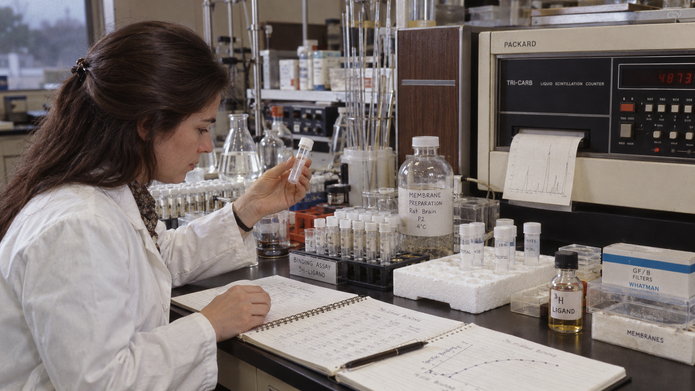
In 1973, a graduate researcher named Candace Pert and neuroscientist Solomon Snyder published evidence for an opioid receptor in nervous tissue.
The paper did more than identify a binding site for a class of drugs. It helped establish that the brain contained specific molecular targets through which morphine-like compounds produced their effects.
That finding contributed to a transformation in neuroscience and helped establish the experimental foundation for later discoveries involving endogenous opioid peptides.
But Pert’s role in the breakthrough would become inseparable from another question: when a scientific discovery earns a major award, who deserves recognition?
The answer became the subject of a public controversy five years after the original experiment.
The Experiment That Made Opioid Receptors Measurable
The original study appeared in Science on March 9, 1973, under the title “Opiate receptor: demonstration in nervous tissue.”
Its authors were C. B. Pert and S. H. Snyder.
Working at Johns Hopkins University, the researchers used tritium-labeled naloxone, a radioactive form of an opioid antagonist, to examine binding sites in nervous tissue.
The approach relied on a powerful experimental principle: if a labeled drug binds to a particular biological target, researchers can measure that interaction and investigate whether other compounds compete for the same binding sites.
Pert and Snyder examined binding in mammalian brain material and guinea-pig intestinal tissue.
They found that different opioid drugs and antagonists competed for binding sites in patterns closely associated with their pharmacological potency.
That relationship was important because it linked the measurable interaction to the known biological effects of opioid compounds.
Instead of merely observing that morphine affected the nervous system, the researchers had demonstrated a way to investigate specific molecular binding associated with opioid pharmacology.
The experiment did not reveal an atomic-resolution receptor structure, and it did not explain every step of opioid signaling.
Its achievement was establishing a measurable biological target that other laboratories could investigate.
That distinction matters. A receptor becomes scientifically useful not simply when its existence is proposed, but when researchers can detect, characterize and test its interactions with molecules.
From Binding Sites to a Map of the Brain
The March 1973 paper was part of a rapidly developing field.
Other investigators, including Eric Simon and colleagues in New York and Lars Terenius in Sweden, also reported important evidence for opioid-receptor binding during 1973.
The broader discovery was therefore not confined to one laboratory or one experimental group.
The next challenge was understanding where these binding sites appeared in the nervous system and how their distribution related to drug effects.
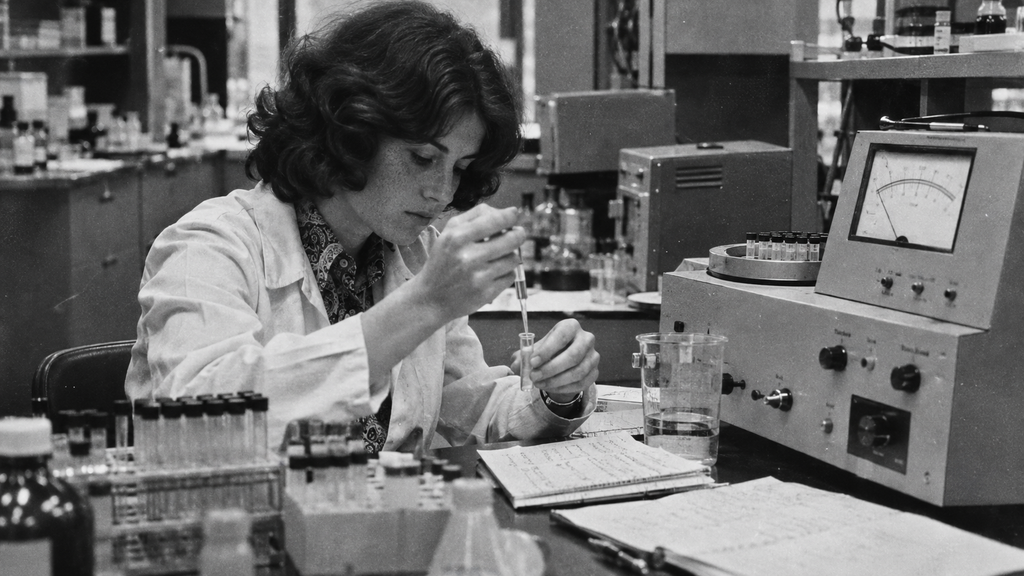
On October 26, 1973, a paper in Nature by Michael Kuhar, Candace Pert and Solomon Snyder examined the regional distribution of opioid-receptor binding in monkey and human brains.
Different regions displayed different amounts of receptor binding.
That anatomical pattern was scientifically meaningful because drugs acting on the nervous system do not necessarily affect every brain region equally.
Mapping receptor distribution helped researchers connect molecular pharmacology with the organization of neural systems involved in pain, behavior and other functions.
The work also helped establish experimental approaches that could be adapted to other receptor systems.
The story continued in 1975, when John Hughes, Hans Kosterlitz and colleagues identified the chemical sequences of methionine-enkephalin and leucine-enkephalin.
These naturally occurring five-amino-acid peptides helped explain why the body possessed receptors capable of responding to morphine-like drugs.
The receptor experiments and the identification of endogenous opioid peptides were related but distinct achievements.
Together, they contributed to a more complete picture of the body’s own opioid signaling system.
The 1978 Award That Sparked a Fight Over Credit
In 1978, the Albert Lasker Basic Medical Research Award recognized major contributions to opioid-receptor and enkephalin research.
The recipients were Solomon Snyder, Hans Kosterlitz and John Hughes.
Candace Pert was not included.
That omission attracted attention because Pert had been the first-listed author on the landmark March 1973 receptor paper and had contributed to subsequent research in the same field.
Pert objected publicly to her exclusion. Contemporary reporting described her disagreement with the award decision and the broader debate about how scientific recognition was distributed among senior investigators, junior researchers and collaborators.
The controversy also raised questions about gender and academic hierarchy.
Some observers argued that her omission reflected inequities affecting younger scientists and women in research. Those interpretations were part of the documented debate, but they should not be confused with a definitive finding about the private motives of every participant.
There is another important part of the historical record.
In his acceptance remarks, Snyder publicly thanked Pert for her role in identifying the opioid receptors in his laboratory.
That acknowledgment matters. It demonstrates that her contribution was recognized in a public statement even though she was not among the formal award recipients.
But acknowledgment and award recognition are not identical.
The controversy became a wider discussion about scientific credit, especially the relationship between laboratory leaders and the researchers who conduct much of the experimental work.
A scientific discovery can be collaborative while the honors attached to it are distributed unevenly.
The strongest historical account does not need to turn the dispute into a simple story of heroes and villains.
The published author lists, the award recipients, Pert’s objections and Snyder’s recorded acknowledgment provide enough evidence to explain why the issue mattered.
A Scientific Career Beyond the Controversy
Pert’s research career continued well beyond the events of the 1970s.
She worked at the National Institute of Mental Health from 1975 to 1987, eventually becoming chief of the Section on Brain Biochemistry.
Her interests expanded to neuropeptides, receptor interactions and the chemical communication linking different biological systems.
She also participated in research involving Peptide T, an investigational compound explored for potential effects related to HIV.
Those later projects were scientifically different from her original opioid-receptor experiments and should be assessed on their own evidence.
Pert became widely associated with broader ideas about communication among the nervous, endocrine and immune systems.
Some of those connections reflect established areas of neuroendocrine and immune signaling. Other interpretations, particularly sweeping claims about emotional states and physical disease, require more careful evaluation.
Her early receptor work stands independently of agreement with every idea she later promoted.
The 1973 experiments had defined biological materials, labeled compounds, competitive-binding measurements and reproducible scientific questions.
Those features made the findings important to molecular pharmacology.
Pert died on September 12, 2013, aged 67.
Her obituary record preserves both her role in the opioid-receptor discovery and her outspoken participation in discussions about scientific recognition.
Why Her Story Still Matters to Peptide Science
Modern peptide research frequently depends on understanding whether a molecule engages a particular receptor and what happens afterward.
Researchers may begin with a proposed ligand, a computational binding model or a biochemical assay.
But a convincing mechanism requires evidence that the molecule interacts with the biological target under relevant conditions and produces a meaningful response.
The principle behind the 1973 opioid-receptor experiments remains recognizable.
Specific binding, competition experiments, receptor distribution and biological consequences are different layers of evidence.
Modern laboratories possess more sophisticated tools for studying molecular structures and signaling pathways, but the distinction between detecting a binding interaction and demonstrating a useful therapeutic effect remains essential.
Pert’s story also raises a different kind of evidence question.
When a scientific breakthrough becomes famous, does the public narrative preserve the contributions of everyone whose experiments established the result?
The answer cannot always be inferred from an award announcement or a simplified biographical profile.
Original publications, author lists, contemporary reporting and institutional records provide a more reliable foundation.
This is an evergreen historical profile, not an October 2026 research announcement.
Its enduring significance lies in two connected stories: the development of experimental methods that helped reveal how opioid drugs interact with the nervous system, and the debate over who receives recognition when those methods lead to major discoveries.
Candace Pert’s contribution belongs in scientific history because the original experimental record documents it.
Primary source: Pert CB, Snyder SH. Opiate receptor: demonstration in nervous tissue. Science. 1973;179(4077):1011–1014. DOI: 10.1126/science.179.4077.1011.
Additional research: Kuhar MJ, Pert CB, Snyder SH. Regional distribution of opiate receptor binding in monkey and human brain. Nature. 1973;245:447–450.
Historical references: 1978 Lasker Award archive and acceptance remarks; 1979 Science reporting on the award controversy; NIH historical obituary.