
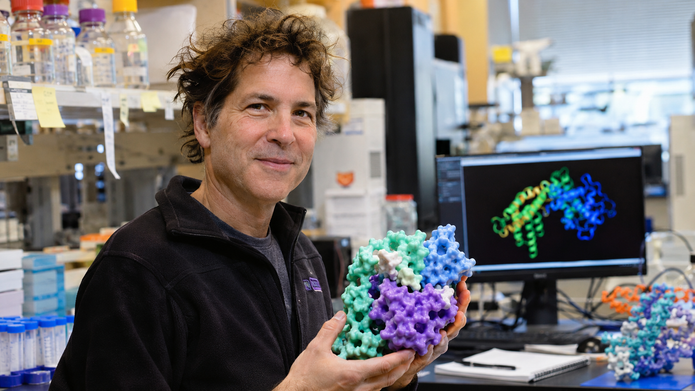
Long before protein design became a favorite phrase in artificial-intelligence headlines, David Baker was pursuing a deceptively radical idea: perhaps scientists did not have to settle for the proteins evolution happened to produce. If they could understand the relationship between amino-acid sequence and three-dimensional shape, they might build entirely new molecular tools.
It was an ambition that required chemistry, computing and years of experiments that did not fit neatly into the traditional division between biology and engineering. Decades later, that pursuit would help earn Baker the 2024 Nobel Prize in Chemistry.
The Radical Idea: Designing Proteins Instead of Discovering Them
David Baker, a researcher at the University of Washington, became a central figure in computational protein design. His group’s work helped establish methods for predicting and engineering protein structures, including the Rosetta software ecosystem.
For much of molecular biology’s history, researchers studied proteins that already existed in nature. They examined their amino-acid sequences, determined their structures and tried to understand the functions those structures supported.
Baker and his collaborators helped develop a different approach. Instead of starting with an existing protein and asking what shape it would adopt, scientists could specify a desired structure and search computationally for an amino-acid sequence capable of forming it.
The distinction was profound. Protein design suggested that researchers might eventually create molecular structures and functions that evolution had not produced, or at least that scientists had not yet discovered in nature.
Top7: The Designed Protein That Marked a Turning Point
One of the field’s defining achievements arrived in 2003. In a study published in Science, a team led by first author Brian Kuhlman, with Baker and other collaborators, described the design of a 93-amino-acid protein called Top7.
Top7 was designed with a novel sequence and fold rather than copied from an existing natural protein. The researchers produced the molecule experimentally and determined its structure using X-ray crystallography. The resulting structure closely matched the computational design.
The importance of that demonstration was conceptual. A protein is not simply a string of amino acids. It folds into a three-dimensional structure whose geometry governs interactions and function.
Predicting the structure formed by an existing sequence is difficult. Designing a new sequence that reliably adopts a chosen fold is a different challenge. Top7 showed that the direction of the problem could be reversed, at least under controlled experimental conditions.
The achievement did not mean researchers could suddenly build any protein they imagined. But it demonstrated that deliberate molecular design could produce stable structures outside the catalog of previously characterized natural folds.
Computational Predictions Still Had to Survive Laboratory Testing
The field advanced through a combination of improved computation and rigorous experimental testing. Researchers proposed candidate sequences, made them, measured their behavior and learned from failures.
A computer-generated structure can be convincing without representing a stable molecule in the real world. Amino acids interact through complex physical forces, and even small changes to a sequence can affect folding, stability and biological behavior.
This made experimental validation essential. A proposed protein had to be produced, purified and examined. Researchers needed evidence that it formed the intended structure and, where relevant, performed the intended function.
Later developments expanded the possibilities from designed structural scaffolds toward binders, enzymes, vaccine components and other functional proteins. The Institute for Protein Design’s account of Baker’s work emphasizes the contributions of many collaborators and trainees, rather than the solitary-genius mythology often attached to major discoveries.
The 2024 Nobel Prize Recognized Two Different Protein Challenges
On October 9, 2024, the Royal Swedish Academy of Sciences announced that Baker would receive half of the Nobel Prize in Chemistry for computational protein design.
Demis Hassabis and John Jumper shared the other half for protein-structure prediction, reflecting their contributions to the development of powerful artificial-intelligence methods for determining protein structures from amino-acid sequences.
The distinction matters. Predicting what a known sequence will look like and designing a new molecule to adopt a chosen structure are related but not identical scientific achievements.
Structure prediction can help researchers understand existing proteins. Protein design asks whether new sequences can be constructed to produce useful structures and, ultimately, new functions.
The two approaches increasingly inform each other, but the Nobel recognized different contributions to the scientific understanding and engineering of proteins.
What Protein Design Could Mean for Peptides and Biotechnology
For peptide researchers and biotechnology companies, the implications are substantial. Computational methods can suggest new ways to create small proteins, constrained peptides and molecular binders with properties that may not be available in existing natural molecules.
A designed protein might eventually be engineered to recognize a particular biological target, assemble into a useful structure or carry out a chemical reaction. Researchers can investigate how changes to amino-acid sequence affect stability, selectivity and interactions with other molecules.
These capabilities could support the development of research tools, diagnostic systems, vaccine components and potential therapeutic candidates. They also offer new ways to test biological hypotheses by constructing molecules with carefully specified properties.
Yet a plausible computational structure is not a medicine. Therapeutic development still requires experimental assays, toxicology, delivery studies, manufacturing controls, clinical trials and regulatory review.
Even a protein that performs exceptionally well in a laboratory assay may fail because it is unstable in the body, difficult to manufacture, poorly delivered to the intended tissue or capable of causing unwanted immune responses.
Computational design can expand the range of molecular candidates researchers investigate. It cannot remove the need to demonstrate that those candidates are safe and effective for a particular medical purpose.
The Larger Legacy: Making Molecular Design an Experimental Discipline
Baker’s larger contribution was helping build an intellectual and technical framework that many laboratories now use to investigate questions once considered beyond rational design.
The history is more interesting than the simplistic claim that artificial intelligence invented biology. Baker and his collaborators spent decades developing computational methods, testing molecular predictions and refining their approaches against experimental evidence.
The work evolved through improvements in algorithms, computing power, structural biology and experimental methods. Each advance made it possible to explore molecular possibilities that had previously been difficult to study systematically.
The 2024 Nobel Prize recognized a scientific transition: from discovering and analyzing the proteins the natural world already contains toward testing whether biology’s molecular vocabulary can be used to construct entirely new structures.
That transition remains unfinished. Researchers cannot yet design every protein function they might want, and computational confidence does not guarantee experimental success.
But the direction of the field has changed. Scientists are no longer limited to asking what proteins nature has already made. Increasingly, they can ask which molecular structures they want to create, then test whether chemistry and biology will allow those designs to exist.
Sometimes the most important breakthrough is not a single medicine or molecule. It is the development of a method that makes entirely new scientific questions possible.
Sources: University of Washington Institute for Protein Design; Nobel Prize in Chemistry 2024; Kuhlman et al., Science (2003), Top7 protein design study.