

Proteins that cut other proteins are among biology’s most consequential tools. They digest food, process hormones, remodel tissue and help regulate signaling. Their power also makes them difficult to design: a useful protease must recognize a target, position a chemical reaction precisely and avoid indiscriminate destruction.
A study published in Nature on October 14, 2026, suggests computational protein design is beginning to cross that threshold. Researchers used artificial intelligence-assisted methods to construct proteins capable of catalyzing the cleavage of selected peptide bonds.
Designing a Protein That Can Cut a Specific Bond
Researchers used RFdiffusion-based methods to construct proteins with zinc-containing active sites positioned beside pockets intended to bind specific peptide substrates.
The catalytic challenge is substantial. Peptide bonds are chemically stable, and a functioning enzyme must arrange its active-site components in a geometry that favors a difficult reaction.
In these designs, zinc helps organize and activate water for peptide-bond hydrolysis. The enzyme must also bind the intended substrate and position the target bond close to the catalytic machinery.
That combination of substrate recognition and catalytic precision distinguishes an active protease from a protein that merely binds another molecule.
Why 36% of Tested Designs Matters
The team tested 135 computational designs. According to the paper, 36% catalyzed cleavage of their intended peptide substrates at the targeted bond.
The strongest initial design accelerated peptide-bond hydrolysis by more than one hundred million times relative to the uncatalyzed reaction. Four additional substitutions increased that enhancement beyond ten billion-fold by improving the organization of the catalytic active site.
Those numbers deserve attention, but they require context.
A rate enhancement is not a clinical response rate, and success on a designed peptide substrate is not equivalent to selective destruction of a disease-causing protein inside a patient.
The result is significant because it shows that researchers can specify catalytic geometry, build a candidate protein and obtain substantial activity in experimental assays.
At the same time, the designs that did not produce the intended activity illustrate why computational prediction remains imperfect.
Disease-Linked Protein Targets Raise New Questions
The researchers went beyond convenient model substrates. They designed metalloproteases capable of cleaving targets associated with human proteins such as TDP-43, amyloid-beta and serum amyloid A.
These proteins are connected to important disease biology, including neurodegeneration and amyloid-related conditions. The study reported substantial catalytic rate enhancements for disease-associated targets.
But the relationship between cutting a protein and treating a disease is far from straightforward.
TDP-43, for example, has essential normal cellular functions. Indiscriminately destroying it could create new problems even if an intervention reduced a disease-associated form of the protein.
Therapeutic development would require a much deeper understanding of target accessibility, selectivity, cellular distribution and the consequences of cleavage products.
The laboratory findings support a promising molecular engineering strategy. They do not demonstrate reversal of neurodegenerative or inflammatory disease.
Molecular Switches and Conditional Cytokine Activation
The study also explored conditional control of biological activity.
Researchers designed caged cytokines and receptor antagonists that could be selectively activated by the engineered proteases.
The underlying idea is to make the activity of a biological molecule depend on a specific molecular cleavage event.
Such systems could eventually inspire therapeutic designs in which biological activity is controlled by molecular conditions rather than being continuously available throughout the body.
That possibility is intriguing, but the gap between a laboratory circuit and a safe treatment remains substantial.
Researchers would need to establish delivery, tissue specificity, stability, immunogenicity and the effects of unintended cleavage before discussing clinical applications with confidence.
AI Proposed the Structures. Experiments Tested Them.
One of the study’s most important features is that the investigators did not rely solely on computational confidence.
They combined experimental screening, structural characterization and iterative improvements to refine the enzymes.
Artificial intelligence helped generate candidate structures. Chemistry and biology determined whether those candidates actually worked.
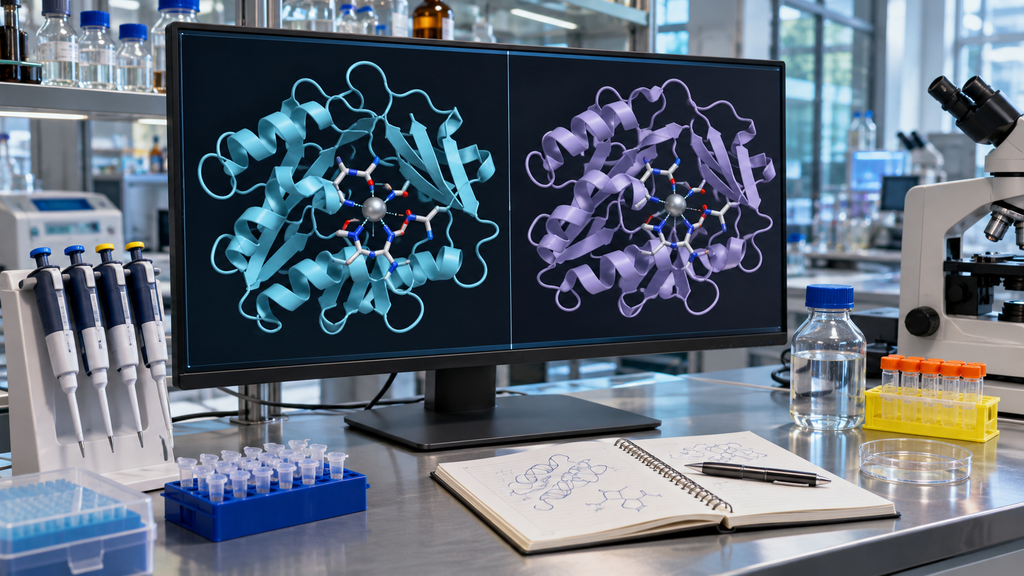
Caption: Conceptual laboratory scene illustrating the experimental testing and structural evaluation of computationally designed proteins.
This combination is more informative than claims that an algorithm can now simply invent drugs.
The field has previously made substantial progress designing proteins that bind selected targets. Catalysis raises the difficulty because binding alone is insufficient.
A catalytic site must help stabilize the reaction’s transition state and organize water, substrate and metal ions precisely enough to accelerate bond cleavage.
The zinc-based designs show how far computational methods have progressed, while unsuccessful candidates underline the continuing importance of experimental validation.
The Road From Designed Proteases to Therapeutics
Clinical headlines would be premature.
No patient received a treatment in this study, and the researchers did not establish that their designed proteins safely reverse neurodegenerative, inflammatory or amyloid-related disease.
For therapeutic use, the designed enzymes would need to reach their intended targets, remain active under relevant physiological conditions and avoid damaging essential proteins.
Researchers would also need to study toxicity, immune responses, degradation, dosing and the biological effects of the fragments produced by cleavage.
The paper reports provisional patent applications associated with aspects of the methods and designs, reflecting potential interest in further development. Patents, however, do not establish clinical effectiveness.
The immediate result is a new experimental toolkit for programmable proteolysis.
That is still a substantial scientific advance. Rather than waiting to discover suitable molecular scissors in nature, researchers are beginning to specify the cut they want and design an enzyme that can perform it.
The breakthrough is the ability to engineer and experimentally validate a precise chemical function. Whether that function can become a safe and effective medicine remains an entirely separate question.
Primary Source: Chen, A., Wu, K., Choi, H. et al. Computational design of metalloproteases. Nature (2026). https://doi.org/10.1038/s41586-026-11167-2