
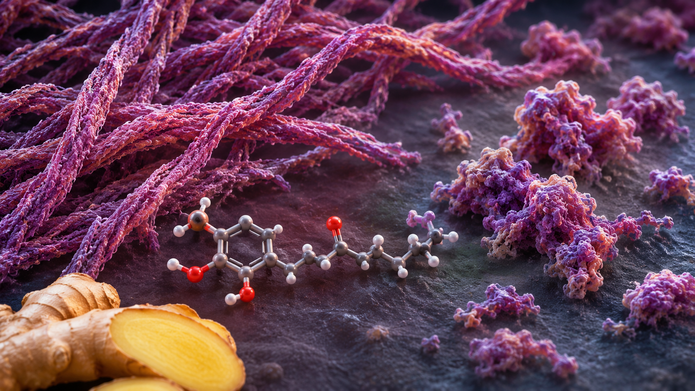
A compound associated with ginger changed how Alzheimer’s-linked peptides assembled in a laboratory experiment.
That sounds like the beginning of a familiar natural-remedy headline.
The more interesting scientific detail is that the solvent also changed the aggregation pattern.
Researchers led by Elina Berntsson examined how 6-gingerol interacts with amyloid-beta peptides and reported changes in fibril formation.
Their paper appears in the October 29 issue of Biochemical and Biophysical Research Communications, although it was first published electronically in May.
The study is a useful demonstration of how molecular experiments can reveal unexpected chemical behavior. It is not evidence that eating ginger prevents Alzheimer’s disease.
What Ginger’s 6-Gingerol Actually Did to Amyloid Peptides
Amyloid-beta peptides are fragments produced from a larger protein called amyloid precursor protein.
Under certain conditions, amyloid-beta molecules can assemble into soluble oligomers, elongated fibrils and larger deposits.
Amyloid plaques are a characteristic pathological feature of Alzheimer’s disease, although the relationship between different amyloid assemblies and clinical symptoms is complex.
Some soluble intermediate assemblies are considered especially relevant to neuronal injury.
The researchers studied amyloid-beta 40 and amyloid-beta 42, commonly abbreviated Aβ40 and Aβ42. The numbers identify peptides containing 40 and 42 amino-acid residues.
These peptides are widely used in experiments investigating how amyloid molecules associate and develop larger structures.
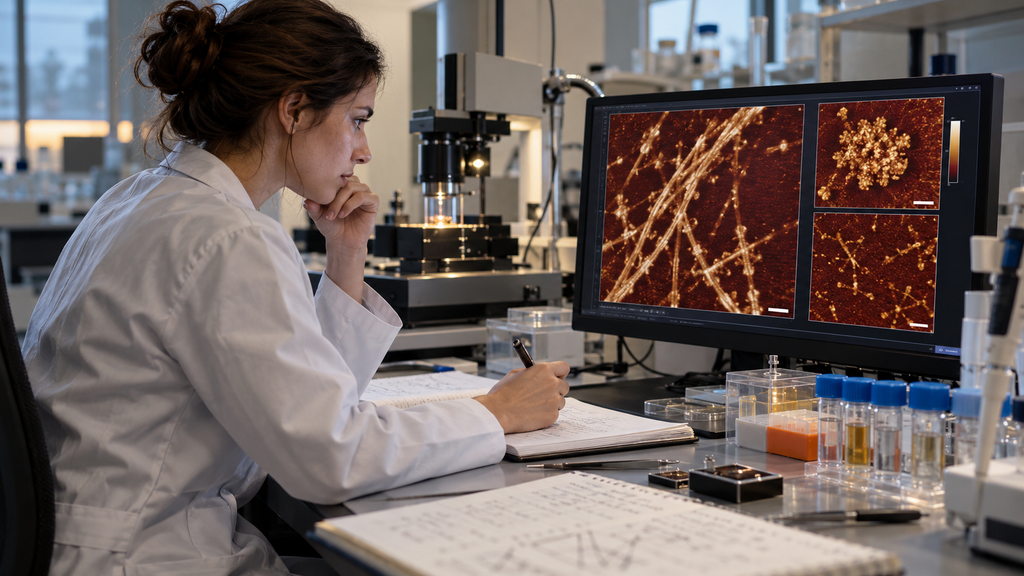
The team examined the effects of 6-gingerol, a naturally occurring constituent of ginger, using biophysical techniques including atomic force microscopy.
They reported that 6-gingerol interfered with fibril elongation and promoted the appearance of more amorphous amyloid-beta agglomerates.
In other words, the compound changed the way the peptide molecules assembled.
That is a structural observation about molecular aggregation, not evidence that the resulting material is harmless or that an Alzheimer’s treatment has been discovered.
The Unexpected Result Was Hiding in the Solvent
The study’s most revealing finding may concern a chemical that was not supposed to be the main subject.
Dimethyl sulfoxide, commonly known as DMSO, is frequently used in laboratory research to dissolve compounds that are difficult to prepare in water-based solutions.
Researchers often need such solvents to introduce experimental molecules into controlled biological or chemical systems.
But a solvent is not necessarily an invisible participant in an experiment.
Berntsson and colleagues observed that DMSO itself could promote the formation of amorphous amyloid-beta agglomerates.
That finding complicates interpretation because changes associated with an experimental preparation may reflect more than the activity of the compound being investigated.
It also makes the solvent-only control particularly important.
If a preparation containing 6-gingerol behaves differently from an untreated sample, researchers need to determine which changes arise from the compound and which are associated with the solvent or other experimental conditions.
This is why careful experimental design uses appropriately matched controls rather than treating every supporting ingredient as biologically irrelevant.
The authors highlighted the solvent’s aggregation effect as a notable observation.
It is a reminder that scientific controls can reveal findings every bit as interesting as the intended experimental result.
When the solvent changes the result, the control experiment becomes part of the discovery.
Fewer Amyloid Fibrils Does Not Automatically Mean Safer Biology
Scientists investigating amyloid aggregation face a difficult measurement problem.
A reduction in long, organized fibrils may appear desirable in one laboratory assay.
However, the same material may have shifted into smaller assemblies or irregular structures with different biological properties.
Some intermediate amyloid-beta oligomers are associated with neuronal toxicity, while other aggregate forms may have different effects.
Morphology alone cannot establish which assemblies are more dangerous.
The researchers also used nuclear magnetic resonance spectroscopy and Thioflavin-T fluorescence measurements to investigate peptide interactions and aggregation behavior.
The published abstract reports that 6-gingerol showed little or no interaction with individual amyloid-beta monomers under the tested conditions.
That is an important distinction.
The observed interference with fibril formation does not necessarily mean the compound strongly binds isolated amyloid-beta molecules and prevents them from assembling.
Its effects may instead involve interactions with particular stages or structures along the aggregation pathway.
Additional experiments would be needed to characterize those processes more fully and determine whether the altered assemblies have different biological consequences.
Why Eating Ginger Is Not the Same as Testing 6-Gingerol
6-Gingerol is one of the characteristic bioactive constituents of ginger.
Its natural origin makes the laboratory result accessible to a general audience, but it also creates an opportunity for misleading health claims.
The experiment did not establish that eating ginger or taking a ginger supplement changes amyloid aggregation in the human brain.
A compound added directly to an experimental preparation does not face the same biological obstacles as a substance consumed through food.
Digestion, absorption, metabolism, circulation and distribution all influence how much of a molecule reaches a particular tissue.
For a potential Alzheimer’s therapy, researchers would also need to understand whether the molecule or relevant metabolites can reach brain tissue at concentrations sufficient to produce a meaningful effect.
Crossing the blood-brain barrier is a substantial additional challenge for many candidate compounds.
The current paper did not measure improved memory, reduced dementia symptoms or clinical outcomes in people.
Its authors referred to previous cell and animal studies reporting potentially beneficial effects of 6-gingerol in Alzheimer’s-related models.
That earlier research provides biological context, but it should not be confused with the experiments reported here.
A naturally occurring chemical can be worthy of serious investigation without becoming a dietary recommendation or an established medicine.
The Next Experiment Matters More Than the Natural-Remedy Headline
The research fits a broader effort to understand how small molecules influence protein aggregation.
Rather than treating aggregation as a simple on-or-off process, scientists investigate several stages, including nucleation, fibril elongation, intermediate assembly and changes in aggregate structure.
Each stage offers a potential intervention point, but each also introduces opportunities for misleading conclusions.
Independent replication would help determine whether the observed effects of 6-gingerol remain consistent under different buffer conditions, solvent concentrations and experimental procedures.
Further studies would need to identify and quantify the aggregation species produced under different conditions.
Cell-based experiments could then investigate whether those species have different effects on neuronal function and survival.
Pharmacokinetic studies would be necessary before meaningful therapeutic exposure could be assumed.
Even positive findings in animal models would not establish that ginger-derived compounds prevent or treat Alzheimer’s disease in humans.
The paper’s timeline also deserves accuracy. Although it appears in the October 29 journal issue, it was first published electronically on May 28, 2026.
Its current editorial value is therefore not a newly announced Alzheimer’s breakthrough but an instructive example of how biochemical experiments should be interpreted.
The lesson extends beyond ginger and amyloid-beta.
Every experimental system contains conditions that can influence its result: solvents, buffers, concentrations, temperatures, surfaces and measurement techniques.
Discovering that one of those conditions matters is not an embarrassment to science. It can be evidence that investigators have looked carefully enough to detect an unexpected variable.
Ginger’s 6-gingerol is chemically interesting, and amyloid aggregation remains an important subject of investigation. But the solvent finding shows why a promising molecular observation must be interpreted alongside its controls.
That is a more useful scientific story than claiming ginger has become an Alzheimer’s treatment.
Source: Berntsson E, et al. 6-gingerol interferes with amyloid-beta (Aβ) peptide aggregation. Biochemical and Biophysical Research Communications. 2026;837:153980. Published electronically May 28, 2026. DOI: 10.1016/j.bbrc.2026.153980.