
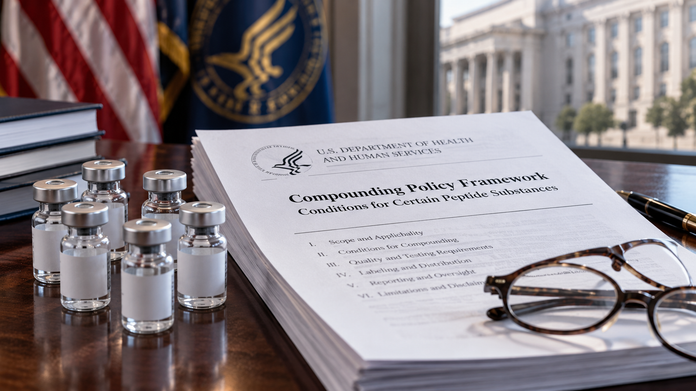
Washington has changed the legal weather around six closely watched peptides without making any of them an approved medicine. On October 28, 2026, the Department of Health and Human Services published an interim enforcement-discretion policy addressing BPC-157, epitalon, KPV, MOTS-c, Semax and TB-500. Its Federal Register notice was published on October 30. The change is consequential, but the opening is narrow: certain licensed compounders may fall within the policy when its conditions are met. Ordinary research-peptide retailers are not given a general authorization to sell medicines.
This Is Enforcement Discretion, Not FDA Approval
The distinction begins with what the government has actually announced. HHS says it does not intend to take enforcement action against a state-licensed pharmacy, federal facility or licensed physician compounding a product from one of the specified bulk drug substances when the policy’s conditions are satisfied. The position is interim, not a final rule adding all six substances to the permanent 503A Bulks List.
Compounded medicines can address patient-specific needs, but they are not FDA-approved. The agency does not review each compounded product for safety, effectiveness and quality before marketing in the way it reviews an approved drug application. This policy does not establish that any of the six peptides treats a particular disease, and HHS says it may reconsider the arrangement if safety signals or product-quality problems arise.
A decision not to take enforcement action is not an FDA approval letter.
Six Peptides Do Not Mean Six Blank Checks
Appendix A names BPC-157, epitalon, KPV, MOTS-c, Semax and TB-500. Appendix B then narrows the permitted identities and dosage forms. For example, the document addresses Semax free base for intranasal use and KPV acetate for topical or oral forms. It describes BPC-157 acetate for subcutaneous, intramuscular, oral and topical forms; epitalon acetate for intermittent subcutaneous or intramuscular courses; and MOTS-c acetate and TB-500 acetate for subcutaneous or intramuscular injections.
Those distinctions are scientifically and legally relevant. The molecules differ in sequence, pharmacology, available evidence and proposed uses. Appearance on the same interim list does not make their benefits equivalent or authorize every formulation sold under a familiar name. Even an apparently small difference in salt form or route can place a product outside the identity and route limitations described by HHS.
Ten Conditions Make the Compounding Door Narrow
The policy’s ten conditions are more than a ceremonial checklist. The bulk drug substance must appear in Appendix A and match the identity and route restrictions in Appendix B. It must be properly characterized, with a valid certificate of analysis showing relevant identity, purity, potency and contaminant testing. The original bulk manufacturer must be FDA-registered, meet the specified manufacturing expectations and have its physical location documented on the certificate. Where repackers or resellers intervene, the policy also addresses manufacturer and certificate validation.
Compounders must provide specified product, serious-adverse-event and quality-problem reporting; include the required labeling statement; and use only one listed active pharmaceutical ingredient in a compounded product. Oral preparations require retained documentation showing adequate human bioavailability for the specific formulation. The policy limits co-packaged drug-delivery devices to FDA 510(k)-cleared syringes and requires compliance with other applicable provisions, including sanitary conditions and a valid patient-specific prescription.
That is not permission to improvise a multi-peptide cocktail or replace clinical oversight with an online checkout form. It is a conditional federal enforcement position tied to defined compounders, ingredients, records, formulations and patients.
The Most Important Evidence May Be the Paperwork
Peptide synthesis can produce closely related impurities, and the label on a vial cannot establish what its contents are. That makes original-manufacturer identification, lot-specific certificates and quality records central to the policy. An FDA-registered manufacturer is not the same thing as an FDA-approved product, and a certificate is only as useful as its authenticity, analytical quality and connection to the lot actually supplied.
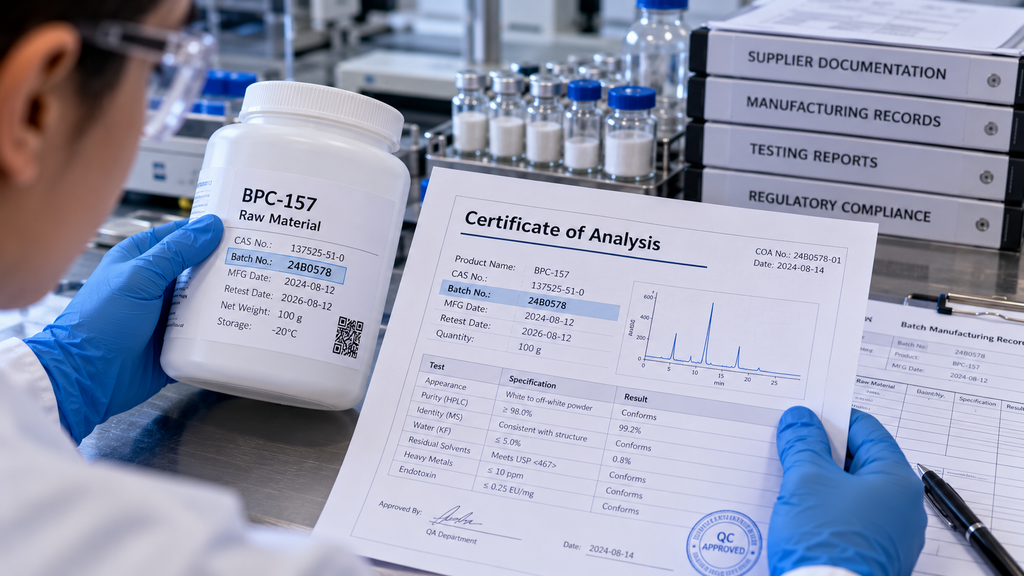
Reporting obligations are just as important. A system that records adverse events, manufacturing sources and quality failures may generate information that the loosely controlled online market does not reliably capture. Whether that actually leads to fewer harmful products or better surveillance is an empirical question, not something that can be assumed merely because the requirements appear on paper.
The Regulators Themselves Disagreed
HHS’s own supporting document records a consequential disagreement. Reviewers in the FDA’s Center for Drug Evaluation and Research recommended against listing the substances, while the Pharmacy Compounding Advisory Committee voted in favor. HHS chose a limited enforcement-discretion approach while the formal rulemaking process continues.
Supporters argue that the policy can redirect demand from poorly controlled research-use-only imports toward licensed compounders with better sourcing and accountability. Critics, including public-health advocates cited by Reuters, warn that human evidence remains limited and that contamination, impurities and unexpected adverse effects are not solved by expanding access. Neither argument is a substitute for actual measurements of product quality and patient outcomes.
The Policy Is Published. The Clinical Verdict Is Still Missing.
The Federal Register published the notice on October 30, 2026, under docket HHS-OASH-2026-0496. Public comments are invited for two weeks after publication, and future rulemaking may address some or all of the substances. Meanwhile, state laws and professional requirements remain relevant. A website selling research vials does not become a licensed pharmacy because its product shares a name with a substance on Appendix A.
The larger question is whether this narrowly controlled opening will improve traceability and safety without increasing use faster than meaningful clinical evidence can be collected. HHS can revisit the policy if safety or quality issues arise. That possibility is not a footnote; it is part of the experiment.
Six peptides. Ten conditions. A real federal policy change. But none of those facts amounts to FDA drug approval, and none supplies a clinical verdict. Washington has opened a door, not declared the science settled.


