FDA’s border-control system for GLP-1 ingredients received a significant update in October, adding Eli Lilly’s obesity-drug ingredient orforglipron to a regulatory framework originally developed amid concerns about foreign-sourced injectable weight-loss medicines.
At the same time, 20 state attorneys general are challenging a central safeguard within that system: a Green List of foreign manufacturers whose specified products can avoid the import alert’s recommendation for detention without physical examination.
Their complaint is not entirely hypothetical. Earlier this year, FDA documented a Chinese supplier repackaging and relabeling semaglutide obtained from other manufacturers, including one not on the Green List, before distributing it in the United States.
But the enforcement timeline complicates the story. FDA had already removed that company from the Green List months before the attorneys general wrote their letter.
The real question is therefore not whether the system caught one problematic supplier. It did. The question is how reliably it can establish the origin and quality of the ingredients moving through that system before they enter the market.
What Import Alert 66-80 Actually Does
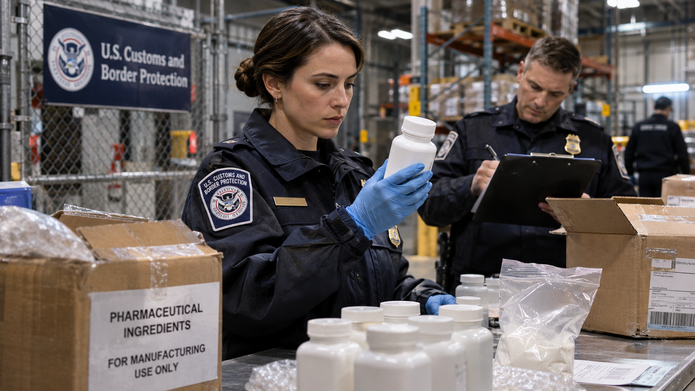
Import Alert 66-80 gives FDA field personnel a mechanism to detain certain imported GLP-1 active pharmaceutical ingredients without physically examining each shipment.
The process is known as detention without physical examination, or DWPE. Instead of first conducting a product-specific inspection, FDA can detain shipments covered by an import alert because the available evidence indicates a potential legal violation.
Importers may submit evidence seeking release, but the alert shifts the practical burden toward demonstrating that the shipment complies with applicable requirements.
The system includes an exception: the Green List.
The list identifies specific foreign manufacturers and associated products that FDA has evaluated and found eligible for exclusion from the import alert’s detention recommendation. It does not give a manufacturer blanket approval for every product or shipment.
FDA established the Green List on September 5, 2025. Import Alert 66-80 followed on September 19, according to legal analysis published by Frier Levitt.
The measures followed an increase in foreign-sourced GLP-1 ingredients used in drug compounding during shortages of approved obesity and diabetes medicines.
FDA’s own regulatory review gives some indication of the concern.
The agency evaluated 48 GLP-1 API manufacturing sites through inspections or remote reviews and reported that 21% showed noncompliance or failed to respond adequately and promptly to requests for records.
Those findings help explain why imported GLP-1 ingredients became a specific enforcement priority. Bulk ingredients intended for pharmaceutical manufacturing can pose serious risks when their identity, purity, production controls or microbial quality cannot be established.
But a Green List designation is not the same as continuous verification of every shipment’s chain of custody. That distinction sits at the center of the current dispute.
What FDA Changed on October 9
FDA’s October 9, 2026, revision to Import Alert 66-80 added orforglipron active pharmaceutical ingredient for three manufacturers already on the Green List.
It also added an orforglipron spray-dried dispersion, a drug-product intermediate, for one manufacturer and introduced a new FDA product code for orforglipron: 61P[][]77.
The revision also updated guidance on the information manufacturers should submit when seeking addition to the Green List and added other product-code categories.
FDA linked the revision to a March 19 memorandum from its Center for Drug Evaluation and Research. The public revision does not attribute these changes to the state attorneys general’s September complaint.
Orforglipron is the active ingredient in Foundayo, Eli Lilly’s once-daily oral GLP-1 receptor agonist.
FDA approved Foundayo in the United States on April 1, 2026. Lilly subsequently made it available through retail, telehealth and direct-to-patient channels, with qualifying self-pay prices starting at $149 per month for its lowest dose.
Adding orforglipron to the import alert does not mean finished Foundayo tablets have been newly restricted. The change concerns specified imported active ingredients, an intermediate and the associated import-control framework.
It also does not establish that every Green List manufacturer producing orforglipron supplies Lilly or is approved to manufacture finished Foundayo.
What it does show is that FDA’s GLP-1 import oversight now explicitly includes the ingredient used in an approved non-peptide obesity pill.
Why Orforglipron Is Different
Semaglutide and tirzepatide are peptide-based medicines. Their manufacturing requires control over complex molecular synthesis, impurities and purification.
Orforglipron is different.
It is a small-molecule, non-peptide GLP-1 receptor agonist. It targets the same receptor system involved in appetite and glucose regulation, but its chemical structure and manufacturing processes differ from those of peptide medicines.
That difference may influence production methods, manufacturing scale and supply-chain economics. It does not automatically mean the compound is simple or inexpensive to manufacture at pharmaceutical quality.
As demand for oral obesity treatments expands, active-ingredient sourcing becomes a natural area of regulatory attention.
There is also a distinction between being eligible for import under one particular alert and being legally usable in a compounded medicine.
FDA’s compounding framework imposes separate requirements on ingredient sourcing, manufacturing practices and whether a compounded product is essentially a copy of a commercially available or approved medicine.
Under section 503A of the Federal Food, Drug, and Cosmetic Act, qualifying compounders face restrictions on regularly making what are essentially copies of commercially available drugs. Different statutory conditions apply to outsourcing facilities under section 503B.
A Green List entry does not override those restrictions, and it is not a license to manufacture or sell an unapproved version of Foundayo.
The October expansion is therefore significant as an import-control change, not as evidence that a new orforglipron compounding market has been legally authorized.
Why Twenty States Challenged the Green List
On September 17, Alabama Attorney General Steve Marshall and attorneys general from 19 other states sent a letter to Secretary of State Marco Rubio raising concerns about foreign-sourced pharmaceutical ingredients, particularly from China.
The letter argued that the Green List could be exploited if a listed supplier imports or repackages material originally manufactured elsewhere without accurately identifying its source.
The concern goes beyond whether a company has its name on an approved list. It involves the underlying records that connect a shipment to the facility that actually manufactured the active ingredient.
The attorneys general framed the issue as a national-security concern as well as a pharmaceutical regulatory matter.
They also cited reporting about Chinese chemical businesses previously associated with fentanyl precursor supply chains entering markets for cosmetic and weight-loss peptides.
That reporting raises potential questions about overlapping commercial networks, but it does not establish that a named GLP-1 importer supplied fentanyl precursors or that a particular GLP-1 shipment was connected to fentanyl production.
The state officials asked for stronger information sharing, more visibility into foreign ingredient suppliers and better methods for identifying suspicious supply-chain activity.
They were not presenting a completed new federal investigation. They were urging federal officials to examine whether existing controls adequately address the risks they identified.
The letter’s most consequential example, however, was already documented by FDA itself.
What FDA Actually Found at Harbin Jixianglong
Harbin Jixianglong Biotech Co., Ltd., a Chinese pharmaceutical ingredient supplier, was added to FDA’s Green List on September 5, 2025.
FDA subsequently inspected the company’s facility from November 3 through November 7, 2025.
In a warning letter dated May 1, 2026, FDA documented serious current good manufacturing practice violations and misbranding involving semaglutide active pharmaceutical ingredients.
According to FDA, Harbin purchased semaglutide from external manufacturers, then repackaged and relabeled the material without adequate documentation or quality-unit oversight.
The company identified itself as the manufacturer on labels even though the active ingredient had been manufactured elsewhere.
FDA also documented changes to manufacturing and retest dates that lacked appropriate supporting data.
The warning letter describes two relabeled semaglutide batches distributed to the United States. The first was shipped on August 23, 2025, before Harbin’s Green List placement. The second was shipped on October 3, 2025, after the designation began.
FDA explicitly identified one source facility as not being on the Green List. The agency expressed concern that listing Harbin rather than the original manufacturer could have circumvented import safeguards.
The distinction matters. The inaccurate relabeling and associated manufacturing deficiencies are documented FDA findings. Whether the company deliberately intended to evade the import system is a separate question, and FDA’s letter describes that as a concern rather than a criminal adjudication.
The problems extended beyond labeling.
FDA described deficiencies involving manufacturing-process validation, analytical testing, cleaning procedures, microbial controls and the suitability of water used in production processes.
These are not merely administrative issues. Inadequate manufacturing controls can create uncertainty about impurity levels, contamination, product identity and the reliability of specifications for ingredients intended for pharmaceutical use.
But the warning letter also documents FDA’s enforcement response.
On February 10, 2026, FDA discussed removal of the two relabeled semaglutide batches from the US market. Harbin agreed to a voluntary recall and initiated it on February 19.
On February 27, FDA removed Harbin from Import Alert 66-80’s Green List and placed it on Import Alert 66-40, which addresses drugs from firms that have failed to meet applicable manufacturing requirements.
Those enforcement steps occurred months before the attorneys general sent their September letter.
The Harbin case therefore establishes two things at once: a supplier had used inaccurate labeling that undermined the intended source-verification safeguards, and FDA subsequently identified the deficiencies and acted against the firm.
That is a stronger and more precise account than suggesting the entire Green List system was simply left open after the violations became known.
What the States Want, and What Happens Next
The attorneys general want the federal government to treat foreign pharmaceutical ingredient traceability as a matter involving national security, public health and state consumer protection.
Their September letter asks for more information about foreign GLP-1 and peptide supply chains, potential links to illicit chemical businesses and warning signs that state investigators should monitor.
It also calls for stronger communication between federal agencies and state attorneys general before problems reach consumers.
No specific public federal response to the September 17 letter was identified in the sources reviewed for this article. That does not establish that no response or communication occurred.
FDA’s October 9 import-alert revision updated the approved Green List product categories, including the new orforglipron listings, but did not publicly identify itself as a response to the state officials.
The continuing question is whether the system can reliably distinguish actual manufacturing sources from firms that package, distribute or relabel ingredients produced somewhere else.
For pharmacies and other regulated purchasers, that distinction is central to supplier qualification. A certificate of analysis or Green List entry is not a substitute for accurate manufacturing records, appropriate testing and a traceable chain of custody.
For patients, the problem is less visible but potentially more consequential.
Most patients never see the manufacturing records behind an active pharmaceutical ingredient. They depend on pharmaceutical companies, compounders, regulators and the supply chain to ensure that the ingredient is what the documentation claims it is.
The Green List can help narrow the universe of suppliers requiring heightened import scrutiny. But it cannot replace accurate information about where the material was made and how it moved through the supply chain.
A Green List entry is evidence of an FDA evaluation. It is not proof that every future shipment has an unbroken, verified supply chain.
The Harbin case demonstrates why that distinction matters. FDA documented a real traceability failure, ordered no blanket industry ban, and used its existing enforcement tools to remove the offending firm from the list.
The states are asking whether those tools can identify similar problems early enough and whether information about foreign suppliers is being shared effectively across government.
The fight over GLP-1 compounding is no longer confined to the pharmacy counter. It also concerns the origins of the ingredients arriving at American ports.
The October revision expanded the import-control system. The Harbin warning showed why the system’s credibility ultimately depends on verifying the manufacturer behind the label.
Disclosure: Grey Pepper’s owner also has business interests in the research-peptide market.
Primary regulatory source: FDA — Import Alert 66-80: Detention Without Physical Examination of GLP-1 Receptor Agonist Bulk Drug Substances. Revised October 9, 2026.
FDA enforcement record: FDA — Warning Letter to Harbin Jixianglong Biotech Co., Ltd., MARCS-CMS 723330. May 1, 2026.
Additional import enforcement: FDA — Import Alert 66-40, Including Harbin Jixianglong’s February 27, 2026 Listing.
State attorneys general letter: Twenty State Attorneys General — Letter to Secretary Marco Rubio. September 17, 2026.
State enforcement perspective: Tennessee Attorney General — Twenty-State Coalition Warning on Pharmaceutical Supply Chains. September 23, 2026.
Legal background: Frier Levitt — FDA Issues Import Alert on GLP-1s Following Green List Launch. October 1, 2025.
Compounding requirements: FDA — Policies for Compounders as GLP-1 Supply Stabilizes. April 1, 2026.
Orforglipron approval: Eli Lilly — FDA Approves Foundayo (Orforglipron). April 1, 2026.