
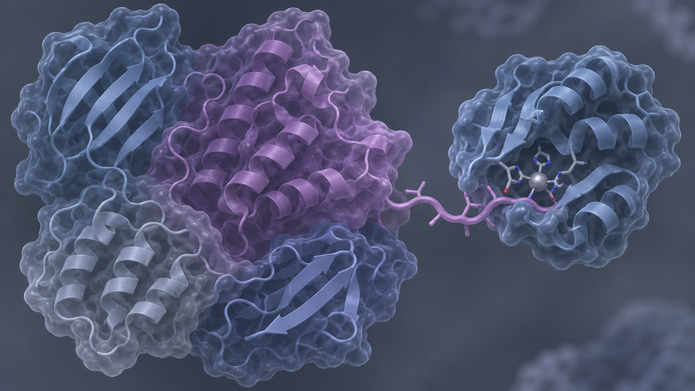
Some of the most important interactions in biology do not happen inside neat, deep pockets. They occur where two proteins touch across broad surfaces, exchanging signals that control growth, inflammation or cell death. For years, many of those interfaces were described as difficult or even undruggable. James Wells helped challenge that assumption by showing that large contact areas can depend on surprisingly small regions of energetic importance.
The discovery changed how researchers could investigate difficult protein targets. Instead of treating an entire molecular surface as equally important, scientists could identify specific residues responsible for much of the binding energy and use that information to guide experiments.
Wells’s career would also help produce a separate but related development: Tethering, a fragment-discovery approach that uses reversible chemical bonds to capture weak interactions near selected protein sites. Together, these advances helped transform how researchers approach proteins that initially appear difficult to influence with drugs.
From Protein Engineering at Genentech to a New View of Molecular Binding
According to his University of California, San Francisco faculty biography, James A. Wells studied biochemistry at the University of California, Berkeley, earned his doctorate in biochemistry at Washington State University and completed postdoctoral research at Stanford University School of Medicine.
In 1982, he joined Genentech as a founding member of its Protein Engineering Department. He remained there for 16 years, working during a period when biotechnology researchers were learning not merely to isolate biological molecules but to redesign proteins and test how their functions changed.
His research helped establish methods for modifying enzymes, hormones and antibodies. These efforts used techniques such as site-directed mutagenesis, which allows scientists to change particular amino acids in a protein, and phage display, which can help identify molecular variants with desired binding properties.
One of the central scientific questions concerned how proteins recognize each other. Molecular structures could reveal where two proteins made physical contact, but identifying every contact did not explain which interactions were most important for binding.
That distinction mattered because protein interfaces can involve dozens of amino-acid side chains. A large contact surface may appear to require a drug or engineered molecule capable of covering a substantial region. But the contributions of individual residues are not necessarily equal.
Wells and colleagues investigated whether relatively small regions within these interfaces could account for much of their binding energy. Their findings provided an influential experimental basis for understanding what researchers now commonly call protein interaction hot spots.
The 1995 Experiment That Revealed Protein Binding Hot Spots
On January 20, 1995, Tim Clackson and James A. Wells published a paper in Science titled A hot spot of binding energy in a hormone-receptor interface. Their investigation focused on the interaction between human growth hormone and the extracellular portion of its receptor.
Earlier structural work had shown that approximately 30 amino-acid side chains from each interacting protein participated in the contact interface. The structure established where the molecules touched, but the researchers wanted to determine which residues contributed most strongly to binding.
To answer that question, they systematically replaced individual contact residues with alanine, an amino acid with a comparatively small side chain. This approach, known as alanine-scanning mutagenesis, allows researchers to investigate how removing particular side-chain interactions changes a protein’s binding affinity.
The result was striking. A central hydrophobic region of the receptor interface, dominated by two tryptophan residues, accounted for more than three-quarters of the binding free energy measured in the system.
Many surrounding contact residues contributed much less. The interface was large in structural terms, but its functional importance was concentrated in a smaller region.
This helped establish a distinction between a structural epitope, the region where molecules physically interact, and a functional epitope, the residues that make especially important contributions to the strength of that interaction.
The scientific implication was subtle but powerful. A protein interaction could involve two broad molecular surfaces while depending disproportionately on a handful of amino-acid positions. Those positions offered experimentally identifiable targets for further investigation.
That did not mean every protein interaction depended on exactly two residues or that every hot spot could be reached by a conventional small-molecule drug. It meant researchers had a practical way to measure where binding energy was concentrated instead of assuming the entire interface was equally important.
Understanding those regions helped create opportunities for protein engineering, peptide selection and later molecular discovery strategies. A difficult interaction was no longer simply a large, featureless surface. It could be investigated through a series of specific, testable molecular questions.
At Sunesis, Wells Helped Develop Tethering to Capture Weak-Binding Fragments
In 1998, Wells cofounded Sunesis Pharmaceuticals, where he served as president and chief scientific officer. The company became an important setting for another research strategy that approached drug discovery from a different direction.
Traditional molecular screening often aims to identify compounds that already bind strongly enough to a target to produce a measurable signal. But some useful chemical starting points interact only weakly with proteins. Such fragments may be missed by conventional screening methods even when their structures offer opportunities for optimization.
Wells and colleagues developed an approach called Tethering, also known as disulfide trapping. The technique uses reversible chemical interactions to help identify molecular fragments with weak affinity for selected protein sites.
The foundational publication appeared on August 15, 2000, in Proceedings of the National Academy of Sciences. Titled Site-directed ligand discovery, the study was authored by Daniel Erlanson, Andrew Braisted, Daniel Raphael, Mark Randal, Robert Stroud, Eric Gordon and James Wells.
In the method described by the researchers, a target protein contains a cysteine residue, either naturally present or introduced through protein engineering. Cysteine can participate in reversible disulfide-bond formation with specially designed small molecular fragments.
Under carefully controlled chemical conditions, fragments in a synthetic library can exchange disulfide bonds with the target protein. Most fragments possess little affinity for the nearby protein surface and are not preferentially retained.
Fragments that have even weak noncovalent affinity for the surrounding binding region can be stabilized in the tethered state. Researchers can then identify these captured fragments, including through mass spectrometry, and use structural studies to investigate how they interact with the protein.
The reversible bond provides a way to discover interactions that might otherwise be too weak to detect. It does not automatically transform a weak fragment into a useful medicine. The chemical starting point must still be improved through further experimental work.
A Weak Fragment Became a Starting Point for More Potent Chemistry
The 2000 Tethering paper provided an experimental demonstration of the method. The researchers examined thymidylate synthase, an enzyme essential for producing components required in DNA synthesis and an established target of interest in anticancer and anti-infective drug research.
Using a library of approximately 1,200 disulfide-containing fragments, the team identified molecules capable of interacting with a selected region of the enzyme.
Those fragments were not finished drugs. Their significance lay in providing chemically accessible starting points that could be investigated through additional structural and medicinal chemistry experiments.
One untethered ligand initially had an inhibition constant of approximately one millimolar, indicating relatively weak inhibitory potency. By synthesizing and evaluating related molecules with guidance from crystallographic structures, the investigators improved potency approximately 3,000-fold.
The result demonstrated a central advantage of fragment-based discovery. A weak initial interaction can provide valuable information when researchers understand where a molecule binds and how its chemical structure might be improved.
The discovery process therefore becomes an iterative investigation. Scientists identify a fragment, examine its interactions, modify its chemical features and test whether those changes improve the desired properties.
However, stronger binding alone is not enough to establish a successful therapeutic candidate. A compound must also demonstrate appropriate selectivity, biological activity, stability and other properties necessary for its intended use.
Hot-spot mapping and Tethering are related through a broader scientific principle, but they are not the same technique. One measures the functional importance of residues within protein interactions. The other uses reversible chemical capture to identify fragment ligands near selected sites.
Together, these approaches changed how researchers could investigate difficult molecular surfaces. Instead of requiring an immediately potent compound against an obvious binding pocket, scientists could begin with a specific site and a weak but informative chemical interaction.
The Broader Legacy: Making Difficult Proteins More Experimentally Accessible
In 2005, Wells joined the University of California, San Francisco, where he became the Harry W. and Diana Hind Distinguished Professor in Pharmaceutical Sciences. He also helped establish the Small Molecule Discovery Center, expanding the university’s capacity to investigate potential drug targets using modern screening approaches.
His subsequent research extended beyond the original protein-binding experiments. The Wells Lab studied allosteric regulation, the process through which changes at one part of a protein can influence activity at another, sometimes distant, region.
This matters because an intervention does not always need to occupy a protein’s main active site. In some cases, binding at a regulatory site can alter protein behavior indirectly. Understanding those connections can reveal experimental opportunities that would be missed by focusing only on conventional active-site inhibitors.
The laboratory also investigated caspases, a family of enzymes involved in programmed cell death, and developed technologies for identifying protein cleavage events. By mapping which proteins are processed during cellular signaling, researchers can gain a more complete understanding of how biological pathways operate.
More recent laboratory work has included investigations of cell-surface proteins and how their composition changes during disease, cellular differentiation and responses to drugs. These research programs reflect an enduring interest in understanding biological communication through molecular interactions.
That breadth should not be confused with a claim that every target or platform generated an approved treatment. Discovery technologies create opportunities, but each potential therapy must still establish appropriate biological performance, safety and clinical value.
The same principle applies to the language of undruggable proteins. Many protein interfaces were once viewed as exceptionally difficult targets because their surfaces lacked the deep binding pockets commonly associated with traditional small-molecule drugs.
Wells and his collaborators helped show why that description was incomplete. Even an extensive molecular interface may depend on smaller regions of energetic importance. Those regions can be mapped, experimentally manipulated and investigated through chemical or protein-engineering techniques.
The work did not eliminate problems of compound selectivity, cellular delivery, stability or clinical development. It made some of those problems more approachable by providing better ways to identify and test promising molecular interactions.
Wells’s career is a reminder that peptide and protein medicine depends on more than discovering another naturally occurring hormone. It also depends on learning how molecular surfaces interact, how weak binding can be detected and how chemistry can be directed toward specific biological questions.
His contribution is not limited to one blockbuster product. It includes a way of seeing difficult proteins as systems that can be mapped, measured and sometimes made vulnerable to intervention. The larger lesson is that an apparently inaccessible target can become a tractable scientific problem when researchers learn where its most important interactions occur.
Original hot-spot research: Clackson T. and Wells J.A. A hot spot of binding energy in a hormone-receptor interface. Science, January 20, 1995.
Original Tethering research: Erlanson D.A., Braisted A.C., Raphael D.R., Randal M., Stroud R.M., Gordon E.M. and Wells J.A. Site-directed ligand discovery. Proceedings of the National Academy of Sciences, August 15, 2000.
Institutional biography: James Wells, University of California, San Francisco Department of Cellular and Molecular Pharmacology.
Research background: Wells Lab — Site-Directed Drug Discovery for Challenging Targets.


