
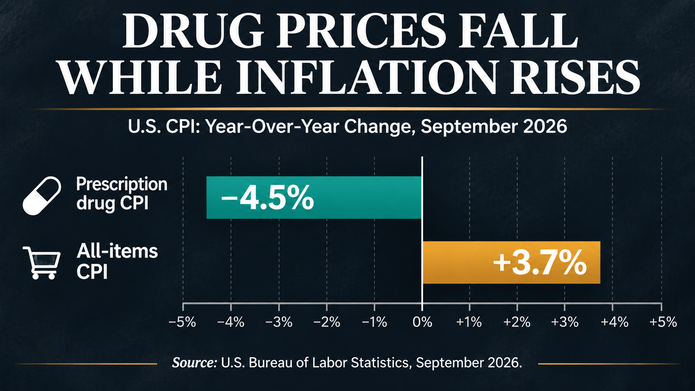
On November 3, the White House reposted an opinion essay under a headline claiming that prescription drug prices are falling at the fastest rate in more than 60 years. The underlying statistic is real: the consumer price index for prescription drugs has declined sharply in 2026. What the repost leaves out is what that index measures, what it cannot see, and how much of the decline can be traced to Medicare drug price negotiation, a policy passed in 2022, rather than the administration’s newer pricing agreements and TrumpRx cash-pay portal.
For anyone trying to understand GLP-1 economics, the distinction is not academic. The pharmaceutical market has several different kinds of prices, and the one appearing in an inflation index is not necessarily the one patients pay, insurers negotiate or manufacturers ultimately receive.
What the White House Claim Actually Says
The source is a November 2 essay in City Journal by Joel Zinberg, who directs a public health initiative at the Paragon Health Institute and previously served as a special assistant to the president on the National Economic Council.
Zinberg argues that prescription drug prices have declined throughout 2026 and attributes much of the improvement to the Trump administration’s policies. The White House promoted that argument on November 3, presenting the decline as evidence that its approach to drug pricing is delivering results.
The latest relevant Bureau of Labor Statistics figures are from September 2026, released on October 14. They show that the prescription-drug CPI declined 4.5 percent from a year earlier while the overall consumer price index increased 3.7 percent.
The prescription-drug index also fell 1.2 percent in September on a seasonally adjusted monthly basis. These are different measures: the larger 4.5 percent figure compares September 2026 with September 2025, while the monthly decline compares the index with August.
The trend had already attracted attention during the summer. In August, The Fiscal Times reported that July prescription-drug prices had declined 3.1 percent year over year, the steepest annual fall since March 1963. Its coverage pointed to several potential explanations, including Medicare negotiation, generic competition and lower prices for certain popular medicines.
The September result reinforced that unusual decline. The issue is not whether the index fell. It did. The dispute concerns why it fell and how much of the change can reasonably be credited to individual government policies.
The statistic is real. The political interpretation built around it is a claim about causation, and that part requires more evidence.
What the Prescription Drug CPI Measures, and What It Misses
The prescription-drug CPI is not a measure of the final net prices pharmaceutical manufacturers receive. It is also not a direct measure of patients’ out-of-pocket spending.
According to a Bureau of Labor Statistics methodology overview, the index tracks transaction prices received by retail pharmacies. When a prescription is covered by insurance, the price recorded for the transaction includes both the patient’s payment and the portion reimbursed by the insurer.
Eligible transactions include cash purchases, commercially insured purchases and Medicare Part D purchases. Medicaid transactions are excluded from the prescription-drug CPI methodology described by the agency.
That design has consequences. If reimbursement to a pharmacy decreases while a particular patient’s copayment stays unchanged, the index may still fall. Conversely, changes in deductibles, coinsurance or insurance coverage can alter what an individual patient pays without producing an equivalent change in the broader prescription-drug index.
Manufacturer rebates are another important distinction. Drugmakers may provide rebates and other price concessions to pharmacy benefit managers, insurers and government programs through arrangements that occur outside the individual pharmacy transaction.
Those financial adjustments help explain why list prices, pharmacy transaction prices and manufacturer net revenue can differ substantially. The consumer price index does not directly measure the full stream of manufacturer rebates or the resulting net revenue received by drug companies.
The CPI also does not publish a separate prescription-drug inflation series for GLP-1 medicines. That makes it difficult to determine from the headline index alone how much of the decline reflects semaglutide, tirzepatide or other therapeutic categories.
The distinction is increasingly important as regulators examine the financial arrangements between drugmakers, insurers and pharmacy benefit managers. We discussed some of those issues in our report on pharmacy benefit manager fee disclosure.
A falling prescription-drug CPI is meaningful evidence that pharmacy-level transaction prices are declining across the measured basket. It is not proof that every patient is paying less, and it does not identify the contribution of any single pricing program.
Medicare Drug Price Negotiation Is the Quieter Explanation
The most concrete federal drug-pricing change to take effect in January 2026 was established four years earlier.
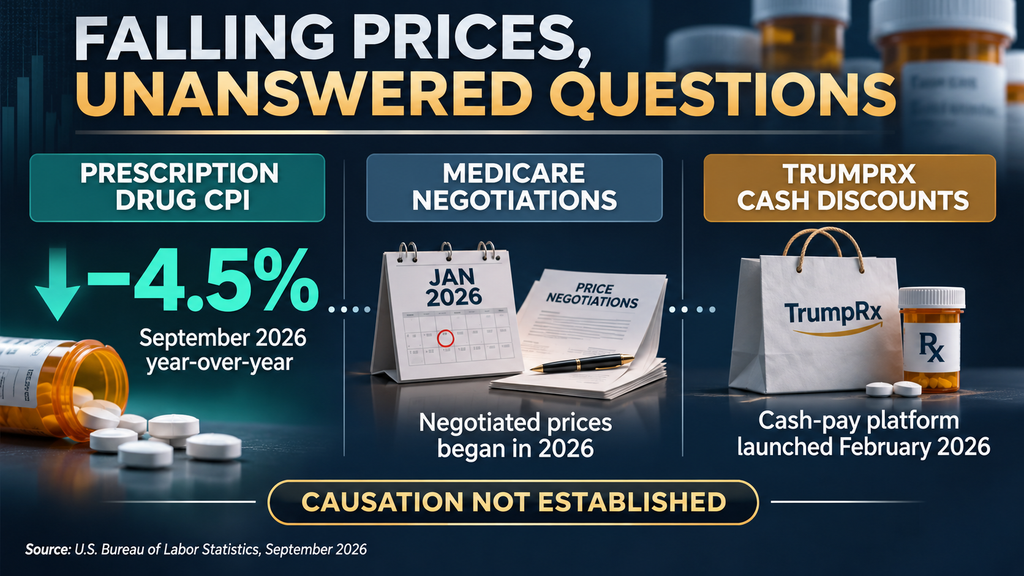
Under the Inflation Reduction Act of 2022, Medicare received authority to negotiate prices for selected high-spending prescription drugs. The first negotiated maximum fair prices, covering ten medicines under Medicare Part D, took effect on January 1, 2026.
Because the prescription-drug CPI includes eligible Medicare Part D pharmacy transactions, changes associated with the negotiation program could contribute to its movement. However, Medicare’s negotiated maximum fair price is not necessarily identical to the total reimbursement recorded for every pharmacy transaction in the CPI sample.
That distinction prevents a simple calculation of the program’s impact from the headline CPI data alone.
Richard Frank, a Brookings Institution senior fellow and Harvard professor emeritus, argued in coverage cited by The Fiscal Times that the Inflation Reduction Act was a likely major contributor to the decline. Other independent experts cautioned that identifying the causes is complicated.
Zinberg acknowledges that Medicare negotiation explains some of the decline but argues that it cannot fully explain continued price decreases in later months. He instead emphasizes TrumpRx discounts, pharmaceutical pricing agreements and generic competition.
Those factors deserve consideration. The administration officially launched TrumpRx on February 5, 2026, providing a way for cash-paying consumers to locate discounts on selected prescription medicines. The platform initially included approximately 40 medicines and subsequently expanded its catalog through additional manufacturer and pharmacy arrangements.
By November, Zinberg described the platform as offering discounts on more than 800 drugs. That should not be confused with the original launch inventory, nor does the number of listed medicines establish how many prescriptions have actually been purchased through its discount arrangements.
Generic competition is another plausible contributor. When competing generic products enter the market, prices can decline and prescribing patterns can shift. But generic approvals, by themselves, do not establish the timing or magnitude of their effect on the September 2026 prescription-drug CPI.
Medicare negotiation began affecting selected drug prices in January. TrumpRx launched in February. Manufacturer discounts and generic competition have continued to evolve. The timing of these changes matters, but timing alone is not a reliable estimate of their relative effects.
Where GLP-1 Drugs Fit Into the Price Debate
GLP-1 medicines provide one possible connection between the administration’s pricing policies and the broader prescription-drug market. Products containing semaglutide and tirzepatide account for substantial U.S. pharmaceutical spending, while pricing and insurance coverage for obesity treatment have become major affordability questions.
Zinberg argues that cash-pay discounts, especially for GLP-1 medicines, contributed substantially to the decline in prescription prices. The argument is plausible in principle: changes in the prices of widely purchased medicines can influence a consumer price index.
But the magnitude of that influence cannot be determined simply from total manufacturer sales or spending estimates. The prescription-drug CPI uses its own sampling and expenditure-weighting methodology. It does not directly translate national drug sales totals into a measurable contribution from each brand.
The market also contains different patient populations with different payment arrangements. Someone purchasing medication through a direct cash-pay channel may experience a substantial discount. A commercially insured patient with a fixed copayment may see little immediate change. Another patient may face high out-of-pocket costs because their insurance plan excludes obesity treatment.
Employer coverage remains a major limitation. KFF’s 2026 employer survey found that 18 percent of firms with at least 200 employees offering health benefits covered GLP-1 medicines primarily for weight loss in their largest health plan. Coverage varied by employer size and should not be confused with coverage for diabetes.
We examined those concerns in our report on employer GLP-1 coverage and 2027 costs.
Another major development is already scheduled for January 2027. Novo Nordisk announced on February 24, 2026, that it would reduce the U.S. list prices of selected Wegovy, Ozempic and related semaglutide products to $675 per month, corresponding to reductions of approximately 50 percent for Wegovy and 35 percent for Ozempic.
Novo reiterated the planned reductions in its November 4 financial reporting. The price cuts were therefore not a new November announcement. They had already been scheduled months earlier.
The changes also concern list prices, not a guaranteed reduction in every patient’s payment. Novo stated that the list-price action would not change its existing direct-to-patient self-pay prices. Actual savings will depend on insurance arrangements and purchasing channels.
Separately, Medicare’s negotiated prices for 15 additional selected medicines, including semaglutide products, are scheduled to take effect on January 1, 2027. These negotiated prices and Novo’s list-price reductions are different mechanisms, even though they begin on the same date.
For GLP-1 drugs, that distinction is essential. The list price is one figure. The pharmacy transaction price, manufacturer rebate, insurer liability and patient’s final payment can all differ. A change in one does not automatically produce the same percentage change in the others.
What Would Establish Who Deserves Credit for Falling Drug Prices?
Three types of evidence would move the argument from political messaging toward a more reliable economic explanation.
The first is a detailed analysis of the prescription-drug CPI by medicine and transaction category. That could help determine whether the largest contributions came from Medicare-negotiated products, GLP-1 medicines, generic competition or changes elsewhere in the pharmacy market.
The second is credible transaction-volume data for TrumpRx and related cash-pay programs, including how frequently customers actually use the discounts and whether those purchases replace transactions that would otherwise have occurred through insurance or other channels.
The third is more complete information about prices after rebates and other financial concessions. Such data would allow researchers to distinguish changes in retail pharmacy transactions from changes in the net revenue received by manufacturers.
None of these measures alone would resolve every question. Some transactions involve confidential contracting arrangements, and different policy initiatives may interact with one another. A credible causal analysis would need to account for changes in drug use, insurance coverage, generic availability and the composition of the index itself.
Until that evidence is available, the clearest conclusion is narrower than either side of the political argument may prefer. U.S. prescription-drug transaction prices, as captured by the CPI, are falling. Medicare negotiation, manufacturer discounts, generic competition and newer cash-pay channels may all contribute, but their individual shares of the decline have not been established.
The next important test begins in January 2027, when negotiated Medicare prices for additional drugs take effect alongside scheduled reductions in several major semaglutide list prices. If the prescription-drug CPI continues to decline, competing political explanations will likely return.
The information needed to evaluate those explanations should be demanded before the next round of claims, not after it.
Falling prices are worth celebrating. Misattributed prices are worth checking.
Primary economic data: U.S. Bureau of Labor Statistics, Consumer Price Index — September 2026, released October 14, 2026.
Government statement: The White House, Drug Prices Are Falling at the Fastest Rate in Over 60 Years Under President Trump, November 3, 2026.
Opinion essay: Joel Zinberg, Drug Prices Are Finally Falling. City Journal, November 2, 2026.
BLS methodology: The Pharmaceutical Industry: An Overview of CPI, PPI, and IPP Methodology.
Medicare policy documentation: Centers for Medicare & Medicaid Services — Selected Drugs and Negotiated Prices.
TrumpRx background: Congressional Research Service — TrumpRx: Background and Implementation, July 31, 2026.
Novo Nordisk pricing announcement: Novo Nordisk announces significant reduction in U.S. list prices for Wegovy, Ozempic and Rybelsus, February 24, 2026.


