
An injection is not the only imaginable way to deliver a peptide medicine. It is, however, one of the most reliable ways to bypass the biological barriers that make peptides difficult to administer.
Landmark Medicines, a UK pharmaceutical development company, says it is preparing to evaluate an intranasal drug-delivery platform using GLP-1 receptor agonists. Its announcement offers a useful window into a problem that has frustrated drug developers for decades: how to move a fragile, relatively large molecule into the body without a needle.
Landmark’s September 29, 2026 announcement described plans to advance the technology toward a human volunteer study. The company said candidate molecules, including semaglutide, were being evaluated ahead of final selection.
That distinction is crucial. The company did not report an approved nasal GLP-1 product, successful clinical efficacy results or human dosing under the proposed program.
The Nose Offers a Route That Peptides Struggle to Cross
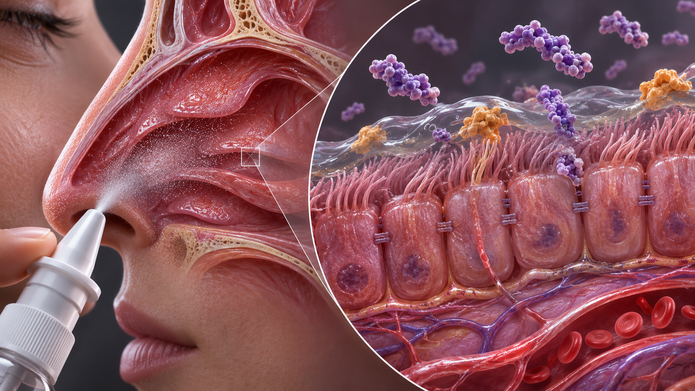
The nose has advantages as a drug-delivery route. Its mucosal surfaces are accessible, the underlying tissue is highly vascularized, and a successful formulation could be easier for some patients to use than an injection.
But nasal administration is not simply an injection performed in a different place.
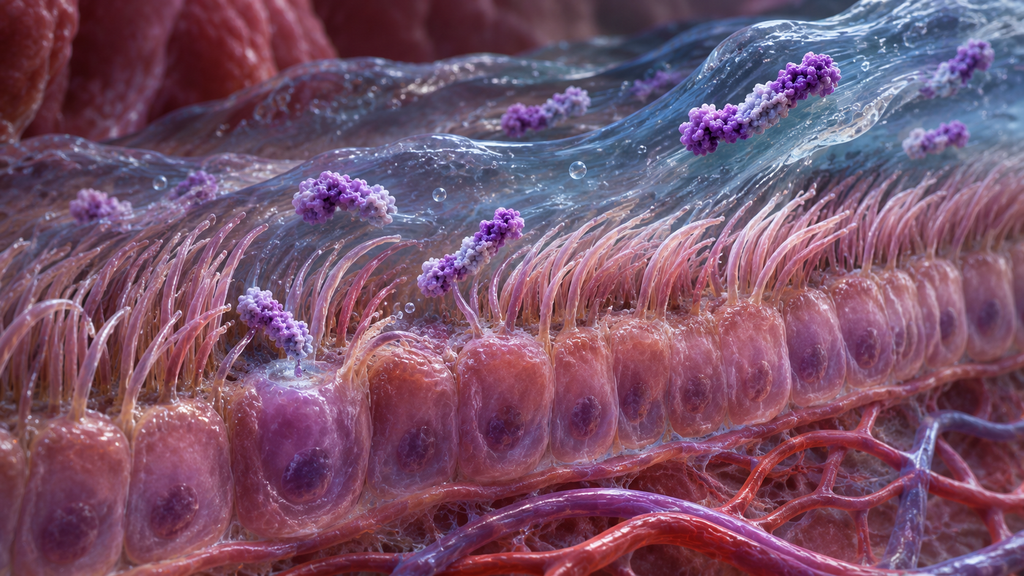
Peptides can be degraded by enzymes, trapped by mucus, cleared by the movement of tiny hair-like cilia or prevented from crossing the epithelial barrier in sufficient quantities.
The amount of liquid that can comfortably be administered is limited. Local irritation and variations in absorption may also complicate repeated use.
These limitations become particularly important when a medicine requires consistent systemic exposure. A nasal product that delivers only a small or unpredictable fraction of its dose may struggle to compete with a formulation that delivers the medicine more reliably.
Overcoming these obstacles requires more than showing that a peptide can be deposited inside the nose. Developers must establish how much intact, active drug survives and reaches its intended destination.
Landmark’s First Question Is Bioavailability, Not Weight Loss
Landmark says its proprietary platform is designed to improve transport across the nasal mucosa. The company describes it as formulation-agnostic, meaning it intends the delivery technology to accommodate different active pharmaceutical ingredients.
That is a development goal rather than proof that the platform works equally well with different peptide drugs.
The proposed human evaluation is intended to investigate pharmacokinetics, systemic bioavailability, dose requirements, safety and tolerability.
Pharmacokinetics describes how a drug enters, moves through and leaves the body. Bioavailability addresses how much of an administered dose reaches systemic circulation.
These are appropriate early questions. Before a sponsor can credibly compare a nasal formulation with an established injectable or oral GLP-1 therapy, it must demonstrate that a useful and reproducible amount of active medicine reaches the bloodstream.
The company’s announcement identifies semaglutide as one candidate under consideration, not as the definitively selected molecule for the proposed human study.
No confirmed clinical bioavailability or efficacy results for Landmark’s proposed GLP-1 program were supplied in the September announcement.
Getting a Peptide Into the Blood Is Not the Same as Getting It Into the Brain
Landmark also discussed a possible future nose-to-brain research pathway involving the olfactory and trigeminal routes.
Those anatomical connections have attracted scientific interest because they may offer ways for certain compounds to reach the central nervous system through pathways associated with the nasal cavity.
Preclinical research provides reasons to investigate whether some GLP-1-related molecules can use these pathways. But the possibility is easily oversold.
Demonstrating systemic exposure after nasal administration would not automatically demonstrate direct transport into the brain. A molecule detected in the circulation may reach central tissues through different routes, and evidence of exposure does not by itself establish a useful therapeutic effect.
Animal findings also cannot establish that the same formulation will perform reliably in people. Human nasal anatomy, delivery technique, drug formulation and dose can all influence the result.
Landmark’s own announcement treats potential nose-to-brain delivery as a separate research direction. Readers should not confuse that possibility with the first proposed evaluation of systemic absorption.
A Needle-Free GLP-1 Still Has to Compete With Established Treatments
The challenge is especially important in metabolic medicine, where drug exposure over time can influence efficacy and adverse events.
A formulation that produces inconsistent exposure, excessive peaks or poor absorption might be less attractive than a predictable injection, even if some patients initially prefer using a spray.
Convenience has to be demonstrated alongside acceptable efficacy and tolerability rather than assumed from the route of administration.
Needle-free peptide delivery is already a competitive field. Oral peptide formulations, longer-acting injections and other delivery technologies attempt to address different parts of the treatment burden.
A nasal GLP-1 platform would need to demonstrate more than the ability to move some peptide across a membrane. Developers must establish whether it produces sufficiently reliable exposure, can be manufactured consistently and offers a practical advantage over available treatment options.
Patient preference may eventually matter, but convenience alone cannot substitute for evidence about clinical performance.
The Real Milestone Is Human Exposure Data
The story is best understood as a development-stage bet, not a consumer product launch.
Landmark has articulated the questions it intends to investigate and identified GLP-1 receptor agonists as the initial application for its nasal platform.
The next meaningful milestones are confirmation of the selected candidate, a publicly documented human study and results demonstrating pharmacokinetics, bioavailability and acceptable safety.
Even favorable early exposure findings would not establish that a nasal GLP-1 product reduces body weight or improves glucose control as effectively as an approved treatment. Those clinical questions require further investigation.
The scientific opportunity is real: a non-injectable platform capable of delivering peptide medicines reliably could expand the options available to drug developers and patients.
But the nasal mucosa is not an open doorway. It is a biological defense system designed to restrict what enters the body.
Until human studies demonstrate that Landmark’s approach can overcome those defenses, a nasal GLP-1 remains a promising delivery hypothesis rather than a proven medicine.
Sources:
- Landmark Medicines — September 29, 2026 company announcement
- Overview of Intranasally Delivered Peptides: Key Considerations for Pharmaceutical Development
- Intranasal Delivery of GLP-1 to the Brain for Obesity Treatment: Opportunities and Challenges
- Nose-to-Brain Drug Delivery: From Bench to Bedside