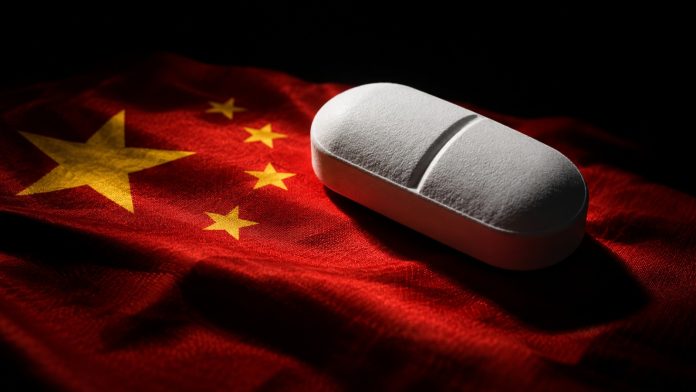
For most of the GLP-1 boom, the story has been told as a heavyweight fight between two Western pharmaceutical giants: Novo Nordisk and Eli Lilly. Denmark had semaglutide. Indianapolis had tirzepatide. Everyone else was trying to catch up. On September 29, Novo complicated that neat little story by agreeing to pay as much as $2.6 billion for rights to an experimental obesity drug discovered by Jiangsu Hengrui Pharmaceuticals in China.
China Is No Longer Just the Supply Chain
The candidate is HRS-1596, a once-weekly oral dual GLP-1/GIP receptor agonist that has been cleared for Phase 1 testing in China. Novo is paying $300 million upfront, with another $2.3 billion tied to development and commercial milestones, for rights outside mainland China, Hong Kong, Macao and Taiwan.
What Novo is buying is possibility — and access to a pipeline ecosystem the global pharmaceutical industry can no longer treat as secondary.
There is no Phase 3 data here. There is not even a global Phase 1 program yet. But Reuters reported that nearly 250 GLP-1 drug candidates are under development in China. The first wave of the obesity revolution was built around a handful of molecules that became household names. The next wave may emerge from a development environment so crowded that Western companies cannot realistically build every promising mechanism themselves.
Why Novo Is Moving Aggressively
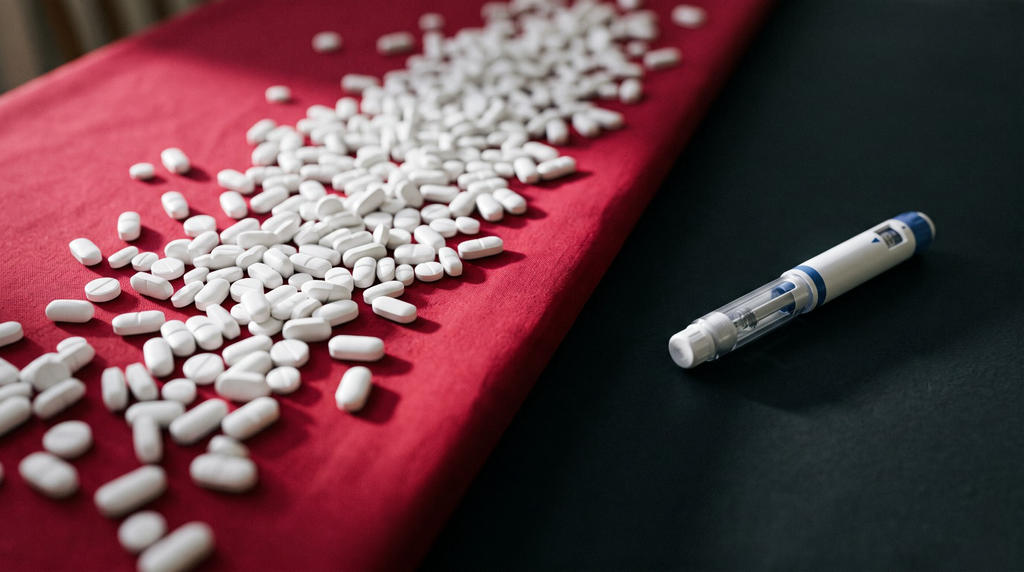
Novo has a strategic reason to move aggressively. Wegovy and Ozempic transformed the company, but success created a new problem: investors now expect Novo to remain near the front of a market where Lilly, Roche, Amgen, AstraZeneca, dozens of biotechs and a rapidly growing Chinese sector are attacking obesity from every angle.
Oral drugs matter because pills can expand access and convenience. Weekly oral drugs matter even more because they could erase one of the remaining advantages of injections — infrequent dosing — without requiring a needle.
A $2.6 Billion Deal Is Not Clinical Proof
None of that means HRS-1596 will work. Early-stage obesity programs die all the time, sometimes after enormous enthusiasm and enormous checks. The molecule still has to prove tolerability, pharmacokinetics, efficacy, manufacturability and eventually cardiovascular and metabolic value.
A $2.6 billion headline is not a clinical result.
Most of that money is contingent precisely because Novo knows this. But the deal is a useful marker of where the industry believes the next assets may come from.
The Innovation Map Has Changed
When one of the two companies that created the modern obesity market is willing to put $300 million down before a candidate has generated global human efficacy data, it is not simply shopping for another GLP-1. It is acknowledging that the innovation map has changed.
The obesity race used to look like Novo versus Lilly. Increasingly, it looks like everybody versus everybody — with some of the most interesting ammunition coming from places Western investors once treated as the supply chain rather than the laboratory.