
Obesity drug development loves new molecules because new molecules make clean headlines. A new receptor target sounds revolutionary. A new delivery technology sounds like plumbing.
Yet the plumbing may determine which medicines people are actually willing to use for years.
A $1.3 Billion Bet on Drug Delivery
Novo Nordisk’s licensing agreement with Swedish drug-delivery company Nanexa is worth up to €1.17 billion, roughly $1.3 billion, and centers on technology for long-acting injectable medicines in obesity, type 2 diabetes and other cardiometabolic conditions.
Investors clearly understood that extending the interval between injections is not a minor convenience feature.
The next obesity breakthrough might not be a new receptor. It might be a better clock.
How Long-Acting Formulations Change the Problem
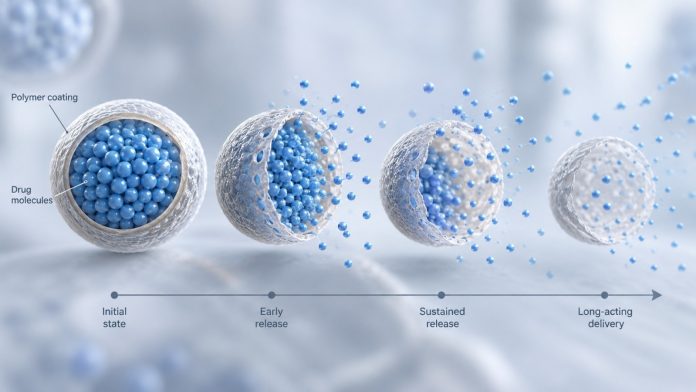
Long-acting formulations work by changing the pharmacokinetic problem. Instead of asking a molecule to remain active in circulation for an extremely long time on its own, a delivery system can create a depot that releases drug gradually.
In principle, that can flatten peaks and troughs, extend exposure and reduce how often a patient needs another dose. The exact performance depends on the drug, formulation, release kinetics and local tissue response, which is why a platform deal still has to prove itself product by product.
Why Fewer Injections Matter
Why spend this kind of money when weekly injections already work? Because chronic therapy magnifies inconvenience.
Fifty-two injections per year may feel manageable during rapid weight loss. The equation can change when treatment becomes maintenance measured in decades.
Monthly or less-frequent administration could improve persistence for some patients and could create a meaningful commercial distinction in a market where efficacy numbers are beginning to cluster.

The Science Is Not Only About Convenience
There is also a scientific reason to care about release profiles. Pharmacokinetics can influence tolerability.
A slower, steadier exposure could theoretically alter gastrointestinal side effects or make titration easier, although that must be demonstrated rather than assumed.
Convenience and reversibility can pull in opposite directions.
Long-acting formulations also create a downside: once a depot is administered, it cannot simply be taken back if a patient experiences an adverse effect.
The Industry Is Optimizing More Than Molecules
Novo’s deal therefore belongs in the same conversation as oral peptides and monthly maintenance dosing.
The industry is no longer optimizing only what a drug does. It is optimizing how the drug enters the body, how long it stays there and how much treatment friction the patient has to tolerate.
A Familiar Mechanism on a Better Schedule
The next obesity blockbuster may indeed have a new mechanism. But it may also be a familiar mechanism delivered on a schedule people barely have to think about.