
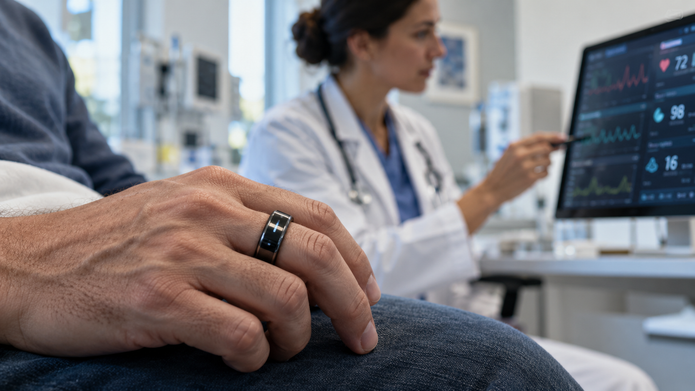
The next obesity-treatment experiment is not another injectable molecule. It is a test of whether clinicians can make better decisions when they can see what happens between appointments.
On October 28, 2026, Oura announced SMART-BMI, a collaboration with UC San Diego Health examining whether continuous wearable data can help improve care during GLP-1 treatment and bariatric surgery. The company makes a ring that measures sleep, heart-rate signals and activity. The research question is whether bringing those measurements into clinical decision-making changes meaningful outcomes rather than merely creating a more sophisticated dashboard.
The Question Is Whether Wearable Data Change Decisions
The problem is easy to understand. Obesity medicines are prescribed during scheduled visits, but treatment is experienced in daily life. Sleep changes. Exercise may become easier or harder. Appetite, fatigue and recovery can fluctuate before the next appointment. A ring can make some of those patterns visible.
But visibility is not the same thing as clinical value. A patient who starts sleeping better may also be losing weight, but that does not prove sleep caused the weight loss. Medication dose, nutrition, illness and life circumstances can affect both. The useful question is whether a care team can interpret the information and respond in ways that improve patient outcomes.
SMART-BMI Has Two Distinct Phases
According to the University of California’s trial listing, SMART-BMI follows two cohorts at UC San Diego Health: adults initiating incretin-based weight-loss medication and adults undergoing metabolic or bariatric surgery. Its registered design allows up to approximately 260 participants, with 52 weeks of follow-up. James J. Reeves, MD, is identified as the lead investigator.
In Phase 1, participants wear an Oura Ring while the existing care team can review biometric data during routine visits. This is a feasibility phase, intended to test whether data can be collected consistently and integrated into ordinary care, not a randomized test of effectiveness. Researchers will evaluate wear adherence, data completeness and how reliably the information reaches clinicians.
Phase 2 will proceed only if the initial review supports moving forward. In that planned randomized phase, participants receive health-coaching support in both groups. One group receives coaching and clinical management informed by wearable data; the comparison group receives coaching without access to those data. By providing coaching in both groups, investigators aim to test the contribution of the measurements themselves rather than the extra attention that often accompanies a new health technology.
The Hard Part Is Turning a Signal Into Care
The trial intends to examine weight and metabolic outcomes, including measures such as blood-sugar control. But some of its most important questions are operational. Will participants wear the ring consistently? Can the clinical team access useful information without becoming overwhelmed? Will data change decisions, or simply accumulate in an electronic chart?
That distinction matters because previous wearable studies have not consistently delivered better weight outcomes simply by supplying devices. Continuous data could make a difference if clinicians act on a pattern that would otherwise go unnoticed. It could also produce noise, false reassurance or a burden that busy clinics cannot sustain.
More biometric data is not, by itself, a better clinical outcome.
Access, Cost and Real-World Workflows Still Matter
Even a successful study at one academic medical center would leave difficult questions about generalizability. A highly engaged research participant may not resemble someone balancing shift work, family care, limited digital access or an overloaded community clinic. Wearable devices also cost money, and a system that requires consistent sensor use and staff attention needs to be affordable and reproducible.
The researchers will need to show not only whether outcomes change, but how. Did clinicians adjust follow-up, behavioral support or treatment discussions because of the data? Were those decisions timely and useful? And did any benefit justify the extra work required to collect, interpret and act on the information?
Oura Has a Commercial Interest. The Study Still Needs Evidence.
The announcement is also a business milestone for Oura. The company is funding SMART-BMI and positioning its ring as a research and care-support tool, beyond its familiar consumer-wellness role. It has already introduced features for people using GLP-1 medications, including dose and side-effect tracking.
That creates a legitimate reason to scrutinize how the study is conducted and reported. The registered protocol states that the sponsor supplies devices and guidance but does not control the analysis, interpretation or publication decision. A commercial relationship is important context; it is not a substitute for evaluating the design and eventual results.
Oura also says its ring is not a medical device intended to diagnose or treat disease. The trial is testing whether clinicians can make useful decisions with wellness-device information. It has not established that a ring independently improves obesity treatment.
The Launch Is Real. The Clinical Results Are Not Here Yet.
Oura publicly announced the study on October 28. The university’s trial listing, however, still described it as not yet accepting patients when checked for this article. The registered study start date and public launch should not be confused with confirmed recruitment or completed results.
The larger question reaches beyond one ring. Obesity care is moving toward combinations of medication, surgery, behavioral support and digital measurement. SMART-BMI asks whether another layer of information adds actual clinical value. The answer could be yes, no or yes for a particular subgroup. For now, the news is the announced collaboration and the registered research plan — not proof that a wearable makes weight-loss treatment work better.