
Most new metabolic-drug headlines describe another way to reduce appetite, delay gastric emptying or produce a larger percentage of weight loss. A clinical-stage peptide called PATAS is asking a different question: can changing how fat cells handle glucose improve insulin resistance?
On October 27, AdipoPharma announced that the first participants with type 2 diabetes had been dosed in the multiple-ascending-dose portion of its Phase 1 clinical program.
That is an important clinical transition, but not a published demonstration that the drug treats diabetes. The announcement marks the beginning of another test of a distinctive biological hypothesis, not proof that the hypothesis has succeeded in patients.
A Different Target in the Diabetes Drug Race
Most attention in metabolic medicine currently goes to drugs that activate receptors involved in appetite, glucose regulation and energy balance.
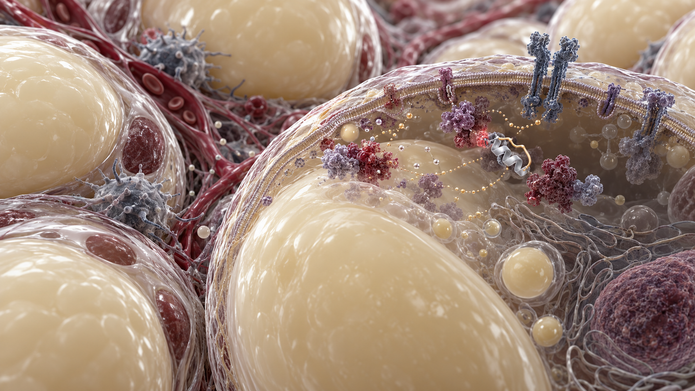
PATAS is designed around a different therapeutic strategy. It aims to influence glucose handling inside adipocytes, the specialized cells responsible for storing energy and participating in metabolic signaling.
The distinction is clinically meaningful. Insulin resistance is not simply the same phenomenon as excess appetite, even though both can occur in metabolic disease.
Fat cells store energy and release signals that influence the liver, skeletal muscle and systemic metabolism. When adipose tissue becomes dysfunctional, its contribution to glucose regulation can deteriorate.
A therapy that genuinely improves adipocyte glucose handling might eventually offer another approach to treating insulin resistance.
But biological plausibility in cells and animals is not equivalent to reproducible benefit in people. PATAS remains an investigational candidate, and the degree to which its mechanism will translate into meaningful clinical outcomes is unknown.
The ALMS1–PKCα Interaction Behind PATAS
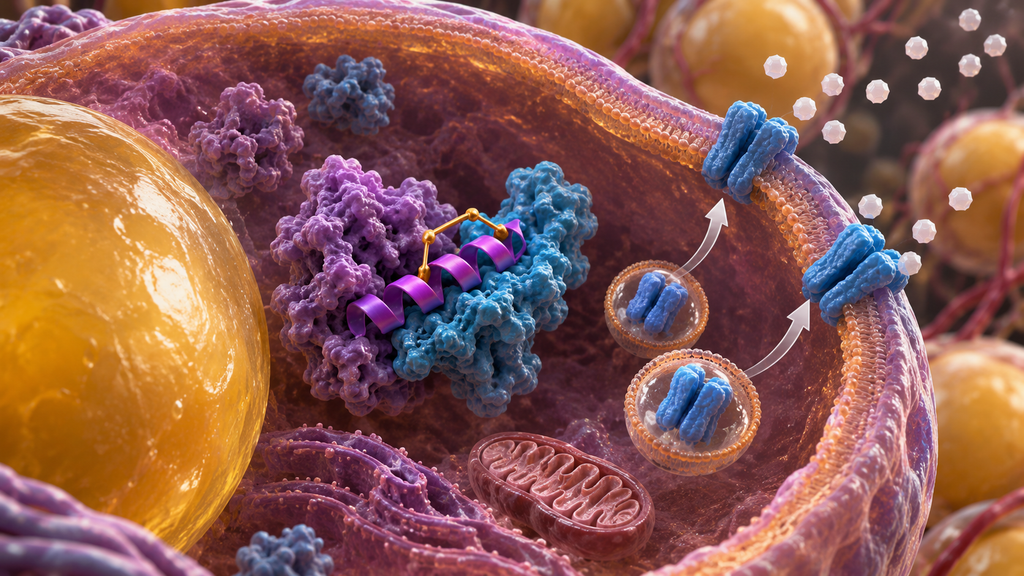
PATAS is a stapled peptide, a molecular design that uses chemical constraints to help maintain a chosen three-dimensional shape.
The program developed from research into ALMS1, a protein associated with Alström syndrome, a rare inherited condition that can involve severe insulin resistance, and protein kinase C-alpha, or PKCα.
Research published in Diabetes in 2022 described an interaction between ALMS1 and PKCα in adipocytes. Under insulin signaling, PKCα can be released from its interaction with ALMS1, participating in processes associated with cellular glucose uptake.
Researchers screened peptide sequences derived from the kinase domain of PKCα and developed PATAS to interfere with that protein interaction.
In cultured human adipocytes, the experimental peptide stimulated insulin-independent glucose uptake, glucose utilization and de novo lipogenesis. In rodent experiments, the investigators also reported improvements in insulin resistance and several associated metabolic measures.
Those observations established a mechanistic foundation for further research. They did not establish that administering PATAS to people with type 2 diabetes would produce the same metabolic effects or offer an acceptable long-term safety profile.
The scientific challenge is therefore larger than identifying an interesting protein interaction. Researchers must determine whether the peptide reaches the relevant tissue, acts with sufficient selectivity and produces a durable response at tolerable exposures.
What the Phase 1b Diabetes Trial Is Measuring
AdipoPharma says PATAS completed the single-ascending-dose portion of its clinical program in healthy volunteers and was well tolerated without serious adverse events in that portion.
That description is encouraging but preliminary. The company’s October announcement did not publish complete dose-by-dose safety tables, pharmacokinetic curves or participant-level results.
The registered study, NCT07223333, is randomized, double-blind and placebo-controlled, with an estimated enrollment of 56 participants across its two parts.
Its multiple-ascending-dose portion involves four weekly subcutaneous injections in participants with type 2 diabetes. The principal assessments include safety, tolerability, pharmacokinetics and pharmacodynamics.
Investigators are also examining exploratory metabolic measures, including oral glucose tolerance, glucose and insulin concentrations, and indices related to insulin resistance.
These measurements can help determine whether the biological activity suggested by preclinical experiments is detectable in people.
However, a four-week dosing study cannot establish the durability of glucose control over years or determine whether treatment reduces cardiovascular, kidney or other diabetes-related complications.
The registry’s estimated total enrollment should also not be confused with the number of patients in the multiple-dose portion alone. The overall program includes both healthy volunteers and participants with diabetes.
A promising cellular mechanism becomes a medical advance only when meaningful benefits can be demonstrated in people.
Why Early Metabolic Signals Are Not Clinical Proof
One useful aspect of the protocol is that it tests a defined biological mechanism against measurable metabolic endpoints rather than relying solely on subjective reports.
Yet a change in a short-term biomarker is not necessarily a reduction in heart attacks, kidney disease, medication burden or diabetes complications.
Even improvements in glucose tolerance or insulin-resistance indices would need to be interpreted alongside the number of participants studied, the magnitude of change, the comparison with placebo and the treatment’s adverse-event profile.
The field has learned repeatedly that a persuasive mechanism can fail when exposed to the complexities of human physiology.
There are also practical uncertainties surrounding the peptide itself. Many hormone-mimicking peptides act through receptors on the cell surface. PATAS is being developed to interfere with a protein interaction associated with intracellular metabolic signaling.
That difference raises questions about delivery, tissue exposure, duration of action and selectivity. A peptide can be elegantly engineered and still struggle to reach the right biological compartment at an effective concentration.
Investors and clinicians should also resist the temptation to declare this a muscle-preserving answer to GLP-1 treatment before comparative human evidence exists.
It is reasonable to investigate whether insulin-sensitizing strategies could eventually complement therapies that influence appetite and glucose control through incretin signaling.
It is not reasonable to promise preservation of muscle mass, substantial weight reduction or remission from type 2 diabetes on the basis of an early clinical dosing announcement.
The Next Milestone Is Human Evidence, Not Another Mechanism
AdipoPharma has indicated that it expects data from participants with type 2 diabetes in 2027.
That is a forward-looking expectation, not a scheduled efficacy verdict already available today. Clinical development timelines can change as enrollment, study sites and protocols evolve.
The study’s registered estimated completion date is May 30, 2027. The more meaningful milestone will be the availability of interpretable clinical results.
Those results will need to show what changed, how consistently it changed, how participants tolerated treatment and whether any observed effects were large enough to justify further development.
Adverse events, withdrawals, drug exposure and dose-response relationships will matter alongside glucose-related measurements.
PATAS is scientifically interesting because it broadens the conversation beyond weight-loss percentages. It shows how peptide engineering can be applied to intracellular metabolic biology rather than exclusively to familiar hormone receptors.
But different does not automatically mean better. A novel mechanism only becomes clinically valuable when its advantages can be measured against existing treatment options and the risks of using it.
The October 27 milestone marks the beginning of a patient-testing phase capable of helping separate a compelling fat-cell hypothesis from a useful human medicine.
For now, PATAS is testing whether changing adipocyte signaling can improve human insulin resistance. The answer is still being collected.
Sources: AdipoPharma Phase 1b announcement, October 27, 2026; ClinicalTrials.gov study NCT07223333; PATAS preclinical research, Diabetes, 2022.