
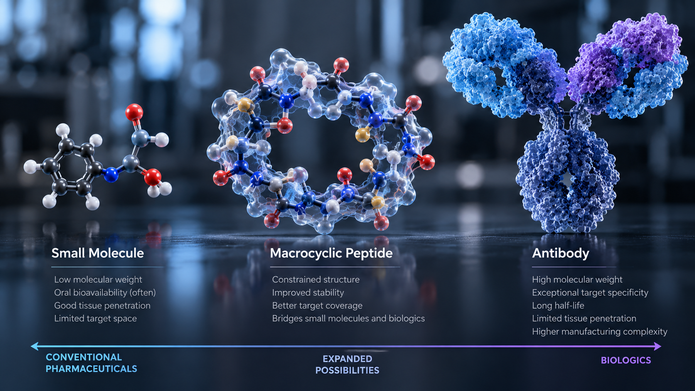
For years, peptides occupied an awkward position in drug development. They could bind targets with exquisite specificity, but they often came with baggage: poor oral bioavailability, rapid degradation, limited membrane permeability and manufacturing challenges.
The biology was seductive. The pharmacology could be a pain in the ass.
That tradeoff is changing.
Why Macrocyclic Peptides Are Expanding the Drug-Discovery Playbook
A wave of 2026 reviews and platform announcements points toward the same conclusion: modern peptide engineering is steadily eroding the boundaries that once kept peptides in a narrow therapeutic lane. Macrocyclization can constrain a molecule into a more useful shape and improve stability. Unnatural amino acids can tune properties that nature never optimized for drug development. mRNA-display and other high-throughput technologies can screen enormous libraries against targets that have frustrated conventional small-molecule programs.
The opportunity is especially interesting for macrocyclic peptides, which occupy a chemical space between conventional small molecules and larger protein therapeutics. Their constrained structures can help them recognize extended protein surfaces, including protein-protein interaction sites that have historically been difficult to target with traditional small-molecule drugs.
But the advantages are not automatic. Cyclization, unnatural amino acids and other modifications must be designed around the properties of each individual molecule. A peptide can become more stable without becoming more permeable, or gain binding affinity while becoming harder to formulate.
The 2026 Research Is Building a Clearer Picture
A July perspective in the Journal of Medicinal Chemistry described cyclic peptides as occupying a valuable middle ground between small molecules and biologics, with increasing attention to oral delivery and a growing footprint in publications and patents.
A September review in Angewandte Chemie emphasized how unnatural amino acids are being used to attack longstanding problems in permeability, stability and bioavailability. And a review published online in August for the October issue of Current Opinion in Chemical Biology focuses on nature-inspired macrocyclic peptides as discovery and engineering tools, including the integration of mRNA-display technologies and artificial intelligence.
Taken together, these papers describe a field moving beyond the discovery of naturally occurring bioactive peptides toward the deliberate engineering of drug-like molecular properties.
The Chemistry Is Improving. The Development Problems Have Not Disappeared.
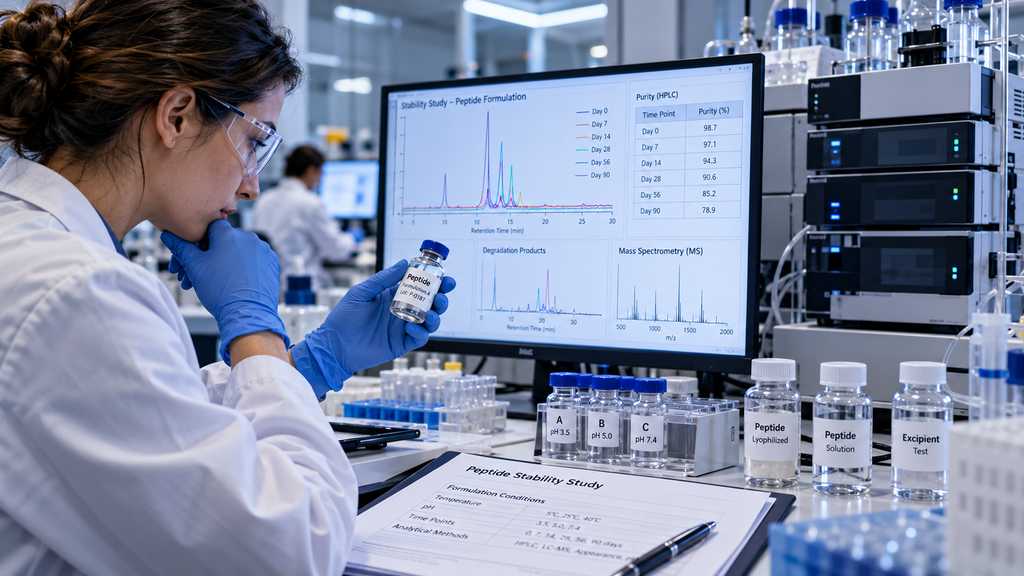
This does not mean the peptide problem is solved. Oral delivery remains difficult. Manufacturing complexity matters. Stability and formulation can still kill an otherwise brilliant molecule.
In fact, an October 6 discussion from Coriolis Pharma makes the unglamorous point that formulation and developability can determine whether sophisticated peptide designs ever become viable products. Changes that improve half-life or biological activity can introduce new challenges involving solubility, aggregation, chemical stability and manufacturing.
That may be the most useful way to understand the moment.
Peptides are not suddenly magic. Scientists are simply getting better at engineering around the reasons they were historically difficult drugs.
From Interesting Molecules to Serious Drug Platforms
The result is a modality that can sometimes reach the large, flat protein interfaces too challenging for classic small molecules while remaining far smaller and more chemically tunable than antibodies.
Modern discovery platforms are helping turn that potential into a repeatable process. Instead of relying only on individual promising peptide sequences, researchers can generate, screen and optimize large libraries of structurally diverse molecules, then use medicinal chemistry to improve their suitability for further development.
The wellness market made peptides culturally famous.
Drug discovery may make them scientifically unavoidable.


