
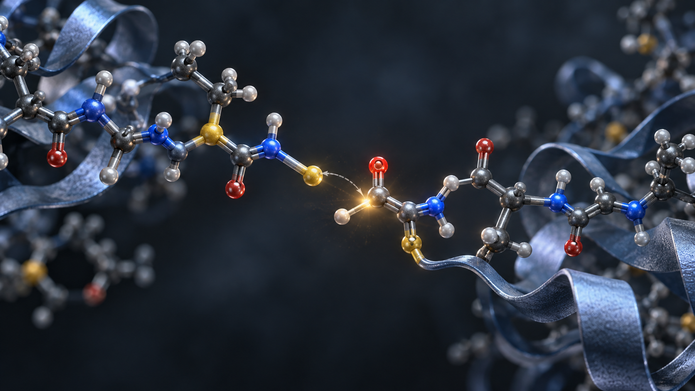
A short peptide is not the same as a full protein, and for much of modern chemistry that difference imposed a practical limit.
Researchers could build chains of amino acids, but assembling larger segments into a correctly connected protein was a demanding task. The difficulty was not simply making two pieces meet. It was joining them without leaving the wrong chemical bond behind.
In 1994, a research team including Philip Dawson published a method called native chemical ligation. It allowed two unprotected peptide segments to join through an ordinary protein-backbone bond, opening a powerful new route to chemically constructed proteins.
The result was a landmark in peptide chemistry. It did not produce a new medicine directly, but it changed the kinds of molecules researchers could deliberately construct and investigate.
The Problem Was Not Just Making Peptides. It Was Joining Them.
The landmark paper appeared in Science on November 4, 1994, under the title “Synthesis of proteins by native chemical ligation.”
Its authors were Philip E. Dawson, Thomas W. Muir, Ian Clark-Lewis and Stephen B. H. Kent.
The work emerged from Kent’s laboratory at the Scripps Research Institute in California. It was a collaborative chemical achievement, not the isolated invention of a single researcher.
The challenge was rooted in the chemistry of proteins themselves.
Proteins consist of amino-acid residues connected through peptide bonds. These ordinary amide linkages form the backbone of the chain, while interactions among the residues help determine the protein’s eventual three-dimensional structure.
Solid-phase peptide synthesis had made shorter sequences accessible to chemists, but producing longer chains became increasingly difficult as the number of reaction and purification steps grew.
One strategy was to prepare shorter fragments separately and then join them.
Earlier chemical ligation approaches could connect peptide segments, but some left a non-native linkage in the protein backbone.
That difference mattered. The researchers wanted a chemical method that would produce the normal backbone connection found in a naturally assembled protein.
The 1994 breakthrough provided a practical answer.
How a Sulfur-Linked Intermediate Becomes a Native Peptide Bond
The method relies on a carefully selected pair of peptide fragments.
One fragment carries a thioester group at its C-terminus, while the second begins with the amino acid cysteine.
The sulfur-containing side chain of the N-terminal cysteine participates in an exchange reaction with the thioester.
This first step produces a transient sulfur-linked intermediate between the fragments.
That intermediate then undergoes an intramolecular rearrangement known as an S-to-N acyl shift.
The acyl group transfers from sulfur to nitrogen, forming the ordinary peptide bond that connects amino acids in a protein backbone.
The chemistry is selective because it takes advantage of the reactivity of the thioester and the cysteine residue rather than requiring every other reactive group in the peptide fragments to be protected.
That is a central reason the method was so useful. Chemists could work with unprotected peptide segments under aqueous conditions instead of relying on a complicated sequence of protective-group manipulations after every connection.
The final product contains a native backbone bond at the ligation site.
But this does not mean every protein is automatically easy to construct. The location of suitable cysteine residues, preparation of peptide thioesters, fragment solubility and reaction conditions can all influence whether a synthesis succeeds.
Interleukin-8 Was the Proof That the Chemistry Could Work
A new chemical reaction becomes more significant when researchers can show that it solves a real molecular construction problem.
For the 1994 team, that demonstration involved human interleukin-8, also known as IL-8 or CXCL8.
Interleukin-8 is a cytokine involved in inflammatory signaling and immune-cell recruitment.
The researchers prepared two unprotected peptide fragments containing 33 and 39 amino-acid residues, respectively.
Using native chemical ligation, they connected these segments to form a continuous 72-residue polypeptide chain.
This was a meaningful test because the target protein contained four cysteine residues that form two disulfide bonds in its native structure.
The team demonstrated the bond-forming reaction, purified the resulting chain and then folded and oxidized the product to obtain the native disulfide-containing protein.
Those steps illustrate an essential distinction in protein science.
A protein’s amino-acid sequence establishes its chemical identity, but its structure and biological properties also depend on how the chain folds and how particular residues interact.
Correctly connecting a chain does not automatically mean that the resulting molecule has adopted the proper functional structure.
Making the correct bond was the breakthrough. Producing the correctly folded protein remained another essential step.
The successful interleukin-8 synthesis showed that native chemical ligation could be part of a practical route to proteins containing complex structural features.
It helped move chemical protein synthesis beyond the preparation of short isolated peptides and toward larger, more biologically relevant molecules.
Dawson’s Career Continued to Expand the Protein-Chemistry Toolkit
Dawson completed his doctorate at Scripps Research in 1996 and pursued postdoctoral work at the California Institute of Technology before returning to Scripps as a faculty member.
His subsequent research focused on developing chemical methods for protein synthesis and bioconjugation.
According to his institutional research profile, his laboratory uses solid-phase peptide synthesis to prepare shorter chains and chemoselective reactions to assemble larger molecules.
This approach can make it possible to introduce nonstandard chemical groups into proteins at defined positions.
Such modifications are useful because ordinary biological protein production does not always provide the exact chemical structure a researcher wants to investigate.
A scientist might want to examine how a specific chemical modification affects protein structure, introduce a fluorescent probe at a defined location or create a molecular tool that allows a particular interaction to be measured.
Controlled chemical construction provides one route to such experiments.
Native chemical ligation also became a foundation for additional strategies in protein semisynthesis and chemical biology.
Later researchers developed ways to extend its scope, address cysteine-related constraints and connect chemical synthesis with biologically produced protein fragments.
These advances expanded what could be assembled, but they did not eliminate the underlying challenges of chemical synthesis.
Purification, solubility, chemical selectivity, folding and manufacturing reproducibility remain important considerations.
Dawson’s documented academic career also includes leadership in graduate education. He served as dean of the Skaggs Graduate School from 2017 to 2024 and became chair of its Graduate School Advisory Committee in 2024.
His scientific recognition includes the Vincent du Vigneaud Award, the Max Bergmann Gold Medal and the Leonidas Zervas Award.
The significance of that career does not require an invented laboratory conversation or personal turning point. The methods, publications and applications provide the historical evidence.
A New Chemical Method Can Change Thousands of Future Experiments
Scientific breakthroughs do not always arrive as new medicines.
Some advances change the methods available to researchers, allowing them to investigate questions that were previously difficult to test.
Native chemical ligation belongs to that category.
By providing a way to connect peptide segments through a native backbone bond, the method expanded the chemical construction of proteins and the possibilities for precise molecular modification.
That matters in medicinal research because investigators often need more than a naturally occurring protein to understand a biological mechanism.
They may need a version containing a specific modification, an engineered chemical handle or a label at a particular residue.
Chemical protein synthesis can help create such molecules for controlled experiments.
It does not guarantee that a constructed protein will be therapeutically useful, nor does it eliminate the need to establish biological activity, toxicity or clinical benefit.
But it can change which molecular questions become experimentally accessible.
There is a wider lesson in the history of peptide chemistry.
The pharmaceutical industry often emphasizes the final molecule: the hormone analog, receptor agonist, antibody or investigational therapeutic.
Behind those products is an evolving toolkit of synthetic reactions, purification methods and analytical techniques that makes molecular research possible.
A method can have a long scientific influence even when its inventors never announce a consumer medicine.
The 1994 publication is now part of that history. It should be understood as a landmark method-development paper, not as a treatment discovery or an event newly reported in 2026.
Its central achievement remains clear: Dawson, Muir, Clark-Lewis and Kent established a practical strategy for joining unprotected peptide fragments while preserving a normal protein backbone.
Sometimes the most consequential scientific breakthrough is not the molecule researchers make, but the new way they learn to make it.
Primary source: Dawson PE, Muir TW, Clark-Lewis I, Kent SBH. Synthesis of proteins by native chemical ligation. Science. 1994;266(5186):776-779. DOI: 10.1126/science.7973629.
Historical reporting: Chemical & Engineering News, November 7, 1994: Protein Engineering — Methods Advance Synthesis of Large Proteins.
Institutional references: Philip Dawson’s Scripps Research faculty profile and Scripps Research graduate-school leadership biography.