
Viruses depend on motion. A coronavirus spike protein must change shape to bring the viral membrane together with the membrane of a cell it is trying to infect. If a molecule can prevent that movement, it may stop infection before the virus gains entry.
That is the premise behind S-880008, a lipid-modified macrocyclic peptide described in a Nature Communications paper published on October 28, 2026.
Researchers found that the experimental compound interfered with SARS-CoV-2 fusion through an unusual molecular mechanism. Laboratory experiments demonstrated activity against multiple viral variants, while intranasal administration reduced viral titers and improved survival in infected mice.
The findings are scientifically important, but they do not establish that the peptide is safe or effective in humans.
What Makes S-880008 Different From Conventional Antivirals?
S-880008 belongs to a class of compounds known as macrocyclic peptides. Unlike ordinary linear peptides, macrocyclic peptides contain a ring-shaped structure that restricts molecular flexibility.
This constrained architecture can help a compound recognize and bind specific protein surfaces, including regions that may be difficult for conventional small-molecule drugs to target.
The researchers identified S-880008 through mRNA display screening and subsequent chemical optimization.
mRNA display allows scientists to evaluate large libraries of peptide candidates and identify molecules that interact with a chosen target. Promising candidates can then be chemically modified to improve their properties.
S-880008 contains two important structural components: a macrocyclic peptide ring and an attached lipid chain.
The combination is significant because the components contribute to interactions with different regions of the coronavirus spike protein.
Rather than functioning as a simple blocker at one familiar binding site, the compound appears to interfere with the structural machinery required for viral entry.
How the Peptide and Lipid Tail Bind the Spike
The SARS-CoV-2 spike protein is a trimer, meaning that it consists of three protein components called protomers.
These components undergo structural rearrangements during the infection process. The spike must interact with a host-cell receptor and subsequently facilitate the fusion of viral and cellular membranes.
Using cryo-electron microscopy, the researchers examined how S-880008 interacts with the spike structure.
They found that the macrocyclic peptide portion anchors near an interface involving the receptor-binding domain, or RBD, and a neighboring region called subdomain 1.
The attached lipid chain reaches into the N-terminal domain of an adjacent spike protomer.
This dual-binding arrangement is particularly interesting because it engages neighboring parts of the spike assembly rather than a single isolated pocket.
The structural findings suggest that S-880008 stabilizes the spike in a receptor-binding-domain three-up conformation.
In this arrangement, all three receptor-binding domains occupy an exposed position. Although that might initially seem favorable for receptor interaction, the resulting structure appears unable to complete the normal sequence of movements required for membrane fusion.
The researchers propose that binding between neighboring protomers suppresses the dissociation and structural rearrangements involved in the fusion process.
The distinction matters: an antiviral compound does not necessarily have to prevent initial receptor attachment to interrupt infection.
It may instead interfere with a later mechanical step that the virus cannot complete without undergoing coordinated structural changes.
Why Blocking Viral Fusion Could Matter Across Variants
SARS-CoV-2 has repeatedly evolved mutations in its spike protein, creating challenges for vaccines, antibodies and antiviral development.
Some spike regions change relatively frequently because mutations can help the virus evade existing immune responses.
Other regions are more conserved because their structure or function is important to the virus.
The research team investigated whether targeting conserved spike interfaces could provide antiviral activity across multiple SARS-CoV-2 variants.
In laboratory experiments, S-880008 demonstrated antiviral activity against diverse variants, including Omicron lineages.
The researchers’ structural analysis provides a possible explanation: the compound engages relatively conserved regions involved in the spike’s functional organization.
Targeting structurally important regions could make it more difficult for the virus to escape inhibition without affecting its own biological function.
However, that is a potential advantage rather than a guarantee.
Viral evolution is unpredictable, and resistance can emerge through mechanisms that are not obvious from an initial structural model.
The reported breadth of activity therefore supports further research but does not prove that S-880008 would remain effective against every future variant.
What the Intranasal Mouse Experiments Demonstrated
The researchers also investigated whether the compound could produce antiviral effects in a living organism.
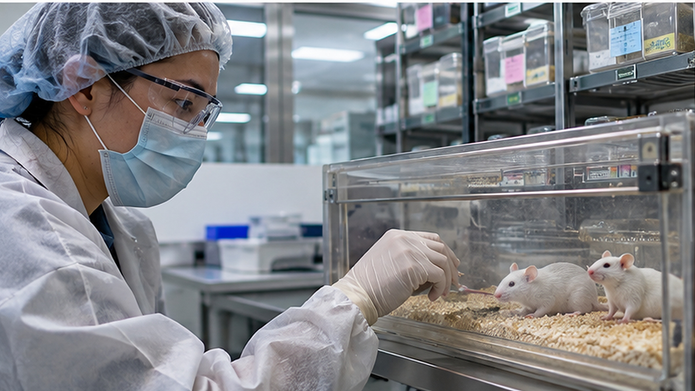
Using a mouse model of SARS-CoV-2 infection, they administered S-880008 intranasally and measured outcomes including viral burden and survival.
The study reported reduced viral titers in the lungs and improved survival following treatment.
These results extend the findings beyond cell-based laboratory experiments and indicate that the compound can exert antiviral activity under the conditions of the tested animal model.
Intranasal delivery is particularly relevant because SARS-CoV-2 infects respiratory tissues.
Administering a compound through the nose may help deliver it near an important site of viral exposure and replication.
However, a successful mouse experiment does not establish an effective treatment strategy for people.
Mouse respiratory anatomy, immune responses, drug distribution and infection dynamics differ from those of humans.
Researchers would still need to determine whether a suitable formulation can achieve consistent concentrations in human respiratory tissues without unacceptable local or systemic side effects.
The animal findings represent evidence supporting further investigation, not proof of clinical benefit.
The Safety and Development Questions Still Unanswered
The chemical properties that make S-880008 scientifically interesting also introduce development challenges.
Macrocyclization can improve peptide stability and influence molecular recognition, but it does not automatically produce adequate drug exposure in the body.
Lipid modification can alter how a compound interacts with proteins and membranes, potentially affecting distribution, stability and other pharmacological characteristics.
Researchers must understand these properties before evaluating a compound in humans.
Important questions include how long S-880008 persists in respiratory tissues, whether repeated exposure causes irritation, whether the molecule interacts with unintended biological targets and how consistently it can be formulated and delivered.
Further toxicology and pharmacokinetic studies would also be needed to establish an appropriate basis for clinical investigation.
The published research involved scientists affiliated with Shionogi and collaborating institutions. The paper discloses relevant employment, funding and other research relationships.
Industry participation is common in pharmaceutical development and does not invalidate experimental findings. Nevertheless, independent replication and additional evaluation are important as a compound advances toward possible clinical use.
No human efficacy findings are established by this study.
The results should therefore not be interpreted as evidence that S-880008 prevents COVID-19 in people or treats an established human infection.
What This Research Means for the Future of Antiviral Peptides
The broader significance of S-880008 lies in its mechanism of action.
Many antiviral strategies focus on preventing a virus from attaching to a receptor, inhibiting an enzyme or disrupting viral replication after entry.
This study illustrates another possibility: using a precisely configured peptide to interfere with the structural movements of a viral protein assembly.
The macrocyclic portion provides one interaction surface, while the lipid chain contributes an additional contact with a neighboring region of the spike.
Together, these interactions appear to stabilize a structure that cannot efficiently complete the viral fusion process.
The approach suggests opportunities for designing antiviral molecules that recognize conserved protein interfaces rather than relying only on exposed and potentially variable surfaces.
However, moving from structural insight to an effective medicine remains a substantial challenge.
Future studies must investigate pharmacology, toxicology, resistance, formulation and whether the mechanism produces a meaningful benefit in humans.
It is also important to distinguish activity against the tested SARS-CoV-2 variants from evidence of effectiveness against unrelated respiratory viruses.
S-880008 has not established itself as a human treatment.
What it has demonstrated is a compelling preclinical design principle: a carefully engineered peptide and lipid anchor can engage multiple regions of a viral protein and interfere with the structural changes required for infection.
The next chapter will depend on whether that molecular ingenuity can be translated into safe, reliable and clinically meaningful antiviral activity.