
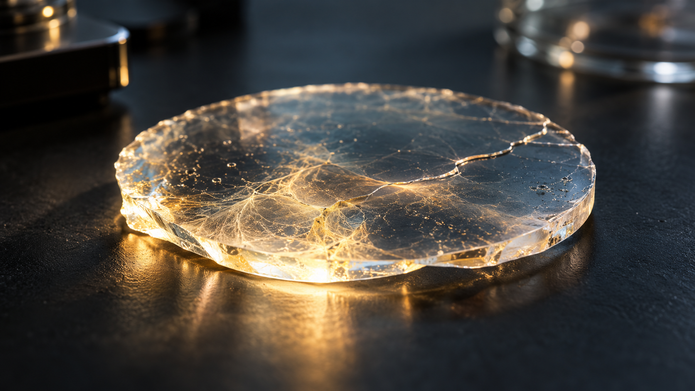
Glass is usually associated with brittleness: once a crack appears, repair often requires heat, adhesives or replacement. A materials-science paper in Nano Letters describes a surprising alternative built from very small peptides.
Chunmei Zhang and colleagues developed glassy solids from protected dipeptides that can be shaped at room temperature and, in certain formulations, repair damage without external stimulation. The result belongs to the world of biomolecular materials, not medicine, but it demonstrates how far peptide science extends beyond hormones and injections.
How Scientists Turned Two Amino Acids Into Glass
The researchers confronted a basic chemical obstacle. Small peptides often prefer to crystallize, arranging themselves into orderly structures rather than the disordered solid state associated with glass.
By adjusting molecular protection and exploiting mobility within the material, the team reported a way to suppress that crystallization tendency. The resulting solids retained characteristics that made them interesting as glass-like materials while allowing molecules to rearrange enough for some forms of self-repair.
The Chemistry Behind a Material That Repairs Itself
One clever detail is the use of a cysteine-lysine dipeptide as an auxiliary to promote healing in peptide glasses that otherwise could not recover autonomously.
That suggests self-repair can be tuned by composition rather than treated as an all-or-nothing property. In principle, materials engineers could choose between stiffness, optical clarity, processability and repair behavior.
In practice, every added component introduces trade-offs that need to be measured, including stability and the possibility of gradual changes after repeated damage.
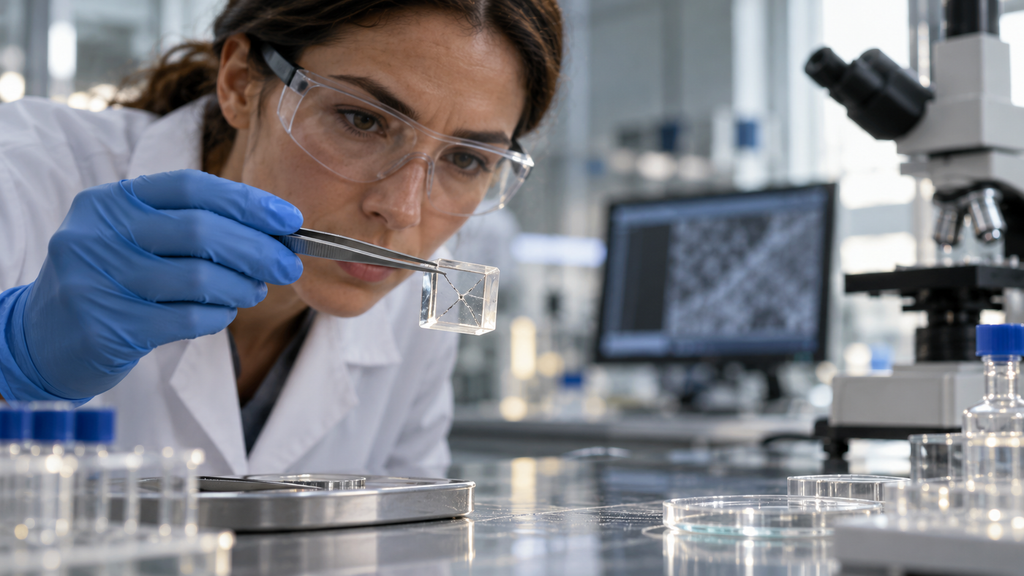
Transparent, Strong and Shapeable Without Heating
The paper describes high transmission of visible light, resistance under wet conditions and mechanical measurements including Young’s moduli as high as 16.3 gigapascals for studied samples.
Those values are material properties under specified tests, not a guarantee that the substance can replace ordinary window glass or an industrial polymer.
Performance in a laboratory sample may change with thickness, humidity, temperature, repeated loading and manufacturing scale. The phrase “peptide glass” is a scientific description of the material, not a consumer-ready product category.
Why Peptides Offer a New Materials-Science Toolbox
Why use peptides at all?
Amino-acid building blocks offer a molecular vocabulary for controlling intermolecular interactions, hydrogen bonding and assembly. They also invite the possibility of materials derived from biologically familiar components.
That does not automatically make every formulation biodegradable, nontoxic or environmentally superior. Those properties depend on synthesis, protecting groups, additives, manufacturing and end-of-life behavior.
A sustainability claim would require lifecycle evidence beyond the mechanical tests reported here.
The idea of self-healing peptide glass also has a research history. A separate study published in Nature in June 2024 demonstrated a transparent, self-healing glass formed from a short peptide. The newer Nano Letters work explores a different strategy based on protected dipeptides and compositional control.
Could Self-Healing Peptide Glass Have Practical Uses?
The biomedical possibilities are intriguing but distant. A transparent, repairable biomolecular material might someday contribute to a sensor coating, an optical component or a device interface.
Yet the study does not show implantation safety, sterility, tissue compatibility or performance in the body. A material can be made from peptides and still fail every requirement for a medical device.
The same caution applies to industrial uses: durability, cost and process control can defeat a beautiful laboratory demonstration.
The Next Test: Can This Work Beyond the Lab?
The publication appeared in the October 2026 issue of Nano Letters, with an issue date of October 7. It is therefore a recent research feature rather than a discovery announced on October 29.
Its value to a peptide newsroom is precisely its unexpected angle. Most peptide coverage follows drug pipelines, receptor agonists and regulatory controversies. Here the central achievement is an engineered solid that changes how we think about repair.
The real question is whether the authors’ strategy can be scaled and generalized to other sequences and geometries without losing its defining behavior.
If it can, the work may inform smart coatings and optical or biomedical materials. If it cannot, it remains a compelling demonstration of molecular design.
Either way, a tiny peptide that helps a glass heal itself is a useful reminder: the next chapter of peptide science may not arrive in a syringe.
Sources
Original research paper — DOI: 10.1021/acs.nanolett.6c03551
Earlier research — A Self-Healing Multispectral Transparent Adhesive Peptide Glass, Nature (2024)