
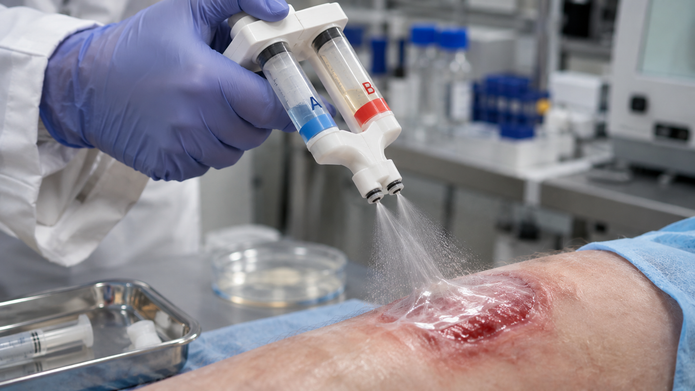
A future wound dressing might not arrive as a sheet, a sponge or a tube of ointment. It could be sprayed into place, where its ingredients assemble into a thin protective film. That is the concept behind a study published October 28, 2026, in npj Biomedical Innovations, describing a two-component system built from hyaluronic acid and a cationic peptide called polyarginine, or PAR30. The research is preclinical, but its simplicity makes it unusually interesting.
The investigators designed a portable dual-syringe delivery approach that brings the two materials together at the surface of a wound or medical device. Hyaluronic acid carries negative charges, while the arginine-rich peptide carries positive charges. When they meet, electrostatic attraction helps them assemble into a conformal polyelectrolyte complex. Rather than relying on a prefabricated patch that may not fit an irregular surface, the coating forms where it is applied.
The idea is not an approved wound treatment. It is an experimental approach to creating antimicrobial protection directly at the surface where bacterial contamination can become a serious problem.
Two Syringes, One Film: How the Peptide Spray Works
The technology combines two familiar principles from materials science: oppositely charged molecules attract, and certain polymers can organize into thin layers when they interact. In this case, the positively charged component is PAR30, a peptide containing 30 arginine residues. Its partner is hyaluronic acid, a negatively charged polymer already widely studied in biomaterials and tissue engineering.
Earlier methods for producing related coatings relied on layer-by-layer dipping, in which a material is repeatedly immersed in different solutions. That approach can produce controlled coatings, but the repeated processing steps take time and are poorly suited to treating an irregular wound directly.
The researchers therefore developed a portable system using two separate syringes and spray nozzles. The components remain separate until application, when they are deposited onto the target surface and assemble into a micrometric film.
The authors used molecular-dynamics simulations to investigate interactions between PAR30 and hyaluronic acid. Their calculations identified a prominent contribution from an N-terminal arginine residue, suggesting that particular positions within the peptide may help organize the resulting complex.
Additional measurements using Raman spectroscopy and focused ion beam-scanning electron microscopy supported formation of continuous coatings on tested materials, including glass and titanium. The resulting film was not perfectly uniform in thickness, but it retained antimicrobial activity under the experimental conditions.
This makes the concept more than a visually appealing spray. The investigators were attempting to transform an established coating chemistry into a practical method that could be applied directly to surfaces with irregular shapes and difficult geometries.
The Film Disrupted Bacteria and Biofilms in Laboratory Tests
The researchers tested the spray system against several bacterial organisms relevant to wound and medical-device infections. These included Staphylococcus aureus, Pseudomonas aeruginosa and Escherichia coli, representing both Gram-positive and Gram-negative bacteria.
In laboratory experiments, the investigators compared different concentrations of PAR30 and hyaluronic acid to identify a formulation with stronger antibacterial activity. The leading formulation contained PAR30 at 10 milligrams per milliliter and hyaluronic acid at 5 milligrams per milliliter.
Under the tested conditions, this formulation substantially reduced bacterial growth. Additional experiments supported contact-dependent antibacterial effects and the ability of coated surfaces to prevent biofilm establishment.
Biofilms are not merely clusters of bacteria waiting to be washed away. They are organized microbial communities embedded in protective material that can make infections harder to clear and reduce the effectiveness of antibiotics and immune responses. A surface that discourages bacterial attachment or kills bacteria on contact could have value even without releasing a conventional antibiotic drug.
The film’s design is intended to keep antimicrobial activity localized to the material’s surface. Its positively charged peptide component can interact with bacterial membranes, contributing to disruption of bacterial integrity under experimental conditions.
The researchers also evaluated storage stability. Antibacterial performance was retained after six months of room-temperature storage of the coating components, while refrigerated storage experiments extending to 18 months showed continued activity.
Those findings support further product development, but they do not independently establish a validated commercial shelf life. Packaging, sterility, repeated handling and manufacturing consistency would require additional qualification before clinical deployment.
MRSA Fell in Mouse Wounds, but Healing Was Not Faster
The researchers then evaluated the system in mouse wound-infection experiments involving methicillin-resistant Staphylococcus aureus, commonly known as MRSA. This bacterium is a clinically important concern because resistance to multiple antibiotics can complicate treatment.
In the experimental infection model, the coating was applied to wounds before bacterial inoculation. The researchers subsequently monitored colonization and measured the amount of recoverable bacteria in wounds and associated dressings.
The spray-treated wounds showed a significant reduction in MRSA burden compared with untreated controls. Additional experiments measuring bacterial contamination over several days also found lower total and staphylococcal bacterial counts in treated wounds.
Those findings are encouraging because they demonstrate activity in a living biological environment rather than exclusively on laboratory surfaces. However, the experiments primarily tested prevention of bacterial colonization after application. They did not establish that the formulation can eliminate an already established deep infection in humans.
There was another important result. When the investigators measured wound closure over ten days, the spray did not significantly alter the healing rate compared with untreated controls.
That distinction matters. A material can reduce bacterial contamination without necessarily making a wound close faster. Antimicrobial protection and accelerated tissue repair are different outcomes, and evidence supporting one should not automatically be treated as proof of the other.

Early Safety Results Were Encouraging, but Not Definitive
Antimicrobial activity is only part of the development challenge. A coating designed for direct contact with damaged tissue must also be evaluated for unwanted effects on healthy cells, inflammation and wound repair.
The researchers examined the formulation in laboratory cell tests and animal experiments. The reported results indicated acceptable compatibility under the tested conditions, including no increase in measured skin inflammation or the inflammatory marker interleukin-6, also called IL-6, in one mouse experiment.
That inflammatory-response experiment involved only three animals per group. The small sample size limits how confidently the observations can be generalized to other conditions, longer exposure periods or larger populations.
The paper also described a separate mouse incision model in which spray treatment reduced some postoperative pain-related responses without impairing motor coordination. Those findings suggest additional biological effects worth investigating, but they do not establish clinical pain relief in people.
Not every safety observation was completely negative. In a laboratory sensitization assessment, PAR30 tested alone produced a signal suggesting possible irritancy. That effect was not observed in the same way with the combined formulation in subsequent experiments.
The combination therefore warrants further safety investigation rather than a broad claim that the coating is non-irritating under all circumstances. Long-term tissue exposure, repeated applications, interactions with other wound products and use in patients with chronic illnesses remain open questions.
Turning a Laboratory Coating Into a Clinical Product Is the Next Test
The concept raises practical questions that laboratory studies cannot settle. How durable is the film under wound fluid, sweat, movement and repeated dressing changes? Could it interfere with tissue remodeling or other materials used on the same wound? How would the system be sterilized, packaged, stored and delivered consistently?
These questions become especially important for a technology intended to work across different wound surfaces and medical-device materials. A film that performs well on glass, titanium or a controlled animal wound may behave differently in an infected human wound containing proteins, damaged tissue, inflammatory fluid and multiple microbial species.
The researchers themselves identified the need for additional testing under hydrated, protein-rich and mechanically challenging conditions. Larger preclinical studies and appropriately designed human trials would be necessary to determine whether the coating reduces clinically important infection outcomes.
Regulatory classification would also matter. Because PAR30 is an antimicrobial peptide that may be treated as a medicinal substance, the authors acknowledged that the final technology could require a drug-device combination development pathway. The appropriate classification would depend on its intended use, mechanism and decisions by relevant regulatory authorities.
Another consideration is the relationship between the research and its commercial development. Some authors disclosed employment with SPARTHA Medical, the company involved in developing the spray technology. That industry participation does not invalidate the findings, but independent replication would help establish the robustness of the results.
Nor should the phrase “antibiotic-free” be read as proof that resistance is impossible. The system does not rely on a conventional antibiotic drug, but PAR30 is itself an antimicrobial agent. Bacteria can adapt to different kinds of antimicrobial pressure, and resistance potential requires systematic investigation.
The wildcard appeal is obvious: a peptide that becomes a protective material only when it reaches a surface is a striking alternative to another systemic injection. Its potential applications extend beyond wounds to medical-device surfaces where biofilm formation can create serious clinical problems.
The responsible headline is equally important. Scientists have demonstrated an intriguing film-forming antimicrobial strategy in laboratory experiments and mouse models. The coating reduced bacterial contamination without accelerating wound closure in the reported experiment. Whether it becomes a safe, effective clinical product is the next story, not a conclusion already reached.
Original research: Li Y., Hathroubi S., Heck O. et al. Invisible shield: sprayable supramolecular antimicrobial microscale films for preventing wound and medical device infections. npj Biomedical Innovations, volume 3, article 63, published October 28, 2026.


