
Modern cancer immunotherapy works partly by removing molecular brakes from immune cells.
The problem is that releasing one brake does not always restore an exhausted T cell.
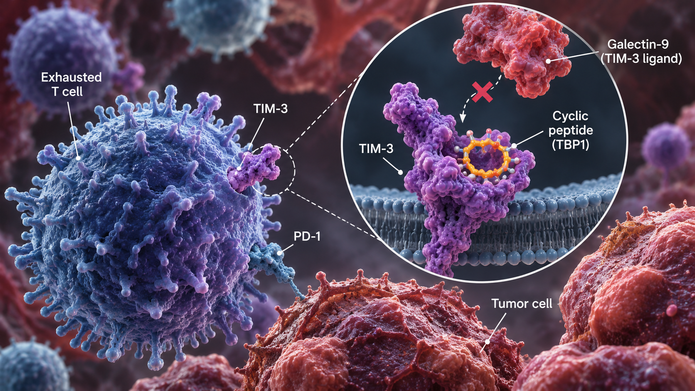
A paper appearing in the October 28 issue of the European Journal of Pharmacology describes a cyclic peptide called TBP1 that targets TIM-3, an immune checkpoint associated with dysfunctional T-cell responses in certain tumors.
Ying Huang and colleagues reported encouraging laboratory and mouse findings, including enhanced antitumor activity when TBP1 was combined with an anti-PD-1 antibody.
That is a promising preclinical result, not evidence that the peptide is a treatment proven effective in people.
Why Blocking PD-1 Does Not Always Restore T-Cell Activity
Checkpoint inhibitors directed at PD-1 or PD-L1 have transformed care for some cancers, yet many tumors fail to respond or eventually develop resistance.
One reason is that immune suppression inside tumors involves more than one molecular pathway.
T cells exposed to persistent stimulation can enter dysfunctional states associated with altered proliferation, reduced cytokine production and impaired antitumor activity.
TIM-3, also known as T-cell immunoglobulin and mucin domain-containing protein 3, can be expressed alongside PD-1 on chronically stimulated T cells.
That co-expression makes TIM-3 a plausible additional target. If several inhibitory mechanisms remain active, blocking PD-1 alone may not restore a sufficiently effective immune response.
However, the biology is not as simple as switching two receptors off. TIM-3 participates in different cellular contexts, and receptor expression alone does not establish that a particular T cell is exhausted.
The therapeutic hypothesis is that interfering with selected TIM-3 interactions may help restore useful immune activity, particularly in combination with an established checkpoint-blocking approach.
Whether that hypothesis delivers a meaningful clinical advantage remains an open question.
How Researchers Found a Cyclic Peptide That Binds TIM-3
Huang and colleagues identified TBP1 using a bacterial surface-display library designed to screen cyclic peptides for their ability to bind TIM-3.
The reported approach used a CX12C peptide-library design, with cysteine residues positioned around twelve intervening amino-acid positions.
The resulting disulfide-cyclic architecture constrains the peptide’s shape, providing a molecular framework that can influence how it recognizes a protein target.
The authors reported that TBP1 bound TIM-3 with high affinity and specificity and recognized both human and mouse forms of the target.
More importantly, competitive-blocking experiments indicated that TBP1 interfered with interactions between TIM-3 and two associated ligands: CEACAM-1 and phosphatidylserine.
CEACAM-1 is a cell adhesion molecule involved in immune regulation, while phosphatidylserine is a membrane phospholipid that participates in cellular recognition processes.
These interactions are relevant to TIM-3 biology, although the consequences vary across cell types and biological settings.
The team also used molecular docking to investigate how TBP1 might interact with TIM-3.
Such modeling can help explain a possible binding arrangement, but it does not independently establish every atomic interaction in a living cell.
The important achievement is that the researchers connected a defined cyclic peptide with experimental evidence of TIM-3 binding and interference with particular ligand interactions.
That makes TBP1 a mechanistically interesting candidate rather than merely a peptide predicted to possess immune activity.
The Mouse Cancer Experiment Is Encouraging, but Limited
After characterizing the binding interactions, the researchers examined whether TBP1 could influence T-cell activity.
In cell-based experiments, the authors reported restoration of functions associated with exhausted T cells through disruption of the TIM-3/CEACAM-1 interaction.
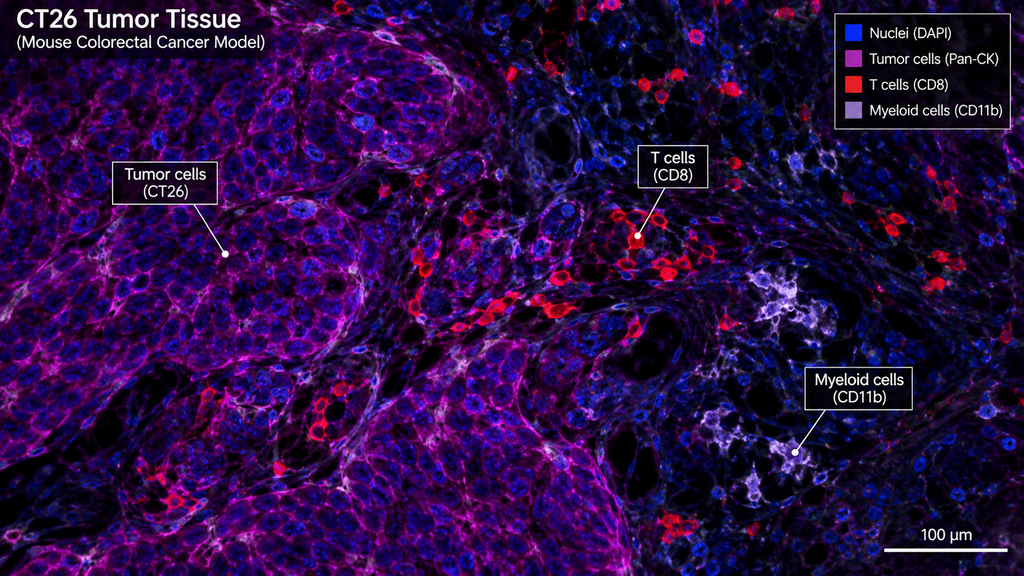
They then evaluated TBP1 in mice bearing CT26 tumors, a commonly used murine colorectal carcinoma model.
The central in-vivo result involved combining TBP1 with an anti-PD-1 antibody.
The researchers reported enhanced antitumor immune activity with the combination, including increased CD4-positive T-cell infiltration and interleukin-2 secretion.
Those findings are relevant because they connect molecular checkpoint interference with measurable immune changes in a living experimental system.
However, changes in immune-cell infiltration or cytokine production are not automatically equivalent to durable cancer control.
The CT26 model provides a controlled setting for investigating mechanisms, but it does not reproduce the full biological diversity of human cancer.
Human tumors differ in genetics, tissue architecture, immune-cell composition, treatment history and the ways they suppress or evade immune responses.
The mouse findings cannot establish that TBP1 will improve survival in patients or work across colorectal, pancreatic, lung or other cancers.
Restoring immune activity in a mouse tumor model is a meaningful experiment. It is not proof that the same treatment will help a person with cancer.
Why the Cyclic Shape Matters—and What It Cannot Guarantee
The cyclic architecture is an important part of the drug-design story.
Ordinary linear peptides may be vulnerable to enzymatic degradation, and restricting a peptide’s conformation can sometimes improve its stability and target engagement.
A relatively small peptide may also behave differently from a large antibody when moving through tissues.
The authors discuss potential advantages of peptide-based checkpoint antagonists, including tissue penetration, tolerability and manufacturing characteristics.
Those are attractive design considerations, but they should not be confused with clinically demonstrated advantages for TBP1.
A cyclic structure does not automatically guarantee sufficient circulation time, predictable tissue distribution or resistance to every degradation pathway.
Researchers would still need to establish how TBP1 is absorbed, distributed, metabolized and eliminated, along with how long it occupies its target under relevant physiological conditions.
They would also need to understand whether the peptide interacts with unintended proteins or produces effects beyond the intended TIM-3 pathway.
The safety challenge is particularly important in cancer immunotherapy.
Checkpoint inhibition can release useful antitumor responses, but it can also provoke inflammation and immune-related injury in healthy tissues.
Combining a TIM-3 antagonist with PD-1 blockade could strengthen beneficial immune activity, harmful immune activity or both.
Only appropriately designed toxicology and clinical studies could begin to define that balance in people.
The Real Test Is Whether TBP1 Can Become a Useful Therapy
The paper’s publication timing deserves precision.
Although the research appears in the October 28 journal issue, PubMed lists its electronic publication date as September 2, 2026.
It is therefore a recent preclinical research feature rather than a discovery first announced on October 30.
The next scientific milestones are relatively straightforward to identify, even if they are difficult to achieve.
Independent researchers will need to reproduce the reported binding and immune-function findings, ideally using additional experimental systems.
Pharmacology studies will need to establish the peptide’s stability, exposure, distribution and relationship between dose and biological effect.
Further tumor models could help determine whether the reported combination activity extends beyond the CT26 setting and which immune populations contribute most strongly to the response.
Safety experiments will need to investigate immune overactivation and possible injury to healthy tissues.
Only after sufficient preclinical development could investigators determine whether a human trial is justified, how it should be designed and what a meaningful treatment comparison would require.
The larger significance is that peptides may participate in immunotherapy as more than passive drug-delivery tags.
A deliberately shaped peptide can itself be engineered to interfere with a biologically important protein interaction.
That possibility expands the molecular toolkit available to cancer researchers, but it does not expand the strength of the evidence already collected.
TBP1 is a promising preclinical question about immune exhaustion and combination checkpoint blockade.
It is not an available cancer treatment. The difference between those statements is the difference between a serious scientific advance and a premature cure headline.
Source: Huang Y, et al. A novel cyclic-peptide antagonist of TIM-3 for cancer immunotherapy by reinvigorating exhausted T-cell activity. European Journal of Pharmacology. 2026;1034:179308. Epub September 2, 2026. DOI: 10.1016/j.ejphar.2026.179308.


