
Tirzepatide muscle loss has become one of the most frequently discussed questions about the new generation of obesity drugs. Until recently, much of the advice about protecting muscle during treatment was supported by evidence from dieting studies and other exercise interventions rather than direct trials involving tirzepatide itself.
A randomized trial published in Nature Medicine on November 9, 2026, puts real numbers on one of the oldest recommendations in medicine: lift weights.
In 120 adults with overweight or obesity, all of whom received tirzepatide for 40 weeks, adding three supervised resistance-training sessions each week did not meaningfully change how much weight participants lost. It did change how much lean tissue they retained, and it turned measurable losses in muscle strength into gains.
The difference was not enormous on a body-composition scan. The exercise group lost approximately 1.1 kilograms less lean soft tissue than the drug-only group, a reduction of nearly one-quarter in the amount lost.
On strength tests, however, the contrast was more striking. Participants taking tirzepatide without resistance training got weaker on average. Those who trained got stronger.
This is evidence from humans in a randomized controlled trial, not an animal experiment or a retrospective comparison. That makes it particularly useful in a field where confident advice about muscle preservation has often moved faster than the direct clinical evidence.
The scale could barely distinguish the two groups. Their strength tests told a different story.
What the Tirzepatide Muscle Loss Trial Actually Tested
The study, called T-REx, was conducted at the University of Western Australia and led by researchers including Daniel Green and Bu Yeap.
Investigators recruited 60 men and 60 postmenopausal women between 50 and 70 years old who had obesity, or overweight with at least one weight-related health condition. Participants had been doing less than 60 minutes of moderate-or-higher-intensity exercise each week before enrollment.
People with diabetes or a history of cardiovascular disease were excluded, along with several other groups whose medical conditions or treatments could complicate the experiment.
All 120 participants received once-weekly tirzepatide injections. The drug was started at 2.5 milligrams and increased gradually toward 15 milligrams per week, depending on tolerability.
Participants were randomized into two groups. Sixty-one received tirzepatide while continuing their usual activities. Fifty-nine received the same medication alongside supervised resistance exercise.
The exercise program was more structured than the generic advice to visit a gym three times a week.
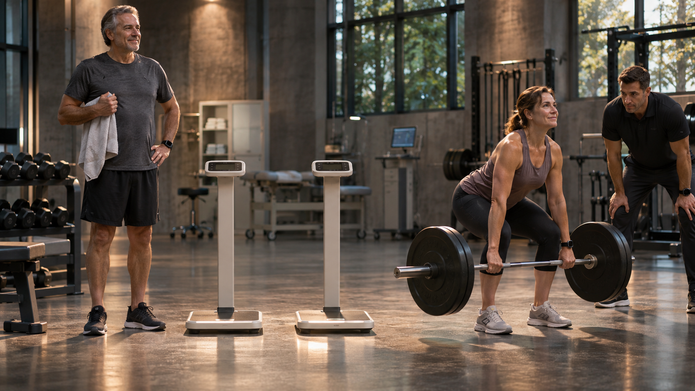
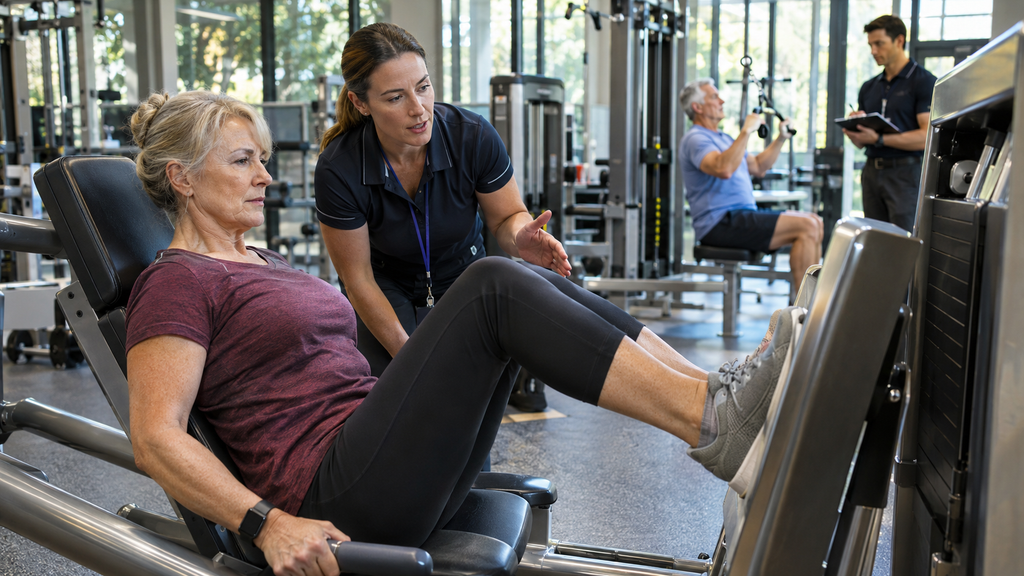
Participants attended three one-hour sessions weekly for 40 weeks at a university training facility. Accredited exercise physiologists supervised progressive exercises including squats, deadlifts, leg presses, chest presses, shoulder presses, lat pulldowns and other movements involving major muscle groups.
Training began at light-to-moderate intensity, with an emphasis on technique and adaptation, then progressed through five eight-week phases toward more demanding strength and muscle-building work.
The exercise group completed 91% of prescribed sessions on average. Overall, 111 of the 120 participants completed the 40-week trial.
Those are unusually favorable adherence and retention figures for a demanding exercise intervention. They strengthen the evidence that the program worked under supervised trial conditions. They also raise a practical question about whether an ordinary clinic could reproduce the same results without the time, staffing and support of a research program.
The trial was randomized, but participants could not be blinded to whether they were lifting weights. Tirzepatide was also given openly to both groups. The comparison therefore tested the added effect of resistance exercise during drug treatment, not tirzepatide against an untreated control group.
The researchers measured body composition using dual-energy X-ray absorptiometry, or DXA, at intervals during the trial. They also measured upper- and lower-body strength and several cardiovascular risk markers.
The central question was whether resistance exercise could change the composition and function of the body even when the amount of weight lost stayed essentially the same.
Same Weight Loss, Different Body Composition
After 40 weeks, participants taking tirzepatide without resistance training had lost an average of 22.61 kilograms. Those who combined the drug with supervised exercise lost 22.28 kilograms.
The difference was not statistically significant. In practical terms, adding resistance exercise did not make participants lose more weight on the scale.
Fat loss was similarly close. Participants receiving tirzepatide alone lost an average of 17.19 kilograms of fat. Those in the exercise group lost 17.98 kilograms.
The study’s two primary outcomes were fat mass and total lean soft-tissue mass. It was the second measure that revealed the benefit of training.
In the drug-only group, total lean soft-tissue mass fell by an average of 4.67 kilograms. In the exercise group, the average reduction was 3.57 kilograms.
The adjusted between-group difference was 1.09 kilograms, with a reported confidence interval from 0.43 to 1.75 kilograms and a p-value below 0.001.
That represents approximately 23% less lean soft-tissue loss in the training group.
It is important to describe the finding precisely. Resistance exercise did not stop participants from losing lean tissue. Both groups lost several kilograms. The intervention reduced the amount lost.
Lean tissue in the arms and legs, known as appendicular lean soft-tissue mass, showed a similar pattern. The drug-only group lost approximately 3.55 kilograms, compared with 2.92 kilograms in the exercise group.
This measure more closely tracks skeletal muscle than total-body lean mass does, although it is still not a direct measurement of muscle fibers.
The trajectory was also informative. Total lean-tissue losses were greatest during the first 24 weeks and then largely plateaued, while appendicular lean tissue continued to decline across the study period.
That suggests body composition may not change at a constant rate throughout obesity treatment. The timing of exercise could matter, and the T-REx design began training alongside medication rather than waiting until major weight loss had already occurred.
Lifting did not prevent lean-tissue loss. It reduced it by about one kilogram while leaving overall weight loss essentially unchanged.
The Strength Results Are the Bigger Surprise
The difference between the groups became much larger when researchers tested what their muscles could actually do.
In the tirzepatide-only group, bench press strength declined by an average of 4.09 kilograms, lat pulldown strength fell by 4.42 kilograms and knee extension strength dropped by 4.42 kilograms.
In the resistance-training group, those same measures increased.
Bench press strength rose by 4.68 kilograms. Lat pulldown strength increased by 8.58 kilograms. Knee extension strength improved by 5.88 kilograms.
All three between-group comparisons were statistically significant.
That is a more dramatic functional result than the roughly one-kilogram difference in lean-tissue loss might suggest.
A person can preserve a meaningful amount of strength without preserving every kilogram of lean tissue. Muscle performance depends on more than size. Training improves coordination, motor-unit recruitment and the nervous system’s ability to activate muscle during a movement.
These adaptations can produce substantial improvements in strength, particularly among people who were previously inactive, even when measurable muscle mass does not increase.
That is why the trial’s body-composition and strength outcomes should be read together rather than treated as interchangeable.
The study provides evidence that a supervised training program can improve muscle function during major medication-assisted weight loss. It does not prove that a one-kilogram difference in measured lean tissue caused all of the strength improvements.
Nor does it show that tirzepatide directly weakens muscles independently of weight loss. Without a group that received neither tirzepatide nor resistance training, the trial cannot isolate that mechanism.
For patients worried about weakness, however, the functional difference is immediately understandable.
Two people can lose roughly the same amount of weight and finish treatment with different abilities to lift, carry and move.
The trial did not directly measure whether those differences reduced falls, prevented disability or improved everyday independence. But it offers a strong reason to investigate those outcomes.
The body-composition scans found a modest benefit. The strength tests found a much larger practical contrast.
Why This Trial Matters for GLP-1 Muscle Loss
Concerns about muscle loss during treatment with GLP-1-based obesity drugs have grown alongside their commercial success.
Semaglutide and tirzepatide can produce substantial reductions in body fat, but some of the weight lost is lean tissue. That is not unique to these drugs. Lean-tissue loss can also occur during substantial weight reduction caused by dieting or other interventions.
The concern is particularly relevant for older adults, whose muscle mass and strength may already be declining with age.
Preserving muscle function can help support mobility and physical independence, which become increasingly important when large amounts of weight are lost over relatively short periods.
Drug developers have responded to the issue by investigating additional treatments intended to preserve or increase muscle during obesity therapy.
Grey Pepper has followed that development race, including Regeneron’s trevogrumab and other experimental muscle-preserving approaches.
Those compounds seek to alter biological pathways involved in muscle maintenance or growth, potentially adding another medication to an obesity treatment regimen.
Resistance exercise is a different intervention. It is already available, requires no new drug approval and has decades of evidence supporting its effects on strength and muscle function in other settings.
What had been missing was a direct randomized test of resistance exercise specifically during treatment with a potent modern incretin medicine such as tirzepatide.
The T-REx study addresses that gap.
It does not demonstrate that resistance exercise is clinically superior to muscle-preserving drugs, since none of those experimental treatments was included in the trial.
It does establish a useful comparison for future studies: an exercise intervention can reduce lean-tissue loss and substantially improve strength without compromising the weight-loss response.
If a new muscle-preserving drug is tested, researchers and clinicians will reasonably want to know whether its benefits add to those of exercise, replace them for patients unable to train, or address different aspects of muscle health.
There is an important affordability distinction, too. Resistance exercise does not require purchasing an additional investigational medicine, but supervised training is not free to deliver. Skilled staff, suitable facilities and consistent attendance all carry costs.
That matters when the research intervention involves approximately 120 supervised sessions over 40 weeks.
The strength gains also occurred without an additional measurable improvement in fat loss, blood pressure, glycemic measures or blood lipids compared with tirzepatide alone.
That makes the finding more specific, not less useful. The additional benefit was primarily in lean-tissue preservation and strength, rather than greater total weight reduction or broader short-term metabolic changes.
Resistance training did not make tirzepatide more effective on the scale. It made the people taking it stronger.
What the Trial Cannot Tell Us
Despite its randomized design and strong exercise adherence, T-REx has several limitations that matter when translating its findings into everyday treatment.
First is the distinction between lean tissue and skeletal muscle.
The primary measure, total lean soft-tissue mass, was derived from DXA scanning. It includes skeletal muscle but also other non-fat tissues and water. Therefore, the reported difference of 1.09 kilograms should not be interpreted as exactly 1.09 kilograms of preserved skeletal muscle.
The authors discuss the relationship between appendicular lean tissue and skeletal muscle mass, but those relationships are estimates rather than direct muscle measurements in every participant.
Second is the population. This was a study of previously inactive adults aged 50 to 70, not a representative sample of everyone prescribed tirzepatide.
The results cannot automatically be applied to young athletes, people with diabetes, patients with established cardiovascular disease, those with substantial frailty, or patients already accustomed to regular resistance training.
Third is the exercise program itself.
Participants received personalized, progressive training supervised by accredited exercise physiologists, and adherence was exceptionally high. Whether a shorter program, home-based resistance exercises or two weekly sessions would deliver similar results remains unknown from this trial.
Fourth is duration. The principal results cover 40 weeks. They do not establish what happens after several years of tirzepatide treatment, after the medication is stopped, or after supervised training ends.
Fifth is functional relevance. Gym-based tests demonstrated improved strength, but the study was not designed to prove that the intervention prevents falls, fractures, disability or hospitalization.
It also did not directly compare resistance exercise with a muscle-preserving medication, nor did it test semaglutide or another GLP-1-based drug in a separate arm.
The publication’s financial disclosures deserve consideration. Eli Lilly provided tirzepatide through an investigator-initiated trial arrangement, reviewed the protocol and checked a manuscript draft for intellectual-property or new safety issues. According to the paper, the company supplied no additional funding and had no role in conducting the study, analyzing the data or writing the report.
Several investigators disclosed speaker honoraria or advisory relationships involving pharmaceutical companies, including Eli Lilly. These relationships do not invalidate the findings, but transparency is especially important in research involving highly commercial medicines.
Finally, the trial did not test whether resistance training is necessary for every person taking tirzepatide. It demonstrated a benefit in the specific population and supervised program studied.
For people with joint disease, significant frailty or other physical limitations, the appropriate exercise prescription may need to be adjusted by a qualified clinician or exercise professional.
The evidence supports resistance training as a potentially valuable part of treatment. It does not justify assuming that everyone can safely begin the same demanding program.
The Bottom Line on Tirzepatide and Strength Training
This is a useful randomized human trial with an answer that is both more modest and more important than a simple claim that lifting weights prevents muscle loss.
Three supervised resistance-training sessions a week during 40 weeks of tirzepatide treatment did not significantly change total weight loss.
They did reduce measured lean soft-tissue loss by approximately 1.1 kilograms, or 23%, and changed the direction of strength outcomes from decline to improvement.
For patients, the result strengthens the case for discussing an appropriate resistance-training program alongside obesity treatment rather than waiting until a large amount of weight has already been lost.
For researchers developing muscle-preserving drugs, it provides a useful reference point: a structured, non-pharmacological intervention has now demonstrated measurable benefit in a randomized tirzepatide trial.
Neither observation means the muscle problem is solved. Both groups still lost lean tissue, and the long-term consequences of that loss remain to be established.
But the study changes the conversation in one meaningful way. The number on the scale is no longer the only result worth watching.
The next question is not simply how much weight a person loses on tirzepatide. It is how much strength they have left when the weight is gone.
Sources and Further Reading
- Green DJ, Haynes A, Underwood DR, et al. Resistance exercise to attenuate lean mass loss during tirzepatide therapy for obesity: a randomized controlled trial. Nature Medicine. Published November 9, 2026. DOI: 10.1038/s41591-026-04752-5.
- University of Western Australia. More men needed for weight loss study. April 1, 2025.
- Australian New Zealand Clinical Trials Registry. The Combination of Tirzepatide and Resistance Exercise (T-REx), ACTRN12623001236684. Registered November 30, 2023.


