

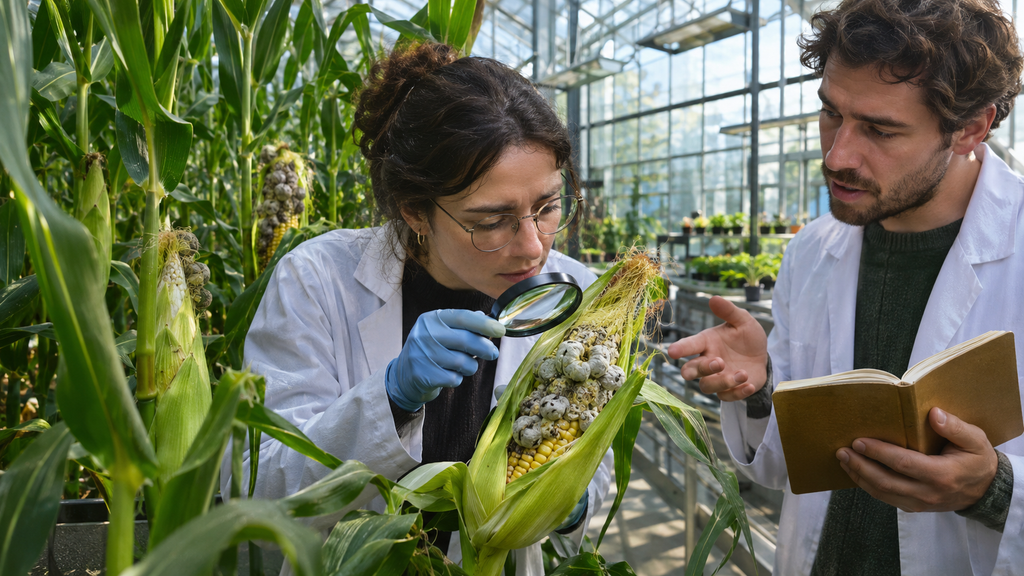
Corn smut is the fungus that turns maize kernels into grey, swollen galls. In Mexico, young galls are harvested as huitlacoche and sold as a delicacy; in many American fields, they represent crop damage. A paper published October 9 in Nature Communications describes how the fungus behind them can sense that it has entered plant tissue. The answer is a nine-amino-acid peptide hidden inside a larger protein, waiting for the plant’s own enzymes to cut it loose.
The work was done in fungal cells, engineered yeast reporter systems and maize plants. No animals or people were involved. The researchers solved the crystal structure of the protein containing the hidden peptide, tested how the peptide activates a fungal receptor, and showed that disrupting the system severely weakens the fungus’s ability to cause disease.
The result belongs to a strand of peptide biology that rarely reaches drug coverage but helps explain how cells communicate. A short peptide, a seven-transmembrane receptor and an enzyme-controlled release mechanism. Strip away the species, and some of the underlying principles resemble the receptor-signaling systems that modern peptide medicines target. The mechanisms are not identical, but the comparison is worth understanding.
What the Corn Smut Fungus Was Sensing
The pathogen is Ustilago maydis. During infection it secretes a protein called Pit2, already known for interfering with maize immune defences. The Düsseldorf-led team, working with collaborators in Göttingen, Groningen, North Carolina and London, found that Pit2 has a second function. When maize papain-like cysteine proteases process the protein, they can release a short peptide fragment from its core. The researchers identified the active nine-residue sequence as WWFGFTGSL.
That fragment acts as a ligand, a molecule capable of activating a receptor. The receptor is a fungal protein previously called Pit1, which the authors renamed Gpe1. It contains 435 amino acids and has the seven-transmembrane architecture characteristic of G-protein-coupled receptors, or GPCRs. A genome-wide structural search identified 34 putative GPCRs in the fungus, and the team characterized Gpe1 in detail.
The sequence of events is the interesting part. The fungus supplies the protein containing the signal, but the host’s enzymes provide the processing step that releases it. The authors solved the crystal structure of Pit2 at 2.3 angstroms and found that two copies form a tightly intertwined pair. The activating peptide sits buried at the interface between them.
In that arrangement, the protein is more than a carrier. It protects the activating sequence until proteolytic processing makes the signal available. The system offers the fungus a way to link receptor activation to an environment where particular plant enzymes are present.
The fungus supplies the hidden signal. The plant supplies the enzyme that can release it.
How the Experiments Were Run
Most of the receptor-activation data came from an engineered yeast reporter strain. The researchers introduced Gpe1 into yeast and connected receptor signaling to a fluorescent readout, allowing them to measure responses to different forms of Pit2.
Full-length Pit2 generated a reporter signal reaching roughly 25% of the reference response. Processed Pit2 fragments produced a response approaching 100% at a tenfold lower concentration. Those percentages were normalized to activation of a yeast control receptor, not direct measurements of the percentage of fungal receptors activated inside infected plants.
Mass spectrometry initially identified an eleven-amino-acid activating fragment, WWFGFTGSLGK. Further peptide experiments narrowed the most active core to nine amino acids, WWFGFTGSL. In the engineered yeast system, the shorter sequence generated a much stronger reporter response than the eleven-residue version.
The wild-type receptor’s half-maximal response occurred at approximately 80 nanomolar. That is the concentration of peptide needed to produce half of the measured maximum response in this assay. Altering the first three amino acids strongly reduced activation, supporting the importance of the peptide’s N-terminal region.
The researchers then tested the biological significance in maize. Removing either the Gpe1 receptor gene or the Pit2 gene nearly eliminated the fungus’s ability to cause disease and form galls. Restoring the normal receptor gene restored virulence, while receptor variants carrying mutations in residues implicated in peptide recognition produced markedly weaker disease symptoms.
Microfluidic imaging supplied another piece of the mechanism. When fungal cells were exposed to the activating peptide under laboratory conditions, their cell-cycle duration decreased from approximately 226 minutes to 167 minutes. The researchers also observed receptor internalization and increased expression of Clp1, a regulator associated with restarting fungal cell division after host penetration.
The pieces fit a coherent model: processing releases a peptide, the peptide activates a receptor, and receptor signaling promotes fungal proliferation. The maize experiments show that the genes involved matter for infection. They do not, by themselves, directly visualize the precise peptide-release event taking place inside living maize tissue.
The Evolutionary Wrinkle
Gpe1-like receptors occur across many smut fungi, but Pit2 is more narrowly distributed among related species. That creates an evolutionary puzzle. The receptor appears to have a broader history than the particular signaling protein the maize pathogen uses to activate it.
The team tested whether peptides from related fungi could activate one another’s receptors. A Pit2-derived peptide from Sporisorium reilianum activated the maize pathogen’s Gpe1 receptor at levels comparable to its own peptide. A peptide from the barley smut fungus Ustilago hordei did not.
In the opposite direction, peptides from the maize and S. reilianum fungi activated the barley smut receptor only weakly, producing relative responses of approximately 30% and 45% in the reported assay. These differences are consistent with co-evolution: related receptors and peptide ligands retain some shared features while accumulating changes that affect how well they work together.
The structural comparison reaches beyond fungi. Gpe1 contains features reminiscent of mammalian rhodopsin-class GPCRs, including conserved residues in its third and sixth transmembrane helices and a predicted extracellular disulfide bond. The authors describe a potential evolutionary connection, while emphasizing important structural differences.
That distinction matters. A resemblance between parts of two receptors is not proof that they recognize ligands or transmit signals in exactly the same way. The team’s Gpe1-peptide complex was modeled computationally and tested through mutations, not directly resolved as an experimental receptor-bound structure.
The receptor is widespread. The peptide that activates it has a more selective evolutionary history.
Why a Plant Pathogen Paper Matters to Peptide Science
Peptide drug design repeatedly encounters the problem of controlling when and where a signaling molecule acts. Short peptides can be biologically powerful, but their stability, exposure and receptor interactions need to be managed carefully.
This fungus offers a natural example of one possible control strategy. Rather than releasing its strongest activating peptide in an immediately available form, it packages the sequence within a larger protein. Processing by enzymes associated with the host environment makes the signal accessible.
That is conceptually related to approaches in drug development in which an inactive or masked therapeutic component is designed to become active after a particular biological event. It does not establish that the fungal system can be transferred directly to a human medicine. The important point is the design principle: proteolytic processing can help determine when a biological signal becomes available.
The GPCR connection is equally interesting. These receptors are central to human pharmacology, from adrenaline signaling to drugs that mimic peptide hormones. Grey Pepper previously examined the scientific history behind them in our profile of Robert Lefkowitz and the development of modern GPCR research. The fungal receptor is not the same as the human GLP-1 receptor, but the research shows how widely receptor-mediated peptide communication extends across living organisms.
For researchers studying how ligand recognition evolves, a pathogen with a defined peptide sequence, experimentally tested receptor and measurable infection phenotype offers a tractable model. The system can be changed genetically, examined structurally and tested in its host without requiring the complexity of human metabolic physiology.
Limitations Worth Stating Plainly
The study makes a strong mechanistic case, but several steps still require direct confirmation. The team solved the structure of Pit2, not the complete structure of Gpe1 bound to its activating peptide. AlphaFold-based models guided the receptor mutations, and those experiments supported the proposed interaction. They did not establish every atomic contact experimentally.
Most receptor-activation measurements were made in engineered yeast. That system offers a controlled way to test the interaction, but signaling behavior in yeast is not necessarily identical to signaling inside U. maydis during maize infection.
The work also supports host-protease-dependent release of the peptide without directly showing the complete processing and activation sequence unfolding inside infected living maize tissue. Mutations that weaken receptor activity could sometimes affect receptor stability, folding or trafficking rather than only the peptide-binding site.
There is a second peptide story inside Pit2 as well. Earlier work identified a fourteen-residue fragment involved in inhibiting plant proteases. The shorter nine-residue sequence characterized in this paper acts as a receptor agonist and lacks the same protease-inhibitory activity. The relative contribution of these peptide products during actual infection remains an open question.
German coverage of the study quoted first author Gabriel Mendoza-Rojas comparing the hidden peptide to treasure locked inside a chest that plant enzymes can open. The analogy is effective, but this remains fundamental research. There is no demonstrated crop treatment based on blocking Gpe1, and no evidence here of a therapeutic effect in animals or humans.
The Transferable Idea
The useful takeaway is bigger than corn smut. A signaling peptide can be stored within another protein, with its availability controlled by an enzyme found in a particular biological environment. In this case the pathogen appears to exploit a host defence-related process to help coordinate its own proliferation.
That makes Gpe1 an interesting target for future crop-protection research. If scientists could disrupt the peptide-receptor interaction without damaging other organisms, they might interfere with one of the processes needed for infection. But developing a practical antifungal treatment would require work beyond the present paper, including identifying suitable compounds, testing selectivity and demonstrating protection in crops.
There is a broader reason to pay attention to natural peptides outside human biology. Grey Pepper recently covered two unusual peptides isolated from a marine bacterium, another reminder that microorganisms have evolved chemical systems researchers are still learning to catalogue. The fungal mechanism adds a different example, one concerned with communication rather than direct antibacterial activity.
Evolution arrived at an elegant arrangement: a nine-amino-acid message stored inside a protein, a host enzyme capable of releasing it, and a receptor that responds to the result. Whether scientists can eventually borrow that strategy for medicine or agriculture remains unanswered.
The fungus hides the message. The plant helps deliver it. And the research shows how precisely a tiny peptide can control a much larger biological event.
Sources
- Mendoza-Rojas G, Nakonz P, Lu M, et al. — A co-evolved peptide-GPCR system senses host entry to drive fungal infection. Nature Communications 17, article 10652, October 9, 2026.
- PubMed Central — Full open-access research paper, including methods, figures and supplementary material. PMID 42855465.
- wissen.de — Wie eine Maispflanze ihren Feind ins eigene Haus lässt, October 26, 2026. German science coverage of the study and researcher comments.
- bioRxiv — A co-evolved peptide-GPCR system senses host entry to drive fungal infection, preprint posted September 27, 2025. The published Nature Communications version is the primary reference.