

Trevogrumab, an experimental antibody from Regeneron, substantially reduced the lean tissue people lost while taking semaglutide, according to the full results of the COURAGE trial published in The Lancet on November 11, 2026. The study was done in humans: 975 adults with obesity enrolled at 60 US sites. It is a significant randomized test of whether a myostatin inhibitor can change what GLP-1 weight loss is made of. It also shows the cost of pushing harder. A three-drug combination that worked best on body composition had the worst safety record in the trial.
Grey Pepper covered the topline findings when Regeneron first presented them. What the peer-reviewed paper adds is a consolidated account of the 26-week and 52-week results, including the dose comparisons and safety findings. Conference disclosures also provide data from the semaglutide-withdrawal phase and an MRI substudy. Those details matter more than a simple claim that an antibody can save muscle.
The central distinction is between changing a body scan and improving a person’s health. COURAGE provides compelling evidence for the first. The second has not yet been established.
Why Trevogrumab Targets Semaglutide Muscle Loss
Rapid weight loss on GLP-1 drugs is not pure fat loss. In COURAGE, people receiving semaglutide plus placebo lost 6.6% of their lean mass by week 26. Regeneron’s earlier analysis estimated that lean tissue accounted for about one-third of the weight lost on semaglutide alone.
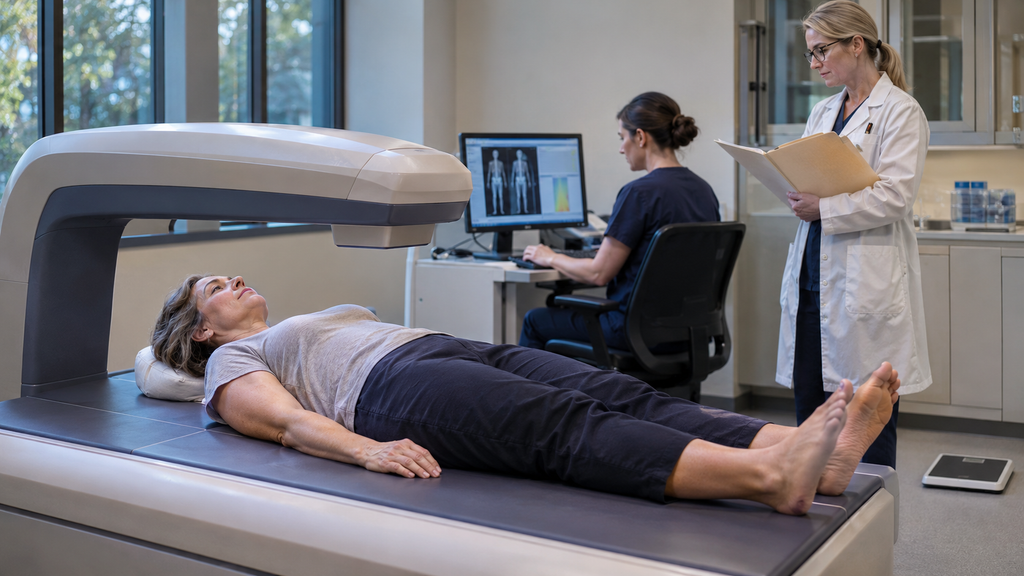
That does not mean one-third of the weight was skeletal muscle. Lean mass, as measured by dual-energy X-ray absorptiometry, or DXA, includes muscle and other non-fat soft tissues, including water and organs. It is a useful body-composition measure, but not a direct test of strength or physical performance.
Myostatin, also called growth differentiation factor 8 or GDF8, is one of the body’s natural brakes on muscle growth. Activin A is a related signaling protein that acts through receptors in the same family. Trevogrumab is an antibody designed to block myostatin. Garetosmab, a second Regeneron antibody, blocks activin A.
The logic behind COURAGE was straightforward. Semaglutide reduces appetite and helps people lose weight. Blocking the signals that restrain muscle growth might allow more of that weight loss to come from fat rather than lean tissue.
The trial tested that idea with trevogrumab alone as an add-on and with the two antibodies together. It was not a test of whether either experimental antibody should replace semaglutide.
The question was not simply how much weight people lost. It was what kind of tissue they lost.
What the COURAGE Trial Found in People
COURAGE was a two-part, randomized, double-blind, placebo-controlled Phase 2 trial funded by Regeneron. It enrolled adults aged 18 to 80 with obesity. Their average age was 49 years, their average body mass index was 36.7, and 64% were women.
Part A assigned 605 participants, of whom 599 received at least one dose of study treatment. Everyone received semaglutide, titrated toward 2.4 mg weekly. They were also assigned to placebo, trevogrumab 200 mg, trevogrumab 400 mg, or trevogrumab 400 mg combined with garetosmab 10 mg/kg. The primary body-composition comparisons were made at 26 weeks.
The semaglutide-plus-placebo group lost 6.6% of lean mass. Against that benchmark, the 200 mg trevogrumab group preserved an additional 3.1 percentage points of lean mass, with a 95% confidence interval of 1.9 to 4.3. The 400 mg group preserved 2.7 points, with an interval of 1.5 to 4.0.
Both differences were statistically significant. In relative terms, the antibody reduced the lean-mass loss seen with semaglutide alone by roughly 40% to 50%, depending on dose and analysis.
The three-drug group preserved 4.5 additional percentage points, with a confidence interval of 3.1 to 5.9. On this outcome, the combination produced the strongest effect.
Part B examined lower trevogrumab doses over 52 weeks in 376 participants. The semaglutide-plus-placebo group lost 7.3% of lean mass. Trevogrumab 75 mg preserved 3.1 additional percentage points, a statistically significant result. The 25 mg dose preserved 1.5 points, but its confidence interval ran from minus 0.3 to plus 3.3, crossing zero. That smaller effect was not statistically significant.
This distinction matters. COURAGE does not prove that every dose of trevogrumab reliably preserves lean mass. The results support a dose-dependent development strategy, while leaving the minimum effective dose unresolved.
On total body weight, adding trevogrumab alone did not produce significantly greater loss than semaglutide plus placebo. In Part A, weight declined by 10.6% in the placebo add-on group, and neither trevogrumab-only dose differed significantly from it.
The triple combination was different. It produced an additional 2.7 percentage points of weight loss and 11.7 percentage points more fat-mass reduction than semaglutide plus placebo. These were estimated treatment differences, not the total percentage of body weight or fat mass lost.
An exploratory MRI substudy involving 76 participants added a more muscle-specific measurement. Regeneron’s October 2026 presentation reported that trevogrumab reduced the loss of thigh-muscle volume by approximately 69% to 72% at week 52, depending on dose.
That is more directly about skeletal muscle than a whole-body DXA measure, although it comes from a much smaller subset of patients.
The difference was primarily in body composition, not the number on the scale.
The Combination That Did Not Hold Up
The safety record divides the study sharply.
Semaglutide with trevogrumab alone was generally well tolerated. Across the tested trevogrumab-only doses, the researchers reported an overall safety profile similar to semaglutide plus placebo. Gastrointestinal complaints, including nausea, diarrhea and constipation, were common across treatment arms.
Adding garetosmab changed that picture.
In the triple-combination arm, 14 of 149 participants, or 9%, experienced a serious adverse event. Forty-eight, or 32%, discontinued treatment. In the 26-week Part A comparison, treatment discontinuations were 4.6% with semaglutide plus placebo, 5.4% with trevogrumab 200 mg, and 10.6% with trevogrumab 400 mg.
Muscle spasms were particularly revealing. They occurred in 61 of 149 people receiving the triple combination, or 41%, compared with 23 of 299 people, or 8%, across the two trevogrumab-only groups, and seven of 151, or 5%, in the placebo add-on group.
Two participants died, both in the triple-combination arm. Regeneron previously described one death as being of undetermined cause in a person with several cardiovascular risk factors. The other followed cardiac arrest in a participant with a history of cardiovascular disease.
Neither the company nor the trial investigators established a causal association between treatment and these deaths. Their occurrence in the same arm nevertheless belongs in any careful account of the safety results. It should not be presented as proof that the combination caused them, nor omitted because causation was not established.
The published investigators concluded that while adding activin A inhibition improved body composition and weight loss, the combination did not have favorable safety and tolerability.
That conclusion narrows the development argument. Trevogrumab by itself demonstrated a measurable body-composition effect with a more manageable safety profile. Adding another antibody increased the effect, but also brought substantially more treatment discontinuations and muscle-related complaints.
The most aggressive combination preserved the most lean mass. It also produced the most troubling safety record.
What Happened After Semaglutide Stopped?
Part A included a second question that could eventually matter as much as preservation during weight loss: what happens to lean tissue when people stop semaglutide?
After 26 weeks, participants discontinued semaglutide and entered an additional 26-week period receiving trevogrumab 400 mg or placebo. The withdrawal-phase findings were described in research presented at the European Association for the Study of Diabetes meeting in September 2026.
Among those receiving placebo during the second period, mean lean mass at week 52 remained 2.4% below the original baseline. Those receiving trevogrumab ended 0.4% above baseline, a between-group difference of 2.8 percentage points.
These results suggest that continuing myostatin inhibition after semaglutide withdrawal may help restore lean tissue. That is potentially useful because discontinuation of GLP-1 therapy often brings weight regain, and researchers are concerned about the composition of the weight that returns.
But the withdrawal result was not COURAGE’s main primary-endpoint comparison. It remains a secondary-phase finding within a Phase 2 development program, not an established treatment strategy.
The result also does not show whether people who regained lean mass became stronger, more mobile or less likely to experience physical decline.
A scan can measure tissue. It cannot by itself establish that the tissue translates into better function.
The Limits of a Lean-Mass Trial
COURAGE gives researchers a clearer answer about myostatin inhibition than they had before. It does not yet give patients an answer about long-term physical health.
DXA lean-mass measurements were central to the trial. MRI provided additional information about skeletal-muscle volume in a smaller group. Neither result is equivalent to demonstrating that patients can lift more, walk farther, climb stairs more easily or avoid falls.
That distinction matters most for older adults and people with frailty, who may care less about the composition of a scan than about maintaining independence during treatment.
The COURAGE population was mostly middle-aged, with an average BMI of 36.7. People already vulnerable to functional decline were not the central focus of the trial. Regeneron has discussed plans for further research in older adults with obesity and reduced muscle mass or strength.
The study was also sponsored by the company developing the antibodies. Regeneron designed and funded the program, and several authors are company employees. Industry-sponsored trials can provide rigorous evidence, particularly when they are randomized and blinded, but independent replication and regulatory review remain important.
There is another comparison COURAGE did not make: exercise.
A separate randomized trial published in Nature Medicine in November 2026 found that adding supervised resistance training to tirzepatide reduced lean-mass loss and improved measured strength compared with tirzepatide alone. Grey Pepper has also covered the broader competition to improve the quality of weight loss with trevogrumab, alongside other efforts to address muscle loss during obesity-drug treatment.
The exercise trial and COURAGE cannot be compared head-to-head. They used different medicines, interventions, participants and outcome measures. No result from COURAGE proves that an antibody works better than resistance training, and the exercise findings do not show that trevogrumab would provide no additional benefit.
A future study could address that directly by comparing an antibody plus standard care against supervised exercise or by testing whether the two approaches work better together.
Trevogrumab and garetosmab remain investigational medicines. Neither is approved for preventing lean-mass loss during obesity treatment. The COURAGE data should not be interpreted as support for purchasing or using unapproved myostatin-blocking products outside clinical trials.
What Comes Next for Trevogrumab
The obesity-drug race has spent years chasing larger percentages of weight loss. COURAGE belongs to a quieter shift toward asking what kind of tissue is lost, and whether the body’s physical capabilities can be preserved along the way.
Regeneron now has a peer-reviewed Phase 2 trial showing that selective myostatin inhibition can reduce lean-mass loss during semaglutide treatment. The MRI substudy offers supporting evidence that at least some of the effect involves actual skeletal muscle.
The safety results also establish a boundary. Blocking both myostatin and activin A produced stronger changes in body composition, but the triple combination was not well tolerated. More molecular targets did not automatically make a better treatment.
The next trial will need to answer questions a body scan cannot: does the preservation of lean tissue produce measurable gains in strength, mobility and metabolic health? Can the effect be maintained over years? Does it help people at greatest risk of frailty? And does the safety profile remain acceptable in a larger population?
The Lancet paper settles an important first question. Trevogrumab can change the composition of semaglutide-induced weight loss in people with obesity.
Whether that makes people healthier remains unproven. And the combination arm is a reminder that improving a scan is not worth any price in safety.
Sources
- The Lancet — Mosenzon O, Rosenstock J, Raya JG, et al. Trevogrumab (anti-GDF8) with or without garetosmab (anti-activin A) for prevention of muscle loss during semaglutide-induced weight reduction in people with obesity (COURAGE). Published November 11, 2026. DOI: 10.1016/S0140-6736(26)01953-7. PubMed PMID 43014326.
- Regeneron Pharmaceuticals — Phase 2 COURAGE Trial Confirms Trevogrumab Prevents Lean Mass and Muscle Loss During GLP-1 Receptor Agonist-induced Weight Loss. October 1, 2026.
- Regeneron Pharmaceuticals — Results from Phase 2 COURAGE Trial Demonstrating Potential to Improve Quality of GLP-1 Receptor Agonist-induced Weight Loss. September 17, 2025.
- European Association for the Study of Diabetes via EurekAlert! — Study shows how trevogrumab (anti-myostatin) can help preserve lean mass during and after semaglutide-induced weight loss. September 30, 2026.
- Nature Medicine — Resistance exercise to attenuate lean mass loss during tirzepatide therapy for obesity: a randomized controlled trial. November 2026.
- ClinicalTrials.gov — COURAGE, NCT06299098.


