
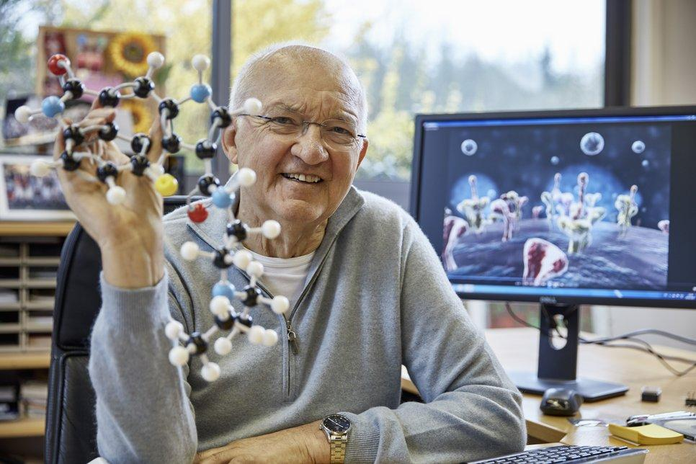
Historical profile. Before recombinant human insulin became an ordinary pharmacy product, it was a race among a handful of laboratories to persuade bacteria to carry and eventually express the genetic instructions for a mammalian hormone.
Axel Ullrich, a German molecular biologist, was in the middle of that race in San Francisco in the late 1970s.
What makes his career unusual is where it went next. After helping to establish methods for cloning insulin-related DNA, Ullrich turned toward the receptors that allow hormones and growth factors to communicate with cells.
That work helped reveal molecular connections between metabolism and cancer, contributing to discoveries behind the breast cancer medicine Herceptin and the kinase inhibitor sunitinib.
In 2019, Ullrich shared the Lasker-DeBakey Clinical Medical Research Award for the invention and development of Herceptin.
His story connects two important chapters of biotechnology: learning to work with the genes encoding therapeutic proteins, and learning to target the cellular receptors that drive disease.
From Silesia to San Francisco
Axel Ullrich was born on October 19, 1943, in Lauban, Silesia, then part of Germany and now Lubań in Poland.
He studied biochemistry at the University of Tübingen and completed a doctorate in molecular genetics at the University of Heidelberg in 1975.
He subsequently moved to the University of California, San Francisco, as a postdoctoral researcher, entering an environment where molecular biology was being transformed by recombinant DNA technology.
Researchers were learning to cut, copy and combine genetic material using enzymes and bacterial plasmids. These methods promised a new way to study mammalian genes and, potentially, manufacture proteins that had previously been extracted from animal tissues.
Insulin was one of the obvious targets.
For decades, people with insulin-dependent diabetes had relied on insulin extracted from pig and cow pancreases. Production depended on animal tissue supplies, complex purification and large-scale pharmaceutical processing.
A method for manufacturing human insulin using microorganisms could transform that supply chain.
But scientists first had to learn how to capture insulin’s genetic instructions and make those instructions function inside biological systems that did not naturally produce human hormones.
Other researchers had already revealed important parts of insulin’s biology. As we explored in our profile of Dorothy Hodgkin, X-ray crystallography eventually established the hormone’s complex three-dimensional structure.
And in our account of Rosalyn Yalow’s radioimmunoassay breakthrough, we examined how researchers learned to measure minute quantities of insulin in blood.
Ullrich’s generation confronted another question: could the genetic blueprint for a peptide hormone be cloned and ultimately used to manufacture it?
The 1977 Rat Insulin Experiment and the Road to Humulin
On June 17, 1977, Science published a paper titled Rat insulin genes: construction of plasmids containing the coding sequences.
Ullrich was the first author, working with John Shine, John Chirgwin, Raymond Pictet, Edward Tischer, William Rutter and Howard Goodman.
The researchers used messenger RNA from rat pancreatic islets to prepare complementary DNA, or cDNA, carrying sequences associated with insulin production.
They inserted those sequences into bacterial plasmids, small circular DNA molecules that can be maintained and copied by bacteria.
Several of the recombinant plasmids contained the complete coding region of rat proinsulin I, along with other portions of the original messenger RNA sequence.
The experiment was a major step for molecular cloning.
But it did not demonstrate that bacteria were already producing pharmaceutical-grade human insulin. The genetic material came from rats, and the result concerned cloning insulin-related DNA rather than manufacturing a finished medicine.
A rat insulin sequence inside a bacterial plasmid was not a drug. It was evidence that a hormone’s genetic blueprint could be captured.
A separate effort involving Genentech and City of Hope researchers developed a route using chemically synthesized DNA coding for human insulin’s A and B chains.
That team successfully expressed the chains in bacteria in 1978 and published its results in 1979. Further research and manufacturing development by Genentech and Eli Lilly helped turn recombinant DNA technology into a commercially practical insulin medicine.
Ullrich’s research also continued toward human insulin genetics.
In April 1980, I. Sures, David Goeddel, Alane Gray and Ullrich published a study in Science describing cloned complementary DNA encoding human preproinsulin.
The study reported recombinant bacterial plasmids containing human preproinsulin sequences, including a clone with the complete coding region.
Meanwhile, Genentech and Lilly continued the engineering and production work necessary to bring recombinant human insulin to patients.
In 1982, the US Food and Drug Administration approved Humulin, the first medicine manufactured using recombinant DNA technology.
It was a milestone achieved by multiple research teams, biotechnology engineers and pharmaceutical manufacturing specialists.
Ullrich was one important contributor to the broader insulin-cloning story, not the sole inventor of the commercial medicine.
Reading the Insulin Receptor Revealed a Molecular Connection to Cancer
Ullrich joined Genentech in the late 1970s. Institutional biographical accounts differ on whether the transition should be dated to 1978 or 1979.
At the company, he increasingly investigated growth factors and the receptors through which cells receive and transmit biological signals.
This was a different part of the same biological conversation.
Insulin is a hormone that signals to cells. The insulin receptor is the protein that recognizes that signal and activates intracellular pathways controlling metabolism and other cellular functions.
Understanding a hormone’s genetic sequence is useful. Understanding its receptor helps explain how the hormone produces its effects.
In 1984, Ullrich and collaborators published research describing the human epidermal growth factor receptor, or EGFR, and its relationship to a cancer-associated oncogene.
The following year, his team published another landmark paper in Nature: Human insulin receptor and its relationship to the tyrosine kinase family of oncogenes.
The researchers deduced the entire 1,370-amino-acid sequence of the human insulin receptor precursor using a complementary DNA clone.
The sequence revealed a signal peptide, a large extracellular alpha subunit, a processing site and a beta subunit containing a membrane-spanning segment.
It also revealed similarities to the human epidermal growth factor receptor and proteins associated with the src family of oncogenes.
The relationship was scientifically important because it connected insulin signaling with the wider world of protein tyrosine kinases, enzymes that regulate cellular signaling by adding phosphate groups to specific protein residues.
Some members of that broader signaling network can contribute to uncontrolled cell growth when altered or excessively activated.
This did not mean insulin itself causes cancer, or that the insulin receptor behaves identically to cancer-driving receptors.
It meant that researchers studying metabolism and researchers studying tumors were encountering related molecular machinery.
The receptor for a familiar metabolic hormone belonged to a much larger family of proteins that scientists were beginning to recognize as possible drug targets.
HER2, Herceptin and the Power of Targeting a Receptor
The search for additional signaling receptors helped lead Ullrich and his colleagues toward HER2.
In December 1985, a team including Lisa Coussens, Arthur Levinson, Axel Ullrich and other collaborators published a Science paper identifying a tyrosine kinase receptor closely related to the epidermal growth factor receptor.
The gene’s chromosomal location and sequence suggested a connection to the neu oncogene previously identified in experimental cancer research.
Other laboratories were independently investigating related genes and their potential role in malignancy.
The developing picture was that some cancers carried abnormal numbers of copies of the HER2 gene, producing excessive amounts of its receptor protein.
That made HER2 both a biological explanation for certain aggressive tumors and a possible target for a drug.
At UCLA, oncologist Dennis Slamon helped establish the clinical significance of HER2 amplification in breast cancer.
At Genentech, H. Michael Shepard, Ullrich and colleagues pursued antibody-based strategies for interfering with HER2 signaling.
The work eventually contributed to trastuzumab, marketed as Herceptin, a humanized monoclonal antibody that targets HER2.
Herceptin received FDA approval in 1998 and helped establish a new model of cancer treatment: identify a molecular abnormality in a tumor and develop a medicine directed at that abnormality.
The clinical success did not belong to one laboratory or one scientist.
It required receptor discovery, tumor biology, antibody engineering, clinical testing and pharmaceutical development across academic and industrial institutions.
In September 2019, the Lasker Foundation recognized Ullrich, Shepard and Slamon with the Lasker-DeBakey Clinical Medical Research Award for their contributions to Herceptin.
The award marked an extraordinary destination for a scientist whose earlier research had focused on cloning insulin genes.
SUGEN and the Cancer Pill That Followed
Ullrich’s work on targeted cancer treatments did not stop with antibodies.
In 1988, he became director of the Molecular Biology Department at the Max Planck Institute of Biochemistry in Martinsried, Germany.
He held that position until 2016, continuing his research into signal transduction, disease-associated genes and therapeutic targets.
In 1991, Ullrich co-founded SUGEN in California with institutional partners including the Max Planck Society and New York University.
The company’s work explored small molecules that could block receptor tyrosine kinases associated with tumor growth and the formation of new blood vessels.
One important pathway involved vascular endothelial growth factor receptors, which help tumors develop the blood supply needed to sustain growth.
Unlike a monoclonal antibody directed at a particular cell-surface target, a small-molecule kinase inhibitor can act on several intracellular signaling enzymes.
The SUGEN research program contributed to sunitinib, a multitargeted kinase inhibitor eventually marketed as Sutent by Pfizer.
Following additional development through successive corporate owners, sunitinib received FDA approval in 2006 for advanced kidney cancer and certain gastrointestinal stromal tumors.
Ullrich also helped establish other biotechnology companies, applying molecular research to the discovery of therapeutic targets and new medicines.
In 2010, he received the Wolf Prize in Medicine for his pioneering work in cancer-related molecular biology and drug development.
His career had now connected recombinant DNA research, receptor sequencing, targeted antibodies and orally administered kinase inhibitors.
What Ullrich’s Career Still Means for Peptide Medicine
Ullrich’s career is easy to turn into a story about one scientist inventing three landmark medicines.
That version would be too simple.
The 1977 rat-insulin experiment was a collaborative molecular-cloning achievement, not the direct manufacture of human insulin.
The commercial development of recombinant human insulin involved several research groups and years of manufacturing work.
HER2 was investigated by overlapping teams, and Herceptin emerged through contributions from scientists, engineers and clinicians across multiple institutions.
Sunitinib similarly required sustained drug-development work long after the underlying receptor biology had been identified.
The scientific record nevertheless establishes Ullrich’s unusually broad contribution.
He was first author on a landmark insulin DNA-cloning paper, coauthored human insulin gene research, led the sequencing study of the human insulin receptor and contributed to discoveries that made HER2-targeted cancer therapy possible.
Those achievements illuminate two capabilities that remain essential to modern biotechnology.
The first is the ability to understand and manipulate genetic instructions for producing biologically active proteins.
The second is the ability to understand precisely how those proteins and other signaling molecules interact with receptors on or inside cells.
Today’s recombinant insulin preparations and peptide drugs depend on highly developed manufacturing and molecular-engineering methods descended from that earlier era.
Modern GLP-1 medicines also depend on detailed knowledge of receptor pharmacology, although the mechanisms and technologies used today go well beyond Ullrich’s original insulin work.
The most enduring lesson is not that insulin research inevitably leads to cancer medicine.
It is that fundamental discoveries about biological signaling can become useful in diseases far removed from the questions that inspired the original experiments.
Axel Ullrich helped move biotechnology from cloning the instructions for a hormone to understanding the signaling proteins that could become drug targets.
He began by studying the genetic instructions for insulin. He helped change how researchers understood the signals that govern cancer.
Sources
Original rat insulin cloning study: Ullrich A, Shine J, Chirgwin J, et al. Rat insulin genes: construction of plasmids containing the coding sequences. Science. June 17, 1977. DOI: 10.1126/science.325648.
Human preproinsulin DNA: Sures I, Goeddel DV, Gray A, Ullrich A. Nucleotide sequence of human preproinsulin complementary DNA. Science. April 4, 1980. DOI: 10.1126/science.6927840.
Human insulin receptor: Ullrich A, Bell JR, Chen EY, et al. Human insulin receptor and its relationship to the tyrosine kinase family of oncogenes. Nature. February 28, 1985. DOI: 10.1038/313756a0.
HER2-related receptor discovery: Coussens L, Yang-Feng TL, Liao YC, et al. Tyrosine kinase receptor with extensive homology to EGF receptor shares chromosomal location with neu oncogene. Science. December 6, 1985. DOI: 10.1126/science.2999974.
Recombinant human insulin history: Riggs AD. Making, Cloning, and the Expression of Human Insulin Genes in Bacteria: The Path to Humulin. Endocrine Reviews. 2021. DOI: 10.1210/endrev/bnaa029.
Herceptin history and award: Lasker Foundation — Herceptin: A Targeted Antibody Therapy for Breast Cancer. 2019 Lasker-DeBakey Clinical Medical Research Award.
Biographical and institutional history: Max Planck Society — Axel Ullrich to Receive the Lasker Award 2019. September 10, 2019.
SUGEN and sunitinib: Max Planck Institute of Biochemistry — Basic Research Leads to a Novel Cancer Therapy. February 13, 2006.
Wolf Prize: Academia Europaea — Wolf Prize Recipients. Includes Axel Ullrich, Medicine, 2010.