
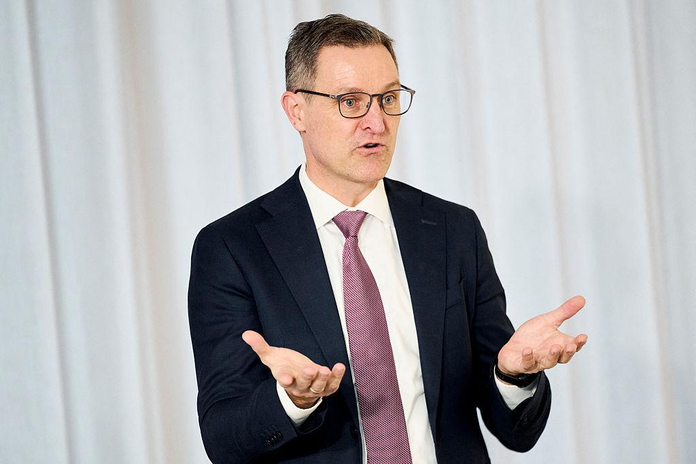
On the same day Novo Nordisk told investors its year would be better than feared, it also announced that the person who has run its finances since 2018 is leaving. Karsten Munk Knudsen, the finance chief who oversaw much of the company’s expansion during the Wegovy and Ozempic boom, will depart at the end of December 2026. His replacement is Luigi La Corte, currently chief financial officer of the Swiss dermatology company Galderma.
The announcement came on November 4, alongside third-quarter results showing improved sales expectations, billions of kroner in non-cash write-downs and renewed momentum in Novo’s obesity franchise. It also comes ahead of significant U.S. list-price reductions for Wegovy and Ozempic scheduled to take effect on January 1, 2027.
Executive changes at large pharmaceutical companies are routine. This one carries particular weight because of what the next CFO inherits: a business transitioning from years of exceptional growth toward a market where competition, pricing and capital allocation are becoming harder to manage.
Who Is Luigi La Corte, Novo Nordisk’s Incoming CFO?
La Corte arrives from Galderma, but his time there has been unusually short. The Swiss dermatology company appointed him CFO effective May 1, 2026, after his previous tenure at Italian pharmaceutical company Recordati. On November 2, Galderma announced that he had decided to leave for another significant opportunity. Two days later, Novo named him as Knudsen’s successor.
That means La Corte had occupied Galderma’s finance leadership position for approximately six months when the new appointment was announced. Galderma said he would continue fulfilling his responsibilities during the transition and that details of succession arrangements would follow.
Novo’s SEC-filed November 4 report provides a more complete picture of his background. La Corte served as CFO of Recordati from 2019 to 2025 and has sat on its board since 2022. Earlier, he held finance positions across GSK, AstraZeneca, PepsiCo and Procter & Gamble. He is an Italian national with an economics master’s degree from Luiss University in Rome and a professional accounting qualification.
Chief executive Mike Doustdar emphasized La Corte’s more than 30 years of international financial experience across healthcare and consumer businesses. The description is relevant because Galderma operates across therapeutic dermatology, injectable aesthetics and skincare, areas where brand positioning, patient demand and commercial channels influence financial performance.
Novo’s obesity business increasingly faces similar commercial questions. Patients may encounter its products through traditional insurance, direct-to-patient services, online healthcare platforms and pharmacy channels, with substantially different pricing arrangements.
That does not establish that Novo hired La Corte specifically to accelerate direct-to-consumer selling. The company has not disclosed such a mandate. But his experience across pharmaceutical and consumer-facing businesses makes the appointment noteworthy as Novo approaches a more price-sensitive period.
Novo has not provided a precise date for La Corte to assume the CFO position. Knudsen will remain through December, and the company says La Corte will relocate to Denmark.
What Karsten Munk Knudsen Leaves Behind
Knudsen’s tenure is almost a corporate history in itself. He joined Novo in 1999, worked in finance across the organization, held senior U.S. finance and technology responsibilities between 2010 and 2014, and became executive vice president and CFO in February 2018.
According to Novo’s November 4 filing, sales, operating profit and operating cash flow almost tripled during his period as finance chief. He also participated in the expansion of manufacturing capacity intended to support Novo’s fast-growing pharmaceutical portfolio.
Those achievements were closely connected to the rise of semaglutide. Ozempic became one of the world’s leading diabetes medicines, while Wegovy helped establish a mass market for prescription obesity treatment. Manufacturing capacity, once one of Novo’s greatest constraints, became a central investment priority.
But the latest quarterly results also illustrate the cost of managing that expansion through a changing market.
Novo recorded DKK 8.7 billion in non-cash impairment charges during the third quarter of 2026. Of that amount, DKK 4.1 billion related to right-sizing its manufacturing network, while DKK 4.6 billion reflected a write-down of the investigational cardiovascular drug ziltivekimab following disappointing clinical results.
Grey Pepper examined Novo’s ziltivekimab impairment and the clinical trials still underway separately. The manufacturing charge belongs to a different part of the same financial story: how much capital a drugmaker should commit when growth expectations change.
An impairment is an accounting reduction in the recorded value of an asset. It does not mean the entire amount was paid out in cash during the quarter. It does, however, reflect a reassessment of expected future economic value.
Novo said its agreement with Knudsen to part ways was mutual and that he would leave to pursue other opportunities. Its filing does not connect his departure to the impairments or any particular financial performance issue. Treating the CFO change as a dismissal over the company’s setbacks would go beyond the disclosed record.
The Guidance Improved, but It Still Allows Sales to Shrink
The numbers released alongside the leadership announcement were stronger than Novo’s previous forecast suggested. Third-quarter sales reached DKK 79.2 billion, an increase of 4% at constant exchange rates. Adjusted operating profit reached DKK 31.7 billion, an increase of 27% on the same currency-adjusted basis.
Reported operating profit told a different story. It fell 9% at constant exchange rates to DKK 23.0 billion, reflecting the impairment charges. The adjusted and reported figures answer different questions: one attempts to show underlying operating performance, while the other incorporates the accounting consequences of the quarter’s setbacks.
Novo’s obesity business continued growing. Third-quarter obesity-care sales reached DKK 26.1 billion, up 22% at constant exchange rates. The Wegovy pill contributed DKK 5.4 billion in quarterly sales, with launches completed in the United States, United Arab Emirates, United Kingdom and Germany by the end of September.
Our coverage of Novo’s third-quarter earnings and the Wegovy pill examines the commercial significance of that performance.
The company also raised its full-year 2026 outlook. Adjusted sales growth and adjusted operating profit growth are now both expected to range from a 2% decline to 2% growth at constant exchange rates. The previous forecast ranged from a 6% decline to flat performance.
That is a meaningful upgrade, but it is not a return to guaranteed expansion.
A forecast that still permits contraction shows how far Novo’s growth expectations have shifted since the strongest years of the obesity-drug boom. The company is seeing improved demand while continuing to confront pricing pressure, competition and changing reimbursement conditions.
Novo also raised its 2026 free-cash-flow outlook to DKK 60 billion to DKK 70 billion. That is a forecast for the current financial year, not guidance for 2027 or a specific target assigned to the incoming CFO.
The January Price Cuts Will Reshape Novo’s Financial Calculations
The most consequential date on Novo’s near-term pricing calendar is January 1, 2027. On that day, previously announced U.S. list-price reductions for Wegovy, Ozempic and oral semaglutide products are scheduled to take effect.
Novo announced the reductions in February 2026, months before the CFO succession became public. The new wholesale acquisition cost is set at $675 per month for applicable products and doses, representing cuts of approximately 50% for Wegovy and 35% for Ozempic.
The change is significant, but list price is not the same as the amount Novo ultimately receives for every prescription. Insurance arrangements, pharmacy benefit manager negotiations, manufacturer rebates and patient assistance programs can create wide differences between published prices and realized revenue.
Novo has also stated that the list-price reductions do not change its existing direct-to-patient self-pay prices. A lower wholesale acquisition cost therefore does not mean every person purchasing semaglutide will automatically receive an equivalent reduction at checkout.
In its latest financial report, Novo acknowledged that lower realized pricing and intensifying competition are affecting its business. The company also expects the announced list-price reductions to affect cash flow in 2027.
Those conditions make the finance function particularly important. Investors will need to understand whether additional prescriptions and broader access can offset pressure on realized prices, how different sales channels affect profitability, and whether capital spending remains appropriate for the demand Novo now expects.
The challenge is not simply to sell more medicine. It is to generate sustainable financial returns while more patients gain access through a changing mix of distribution and reimbursement channels.

What the CFO Handover Does Not Tell Investors
It would be easy to turn this appointment into a sweeping narrative about corporate transformation. A longtime internal executive departs. An outsider with consumer-market experience arrives. The company prepares to cut prices and reassess manufacturing investments.
But those facts do not establish a change in strategy by themselves.
Novo has not attributed Knudsen’s departure to its financial performance, and it has not publicly attached a new commercial mandate to La Corte’s appointment. Nor has it specified the incoming CFO’s exact start date, leaving the final handover schedule open.
There are more useful questions to follow. Will Novo’s 2027 guidance show that prescription volume is compensating for lower realized prices? Will manufacturing spending continue to moderate after years of expansion? How much of the company’s future growth will come from oral medicines rather than injectable products? And will further pipeline setbacks require additional changes to the value of assets on the balance sheet?
La Corte’s relatively brief tenure at Galderma is another piece of the chronology, but it is not evidence of a dispute or failed performance. Galderma announced his departure as a move toward another professional opportunity and said he would support the transition.
The confirmed picture is straightforward. Novo is replacing an internal finance chief with 27 years of institutional knowledge with an executive who has worked across pharmaceuticals and consumer-facing industries. The appointment coincides with improving quarterly performance but also with a business model under more pressure to demonstrate disciplined spending and sustainable margins.
Knudsen helped manage a period when demand for semaglutide stretched Novo’s manufacturing capacity. His successor enters a period when the harder question may be how much each prescription earns, rather than whether the company can produce enough of them.
The handover is not proof of a corporate reset. It is a useful marker of how dramatically the financial questions facing one of the world’s leading obesity-drug companies have changed.
Sources
- Novo Nordisk — SEC Form 6-K. Financial report for the period January 1 to September 30, 2026, including changes to executive management and financial guidance. November 4, 2026. Read the SEC filing.
- Novo Nordisk. Third-quarter adjusted operating profit increases 27% at constant exchange rates; full-year outlook raised. November 4, 2026. Official financial announcement.
- Galderma. Galderma announces proposed board appointments and chief financial officer transition. November 2, 2026. Official transition announcement.
- Galderma. Appointment of Luigi La Corte as chief financial officer, effective May 1, 2026. February 16, 2026. Original appointment announcement.
- Novo Nordisk. Reduction in U.S. list prices for Wegovy, Ozempic and Rybelsus, effective January 1, 2027. February 24, 2026. Official pricing announcement.


