
Yesterday, Novo Nordisk was heading into its third-quarter report with guidance that still allowed sales to shrink. On November 4, the company moved that floor.
Novo Nordisk earnings for the third quarter of 2026 showed net sales of DKK 79.2 billion, up 6% in Danish kroner and 4% at constant exchange rates. The company also raised its full-year outlook for adjusted sales and operating-profit growth.
The standout performer was a product that had only entered the US market in January: the Wegovy pill.
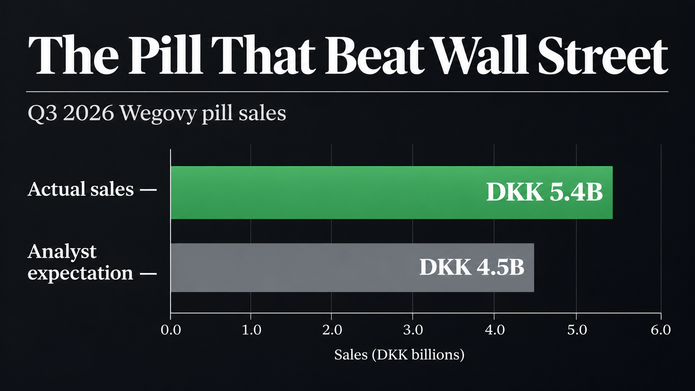
Oral Wegovy generated DKK 5.394 billion in quarterly sales, beating the approximately DKK 4.5 billion analyst expectation cited by AskTraders.
But the stronger results came with a complication. Reported operating profit was weakened by billions in non-cash impairments, and major US list-price reductions for Wegovy and Ozempic are already scheduled for January 1, 2027.
The pill beat the forecast. The next question is how much of that growth Novo can retain when prices change.
What Novo Nordisk Earnings Showed This Quarter
The numbers that attracted attention were the ones that exceeded expectations.
AskTraders, citing analyst consensus figures, reported expectations of approximately DKK 73.6 billion in quarterly sales and DKK 28.6 billion in adjusted operating profit.
Novo delivered DKK 79.195 billion in revenue and DKK 31.720 billion in adjusted operating profit.
Adjusted operating profit increased 27% at constant exchange rates compared with the same quarter a year earlier.
Those figures gave investors evidence that the company could still outperform expectations despite increasing competition across the obesity-treatment market.
According to contemporary Reuters reporting, Novo’s Class B shares rose following the announcement, reflecting a positive initial market reaction to the improved outlook.
Obesity care was a major contributor to the quarter. Sales in the segment reached approximately DKK 26.15 billion, representing growth of about 22% at constant exchange rates.
The company attributed the improved performance to volume growth across its GLP-1 portfolio, including stronger demand for oral Wegovy.
Growth came from both US Operations and International Operations, an encouraging development after a period in which the company’s American business had faced substantial competitive and commercial pressure.
Yet the distinction between beating a forecast and restoring an earlier growth trajectory is important.
A 4% quarterly revenue increase at constant exchange rates is a meaningful improvement, but it is considerably slower than the extraordinary expansion that characterized the first stage of the GLP-1 market.
Novo showed that its business can deliver stronger results than expected. It did not establish that the pricing and competitive challenges behind its previous difficulties have disappeared.
The Wegovy Pill Is Now a Real Business
The oral version of Wegovy was one of the clearest positive developments in Novo’s third-quarter announcement.
Launched in the United States in January 2026, the pill generated DKK 5.394 billion in third-quarter sales.
That was ahead of analyst expectations. AskTraders cited a forecast of approximately DKK 4.5 billion, while Reuters reported a separate consensus estimate of DKK 4.62 billion.
Although the two benchmarks differ, both indicate that oral Wegovy exceeded market expectations.
Reuters also reported that Wegovy pill revenue increased approximately 53% from the previous quarter.
For Novo, the significance extends beyond the revenue generated by a single product.
Oral semaglutide offers an alternative to weekly injections and introduces another way for patients, prescribers and healthcare systems to consider obesity treatment.
By the time of the earnings announcement, Novo said Wegovy pill had launched in eight markets, including the United States, United Arab Emirates, United Kingdom and Germany.
The company also reported that the Wegovy franchise accounted for more than half of new patient starts in the US branded obesity market.
That is a significant commercial indicator, but it requires careful interpretation.
A share of new patient starts measures recent prescribing momentum within a defined market. It does not establish that Novo controls more than half of all obesity-treatment prescriptions or that the competitive contest has been settled.
Eli Lilly remains a formidable rival.
Its tirzepatide franchise continues to generate substantial revenue, as discussed in Grey Pepper’s analysis of Lilly’s third-quarter Mounjaro and Zepbound performance.
The rivalry is also expanding into oral therapies, where comparisons can be complicated by differences in clinical trial populations, treatment doses and study designs.
Our earlier examination of Lilly’s Foundayo and Novo’s oral semaglutide products explains why results from separate studies should not automatically be treated as head-to-head evidence.
The commercial opportunity for oral obesity treatments is substantial. But sustained growth will depend on patient access, tolerability, reimbursement, adherence and competition.
The Wegovy pill is already a meaningful business. Whether its early growth can continue at the same pace remains uncertain.
Adjusted Versus Reported Profit: Two Different Quarters
Read only the adjusted earnings figures and Novo’s third quarter looks like a straightforward recovery.
Read the reported results and the picture becomes more complicated.
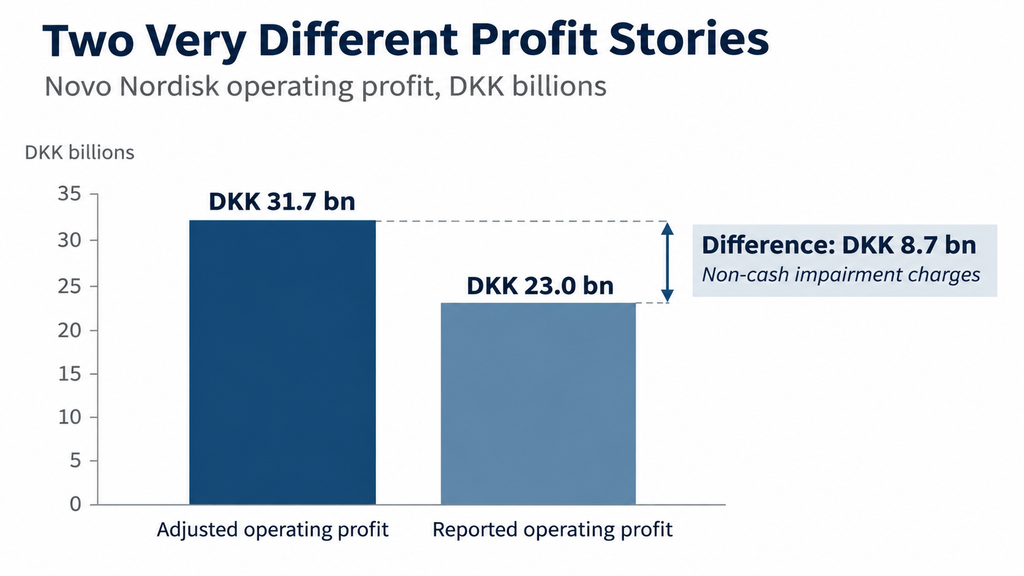
Adjusted operating profit reached DKK 31.720 billion, while reported operating profit was DKK 23.011 billion.
The difference was driven primarily by approximately DKK 8.7 billion in non-cash impairment charges.
Of that amount, DKK 4.6 billion was associated with ziltivekimab, an investigational anti-inflammatory treatment whose outlook deteriorated following the failure of the ZEUS Phase 3 trial.
Another DKK 4.1 billion related to adjustments in Novo’s manufacturing network.
Non-cash impairments do not mean the company spent an equivalent amount of cash during the quarter. They reflect changes in the accounting value of assets and investments.
Nevertheless, they matter because they reveal that earlier development or manufacturing assumptions did not produce the expected economic value.
Reported operating profit fell 9% at constant exchange rates, while adjusted operating profit increased 27% on the same basis.
Both figures are correct. They describe different aspects of the company’s financial performance.
The adjusted comparison also benefits from the year-earlier quarter, which included substantial transformation costs associated with Novo’s 2025 restructuring.
That makes the adjusted growth rate less straightforward than it first appears.
The company’s first nine months of 2026 reveal another important distinction.
Reported sales increased 13% at constant exchange rates, while adjusted sales grew only 2% after excluding items the company classifies as exceptional and non-recurring.
Investors may choose to focus on adjusted figures when evaluating continuing operations. Readers should still understand what has been removed from those calculations.
A company reporting improving adjusted profit while writing down assets is demonstrating two things simultaneously: current commercial performance is stronger, but some previous investments and capacity assumptions have lost value.
Those realities can coexist without making either set of numbers misleading.
The New Guidance Changes the Outlook
Novo’s stronger quarter prompted management to increase its full-year 2026 financial guidance.
The company now expects adjusted sales growth between minus 2% and plus 2% at constant exchange rates.
The same range applies to adjusted operating-profit growth.
Previously, Novo expected both measures to fall between minus 6% and zero.
The improvement is meaningful.
Raising the lower end of the forecast reduces the size of the contraction management considers possible, while lifting the upper end into positive territory creates room for modest annual growth.
The change suggests that management expects the improved demand for its GLP-1 portfolio to support stronger results during the remainder of the year.
However, the revised range still permits a decline in adjusted sales.
That is a notable position for a company that helped create the modern commercial market for GLP-1 obesity medicines.
Novo’s decision to raise guidance does not mean every previous problem has been resolved. It means management has become more optimistic about the balance of growth and pressure affecting the business in 2026.
The company also projected full-year free cash flow of DKK 60 billion to DKK 70 billion.
That outlook indicates substantial expected cash generation, although free cash flow remains subject to operating performance, investment needs and other financial developments.
The stronger forecast gives Novo a more encouraging position heading into the final months of 2026.
It does not yet explain how the business will perform once a new set of US pricing arrangements takes effect.
The Price Cuts Arrive on January 1, 2027
The most consequential numbers for Novo’s future profitability may not be part of the third-quarter income statement at all.
They are already written into the company’s pricing calendar.
On February 24, 2026, Novo announced plans to reduce the US wholesale acquisition cost of specified semaglutide products beginning January 1, 2027.
The planned changes will bring the monthly US list price of covered Wegovy and Ozempic products to $675.
For Wegovy, that represents a reduction of approximately 50% from its previous list price of about $1,350.
For Ozempic, the reduction is approximately 35%.
The pricing changes also cover the company’s oral semaglutide treatment for type 2 diabetes.
These cuts were announced months before the November earnings report. They should therefore be understood as an existing commercial commitment, not a new pricing decision triggered by the third-quarter results.
List prices also require careful interpretation.
The wholesale acquisition cost is the manufacturer’s published list price. It is not necessarily the amount paid by a patient, insurer, employer or pharmacy benefit manager.
Rebates, negotiated discounts, insurance benefits and purchasing arrangements can create substantial differences between a medicine’s list price and its actual net cost.
Novo has also stated that these list-price reductions do not change the direct-to-patient self-pay prices available through its existing purchasing channels.
Even with those distinctions, the reductions are commercially significant.
A lower published price changes an important reference point for discussions among manufacturers, payers and other participants in the pharmaceutical supply chain.
The timing adds another challenge.
Negotiated Medicare prices for selected semaglutide products are also scheduled to take effect on January 1, 2027, under the Medicare Drug Price Negotiation Program.
Those negotiated prices are separate from Novo’s $675 wholesale list price and apply within the relevant Medicare framework.
The company must therefore prepare for several pricing pressures at once, including government negotiation, competition from Eli Lilly, reimbursement decisions and its own list-price reductions.
More prescriptions can support revenue growth, but higher volume does not automatically guarantee higher profit.
The financial outcome will depend on net realized prices, product mix, rebates, treatment demand and manufacturing economics.
Novo’s improved guidance indicates confidence in its near-term operating performance. It does not establish how all these changes will affect the company’s 2027 profitability.
What Novo’s Earnings Comeback Still Has to Prove
The fourth-quarter and 2027 outlooks will be important tests of whether Novo’s improved performance represents a lasting recovery.
The company has demonstrated that its GLP-1 portfolio can generate stronger demand than analysts expected.
Its oral Wegovy launch is becoming a substantial business, and the revised financial guidance provides a more encouraging near-term picture.
But competition remains intense, and the next phase of growth may depend increasingly on the relationship between prescription volume and net pricing.
The company’s development pipeline adds another dimension.
Novo said it was preparing for a potential US launch of CagriSema in early 2027, subject to regulatory approval.
CagriSema combines semaglutide with cagrilintide, an amylin analogue, and represents an attempt to expand treatment options beyond existing semaglutide formulations.
In its November announcement, Novo cited 21% weight loss at 68 weeks in the REDEFINE 9 obesity trial.
The company also described results from REIMAGINE 5, a diabetes trial in which the studied CagriSema regimen produced 12.4% weight loss compared with 9.1% for tirzepatide 5 mg.
That comparison involved a specific tirzepatide dose and should not be interpreted as evidence that CagriSema outperforms every approved dose of the competing treatment.
Novo also began a Phase 3 obesity study of oral zenagamtide in September, illustrating its continued investment in next-generation metabolic medicines.
These programs may eventually broaden Novo’s portfolio, but successful clinical development does not guarantee regulatory approval or commercial success.
The company still needs to demonstrate that its future products can deliver meaningful benefits while remaining competitive on safety, convenience, access and cost.
For patients and payers, the growing importance of oral semaglutide could influence how obesity treatment is offered and reimbursed.
For pharmaceutical manufacturers, it demonstrates the commercial value of developing different formulations of established biological mechanisms.
For investors, however, the central question is narrower.
Can Novo convert rising treatment demand into sustainable earnings growth while price competition intensifies?
The Wegovy pill has proved it can generate significant sales. The next test is what those sales will be worth when US pricing changes take effect.
That is what makes the third-quarter results more interesting than a simple earnings beat.
Novo raised guidance, delivered strong oral Wegovy revenue and demonstrated continued demand for its obesity medicines.
At the same time, impairment charges revealed the costs of earlier strategic assumptions, and the company faces a future in which volume growth may need to offset growing price pressure.
Those developments point toward a changing pharmaceutical market in which the ability to manufacture, distribute and price medicines effectively may become as important commercially as the original scientific breakthrough.
Novo spent much of the previous year explaining why its business had lost momentum.
This quarter, it showed that growth can recover.
The next four quarters will help determine how much that growth is worth when the pricing environment changes.
Primary source: Novo Nordisk — Financial Report for the Period January 1 to September 30, 2026. November 4, 2026.
Earnings and analyst expectations: AskTraders — Novo Nordisk Raises Outlook on Wegovy Pill Beat. November 4, 2026.
Independent financial reporting: Reuters — Novo Nordisk Q3 Profit Beats Forecast, Raises 2026 Guidance. November 4, 2026.
Additional financial reporting: Investing.com via Yahoo Finance — Novo Nordisk Raises 2026 Outlook as Q3 Obesity Sales Jump. November 4, 2026.
US pricing announcement: Novo Nordisk — US List-Price Reductions for Wegovy and Ozempic. February 24, 2026.
Regulatory pricing context: Centers for Medicare & Medicaid Services — Medicare Drug Price Negotiation Program, Selected Drugs and Negotiated Prices.


