
Argenx built one of biotech’s most successful recent immunology franchises around an antibody fragment delivered by infusion or injection.
On November 9, 2026, the company announced a deal worth up to approximately $1.15 billion to acquire something very different: a discovery platform for macrocyclic peptides, ring-shaped molecules that researchers hope can reach difficult drug targets while offering the possibility of oral medicines.
The company is Unnatural Products, a biotechnology firm based in Santa Cruz, California, known as UNP. argenx has agreed to pay $550 million upfront in cash, with another $595 million potentially payable if specified development and regulatory milestones are achieved.
What the announcement does not provide is equally interesting. It identifies no specific clinical drug candidate, indication or development timeline associated with the acquisition.
That gap is the story. This is a substantial investment in the machinery of drug discovery rather than a publicly identified treatment approaching approval.
And it reflects an increasingly valuable ambition in pharmaceutical research: developing peptides capable of engaging targets that have historically required larger biological medicines, while overcoming the barriers that make oral peptide delivery difficult.
What argenx Is Buying in the Unnatural Products Deal
According to the November 9 announcement furnished to the US Securities and Exchange Commission, argenx will acquire the remaining shares of UNP, in which it already owns a minority stake.
The transaction provides $550 million upfront, funded from cash on hand, and up to $595 million in additional payments tied to specified development and regulatory milestones.
The total potential consideration is approximately $1.15 billion. Importantly, the milestone payments are contingent. They are not guaranteed payments or evidence that the underlying research programs will succeed.
Both companies’ boards have approved the agreement. Closing is expected before the end of 2026, subject to customary conditions.
UNP will continue operating from Santa Cruz, which argenx intends to establish as its dedicated peptide discovery hub.
Under the planned structure, UNP’s existing leadership and scientists will remain responsible for discovery activities within a strategic framework agreed with argenx. The larger company will contribute clinical development, regulatory and commercialization capabilities.
The scientific team is an important part of what argenx is purchasing. UNP was founded in 2016 by Cameron Pye and Joshua Schwochert, whose academic research at the University of California, Santa Cruz, focused on the behavior and engineering of macrocyclic molecules.
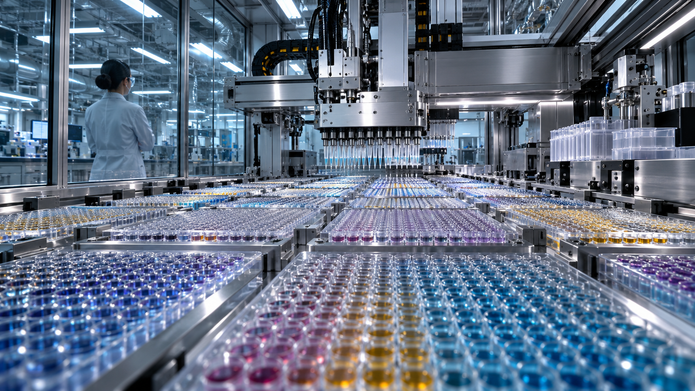
UNP says it has spent the past decade developing a platform combining computational molecular design, automated chemical synthesis and biological screening.
Rather than identifying one newly acquired medicine, the announcement describes a system intended to repeatedly discover and optimize future candidates.
Karen Massey, chief executive of argenx, said the acquisition adds peptide capabilities complementary to the company’s antibody engineering and creates opportunities for oral and long-acting medicines.
The $550 million buys a discovery engine, not a finished medicine.
Why Macrocyclic Peptides Are Worth Such a Premium
The attraction of macrocyclic peptides begins with a problem that has frustrated pharmaceutical researchers for decades.
Conventional small-molecule drugs often work by fitting into pockets on proteins. But some therapeutically important targets have broad, relatively flat surfaces or complex interfaces that are difficult for ordinary small molecules to engage.
Antibodies can recognize larger biological surfaces with high specificity, but their size generally prevents conventional oral administration. Many must be delivered through injections or infusions.
Macrocyclic peptides occupy an interesting middle ground.
Their amino-acid structures are constrained into rings, potentially helping them recognize larger or more complex binding surfaces. Molecular cyclization can also improve resistance to enzymatic breakdown and, with the right chemical design, support membrane permeability.
But forming a ring does not automatically produce an orally absorbed medicine.
Peptides often carry substantial molecular weight and polarity. Those properties can make it difficult for intact molecules to cross the intestinal barrier and reach sufficient concentrations in the bloodstream.
There are important exceptions. Cyclosporine, an established immunosuppressant, is an orally administered cyclic peptide. Its properties demonstrate that oral delivery is possible, but also illustrate how carefully balanced molecular conformation, permeability and metabolic stability need to be.
Other peptide-based medicines have reached patients through specialized formulations, while many experimental oral peptides have struggled with inconsistent absorption or inadequate exposure.
That makes UNP’s specific approach commercially interesting.
The company describes combining AI-guided molecular design with massively parallel chemical synthesis and direct biological screening. Instead of slowly optimizing one compound at a time, the platform is designed to generate and test many molecular variations, searching for combinations of target binding, stability and other drug-like properties.
High-quality binding in a laboratory assay, however, is only an early requirement. A useful oral drug must also survive biological barriers, reach its intended target, produce an acceptable safety profile and demonstrate meaningful effects in human trials.

The value of making peptides last longer is already apparent elsewhere in pharmaceutical science, as Grey Pepper examined in its explanation of semaglutide’s half-life engineering.
UNP is pursuing a different problem: identifying cyclic molecules with the properties needed to make difficult targets accessible to drug development, potentially through oral administration.
For argenx, success could expand the range of medicines the company can create. Failure would demonstrate that even sophisticated molecular engineering cannot guarantee clinical success.
The FcRn Clue and the Vyvgart Franchise
Although the acquisition announcement does not identify a drug candidate, the companies’ earlier collaboration offers a clue about their research priorities.
In July 2025, UNP announced a multi-target research agreement with argenx to discover oral macrocyclic peptide therapeutics against selected targets.
The agreement included upfront and research payments, with up to approximately $1.5 billion in potential milestones and option payments, plus royalties. Those possible payments belonged to the earlier collaboration and should not be confused with the consideration announced for the acquisition.
During argenx’s May 2026 earnings call, chief executive Karen Massey identified FcRn as the first target under the partnership.
FcRn, the neonatal Fc receptor, is already central to argenx’s commercial business. Its medicine Vyvgart contains efgartigimod, an engineered antibody fragment that binds FcRn and reduces circulating immunoglobulin G, or IgG, antibodies.
This mechanism has clinical value in certain antibody-mediated autoimmune diseases, including generalized myasthenia gravis. Approved Vyvgart formulations are administered intravenously or subcutaneously rather than as conventional oral tablets.
An effective oral FcRn inhibitor could therefore offer a different treatment format and potentially expand the population willing or able to receive FcRn-targeted therapy.
But this remains a development objective, not a demonstrated result for a publicly identified UNP candidate.
The November 9 acquisition announcement does not provide a molecular structure, dose, human pharmacokinetic dataset, clinical endpoint or development schedule for an oral FcRn treatment.
Nor does it establish that a candidate from the collaboration has successfully delivered clinically useful FcRn inhibition after oral administration.
There is a significant difference between identifying an attractive receptor and demonstrating that a new drug can safely and effectively modify it in patients.
The FcRn target is established. A clinically effective oral UNP medicine targeting it remains to be demonstrated.
What Happens to Unnatural Products’ Other Partners?
UNP has attracted investment and commercial interest from pharmaceutical companies beyond argenx.
In February 2026, UNP announced a licensing agreement with Novartis involving macrocyclic peptide therapies for an undisclosed cardiovascular program.
According to Reuters, the financial terms included up to $100 million upfront and approximately $1.7 billion in potential development, regulatory and commercial milestones, plus royalties.
Novartis is responsible for clinical development, manufacturing and worldwide commercialization of resulting products under that arrangement.
UNP also announced a research collaboration with Merck, known as MSD outside the United States and Canada, in January 2024. That arrangement involves a challenging oncology target and offers UNP the possibility of receiving up to approximately $220 million in development and commercialization milestones.
Its relationship with BridgeBio Pharma dates to 2021. In December 2024, UNP announced that BridgeBio had exercised an option to license macrocyclic candidates developed through their collaboration for rare-disease and oncology applications.
These agreements show that multiple pharmaceutical companies have been willing to commit capital to UNP’s discovery technology.
They do not establish that all the associated milestones will be earned, or that the compounds involved will ultimately become approved medicines.
The acquisition also introduces a commercial question. A technology platform serving several pharmaceutical partners has different incentives once it becomes part of a larger company with its own therapeutic priorities.
Will existing collaborations continue under their current terms? Will future research agreements remain possible? How will potentially sensitive research information be handled between commercial competitors?
Neither the argenx acquisition announcement nor UNP’s accompanying release specifies changes to the Novartis, Merck or BridgeBio agreements.
The existence of those relationships is documented. Their future arrangements under argenx ownership remain an open question.
The $550 Million Bet and the Evidence Still Missing
The financial context makes this transaction particularly revealing.
argenx reported approximately $3.7 billion in cash, cash equivalents and current financial assets as of September 30, 2026, after its acquisition of Forte Biosciences.
Against that reported liquidity position, the $550 million upfront commitment represents roughly 15%. The comparison uses the September balance sheet, not an updated estimate of cash available on the eventual closing date.
The deal also follows argenx’s purchase of Forte Biosciences, completed on August 27, 2026, following an agreement that valued Forte’s equity at approximately $2.2 billion.
That transaction added FB102, an investigational antibody targeting CD122, to argenx’s immunology pipeline.
Together, the acquisitions suggest a company increasingly willing to purchase external scientific capabilities and development programs rather than rely exclusively on internal discovery.
But the two transactions carry different types of evidence.
Forte brought an identified clinical-stage antibody program. The UNP announcement emphasizes a discovery platform, an experienced research team and the potential to produce multiple future candidates.
The price therefore reflects expectations about what the platform may generate, not publicly demonstrated clinical efficacy from a named medicine included in the acquisition announcement.
The distinction also matters when reading the transaction’s maximum value.
The $595 million in additional consideration depends on future milestones. Some or all of those payments may never become due.
Nor should the ability to engineer and screen macrocyclic peptides be treated as evidence that they will automatically outperform antibodies or conventional small molecules.
The key questions are whether UNP’s platform can consistently produce suitable candidates, whether those molecules reach useful concentrations after administration, and whether they eventually demonstrate safety and meaningful efficacy in appropriately designed human studies.
Manufacturing cost, formulation stability and intellectual-property considerations will also affect the commercial value of successful compounds.
None of those outcomes can be established by the acquisition price alone.
argenx may have access to collaboration findings that have not been made public. Its willingness to invest substantial cash suggests confidence in UNP’s capabilities, but outside investors cannot independently evaluate undisclosed preclinical data.
The most meaningful future disclosure would identify a development candidate, its molecular target, relevant pharmacokinetic and safety evidence, and a credible pathway toward clinical testing.
Until then, the transaction remains an expensive and deliberate bet on a scientific platform.
For the wider pharmaceutical industry, the acquisition provides another example of how valuable new peptide-discovery capabilities have become. Companies are increasingly competing not only over which drug performs best, but over which technologies could produce the next generation of medicines.
argenx has agreed to pay hundreds of millions of dollars for the ability to explore that future from a Santa Cruz laboratory.
The company has purchased the promise of new chemistry. The clinical evidence needed to turn that promise into medicines still has to be produced.
Sources and Further Reading
- argenx. Acquisition of Unnatural Products, Inc. Press Release Furnished on SEC Form 6-K, Exhibit 99.1. November 9, 2026.
- Unnatural Products. Unnatural Products to Be Acquired by argenx for up to $1.15 Billion. November 9, 2026.
- Unnatural Products. Multi-Target Collaboration with argenx to Develop Oral Macrocyclic Peptide Therapeutics. July 1, 2025.
- argenx. Third Quarter 2026 Financial Results and Business Update. October 22, 2026.
- argenx. Completion of Forte Biosciences Acquisition. August 27, 2026.
- argenx. First Quarter 2026 Earnings Call Transcript, Including Discussion of the Oral FcRn Collaboration. May 7, 2026.
- Reuters. Unnatural Products and Novartis Sign Licensing Agreement for Cardiovascular Program. February 18, 2026.
- Unnatural Products. Research Collaboration with Merck. January 23, 2024.
- Unnatural Products. BridgeBio Exercises Option to License Macrocyclic Therapeutics. December 3, 2024.
- Cyclic Peptides for Drug Development. Angewandte Chemie International Edition, 2023. Review of cyclic-peptide design and oral delivery.