
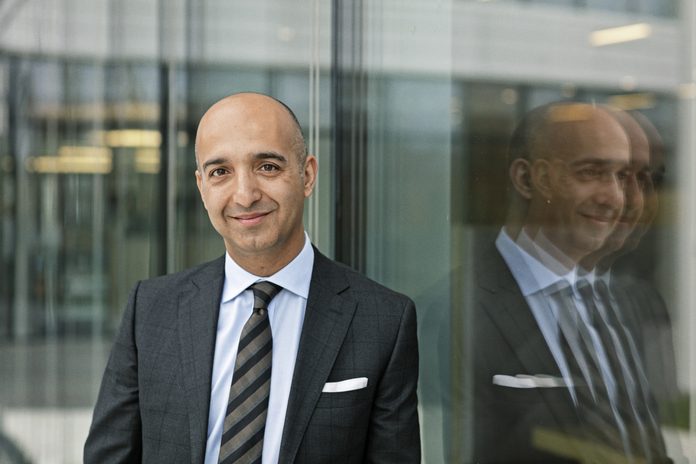
Mike Doustdar did not arrive at the top of Novo Nordisk through the laboratory or the Copenhagen boardroom. According to the company’s official biography, the executive now running one of the world’s most influential diabetes and obesity-drug manufacturers joined Novo in 1992 as an office clerk in Vienna.
On November 4, 2026, Doustdar presented a third-quarter report that was stronger than investors had expected. Novo reported improved sales, substantial growth in adjusted operating profit and increasing revenue from the Wegovy pill. It also raised its full-year financial outlook.
The more revealing detail was what the revised forecast still allowed. Even after the upgrade, Novo projected adjusted sales and operating profit growth between minus 2% and plus 2% at constant exchange rates.
For a company that helped create the modern obesity-drug market, an improved forecast that still permits contraction is a reminder of how much has changed. For Doustdar, it is also a test of whether a career built on commercial execution can help restore more consistent growth.
From Vienna Office Clerk to the Top of Novo Nordisk
Maziar Mike Doustdar was born in Iran in 1970 and grew up in the United States, according to Novo Nordisk’s official biography. An Austrian national, he studied international business at Webster University in Vienna, earning his bachelor’s degree in 1994.
He had already begun his career at Novo two years earlier. In 1992, Doustdar joined the company’s Vienna office as an office clerk, performing administrative and reception duties before moving into finance in 1993.
His early responsibilities gradually expanded. By 1995, he was working as a finance manager across several Central and Eastern European markets. In the following years, he held positions involving information technology, logistics, operations and commercial management across different parts of Novo’s international business.
In 2007, he became general manager of Novo Nordisk Near East, based in Istanbul. The role involved managing operations across markets with very different healthcare systems, commercial environments and regulatory challenges.
He was promoted to vice president of Business Area Near East in 2010 and moved to Malaysia in 2012 to lead the company’s Oceania and Southeast Asia operations.
His rise continued in 2013, when he became senior vice president of International Operations. In April 2015, he was promoted to executive vice president, taking responsibility for a business that would eventually encompass most of Novo’s markets outside the United States.
That experience became the central argument for his eventual appointment as chief executive. Novo’s international operations more than doubled their sales under his leadership, reaching approximately DKK 112 billion in 2024.
On July 29, 2025, Novo announced that Doustdar would succeed Lars Fruergaard Jørgensen as president and chief executive officer. The appointment became effective on August 7.
The company was entering a more difficult competitive period. Its obesity-drug franchise remained substantial, but expectations had changed as competition intensified and investors began questioning whether the extraordinary growth of previous years could continue.
The appointment reflected a strategic choice. Novo selected an executive whose career had been shaped by international markets, operations and commercial management rather than a career primarily spent directing pharmaceutical research.
A company built on insulin science had handed leadership to someone who had learned its business market by market.
A First Year Defined by Cost Discipline and Restructuring
Doustdar’s arrival did not immediately produce a return to the rapid growth that investors had previously associated with Novo Nordisk. The early period of his leadership was marked by organizational changes, an emphasis on execution and efforts to direct resources toward the company’s core diabetes and obesity businesses.
In September 2025, Novo announced a major company-wide transformation designed to simplify the organization, speed up decision-making and redirect spending toward commercial and research priorities.
The plan included the intended reduction of approximately 9,000 positions globally, from a workforce of around 78,400. Novo estimated that the changes could generate approximately DKK 8 billion in annualized savings by the end of 2026.
Such reductions are financially consequential, but their strategic value cannot be measured by cost savings alone. A leaner organization may operate more efficiently, yet pharmaceutical companies also depend on research capacity, institutional knowledge and the ability to bring new products through lengthy development and regulatory processes.
The scale of the reset is visible in Novo’s financial comparisons. The company’s November 2026 report references DKK 9 billion in transformation costs recognized during the third quarter of 2025.
Those prior-year expenses make the 2026 adjusted operating-profit comparison more favorable. A large reported increase in adjusted profit therefore reflects more than current product demand or new efficiencies. It also reflects the financial base against which this year’s results are being measured.
The third quarter of 2026 brought a separate set of charges. Novo recorded DKK 8.7 billion in non-cash impairments, including DKK 4.6 billion associated with the investigational cardiovascular drug ziltivekimab and DKK 4.1 billion connected to manufacturing-network right-sizing.
These impairments are not the same as the prior year’s workforce-transformation costs. They represent reductions in the recorded value of assets following changes in expected future economic benefits.
The distinction helps explain the quarter’s contrasting profit measures. Adjusted operating profit increased 34% in Danish kroner to DKK 31.7 billion, equivalent to 27% growth at constant exchange rates. Reported operating profit, which included the impairment charges, fell 3% in kroner and 9% at constant exchange rates to DKK 23.0 billion.
Both figures matter. The adjusted number provides a view of the business excluding specified exceptional items. The reported number captures the financial consequences of the company’s decisions about the value of its assets and development investments.
For Doustdar, cost discipline is part of the leadership story. But the larger test is whether those decisions create a business capable of delivering sustained growth rather than simply a more favorable quarterly comparison.

The Wegovy Pill Changed the Tone of the Quarter
The clearest commercial bright spot in Novo’s November 4 report was the Wegovy pill.
Novo reported DKK 5.394 billion in third-quarter sales of the oral obesity treatment. By the end of September, the product had launched in the United States, United Arab Emirates, United Kingdom and Germany. Additional international launches followed.
The result mattered because Novo’s future cannot depend indefinitely on the strength of its existing injectable medicines. Oral treatments create another commercial opportunity, potentially reaching patients who prefer tablets or face barriers associated with injections.
But the market is also highly competitive. Eli Lilly has expanded its presence in obesity and diabetes treatment through Mounjaro and Zepbound, while newer oral medicines are creating additional pressure on product differentiation, pricing and access.
Grey Pepper covered that competitive environment in its analysis of Lilly’s third-quarter Mounjaro and Zepbound sales. The growing oral market adds another dimension, as discussed in our report on the indirect comparison of oral obesity medicines.
Novo’s overall third-quarter net sales reached DKK 79.195 billion, an increase of 6% in Danish kroner and 4% at constant exchange rates. The company attributed growth primarily to continued GLP-1 volume expansion, particularly in obesity.
For an executive whose previous career centered on developing international operations, the Wegovy pill offers a meaningful test of commercial execution. Success depends on market launches, distribution, pricing, physician adoption and the ability to reach patients.
These factors interact with the drug’s clinical profile, but they are not identical to it. An effective treatment must also be available, affordable and competitive within rapidly changing healthcare systems.
The company is preparing for another potential addition to its obesity portfolio. Novo said it was working toward a U.S. launch of CagriSema in early 2027, subject to regulatory approval.
CagriSema combines semaglutide with the amylin analogue cagrilintide. Its prospective launch would provide another opportunity to expand treatment options, although its final regulatory status and commercial performance remain uncertain.
For now, the Wegovy pill has supplied a measurable commercial success during a difficult transition. The unresolved question is whether that momentum will continue through future quarters as competition and pricing pressure intensify.
A Raised Forecast That Still Allows Novo’s Adjusted Sales to Decline
Here is where the financial story requires a closer reading.
Following the stronger-than-expected third quarter, Novo increased its 2026 outlook for adjusted sales growth and adjusted operating-profit growth to a range of minus 2% to plus 2%, measured at constant exchange rates.
The previous forecast ranged from a 6% decline to no growth. The new guidance therefore represents a genuine improvement in management’s expectations.
But a raised forecast is not necessarily a growth forecast. At the low end, Novo still expects adjusted sales and adjusted operating profit to be 2% below the comparable prior-year figures.
That distinction is important for interpreting both the company’s recovery narrative and Doustdar’s leadership.
During the first nine months of 2026, Novo reported DKK 227.746 billion in adjusted net sales, flat in Danish kroner and 2% higher at constant exchange rates. Adjusted operating profit increased 8% at constant exchange rates over the same period.
The company’s reported nine-month net sales were considerably higher, at DKK 254.506 billion, representing 13% growth at constant exchange rates. However, that reported figure included a DKK 26.8 billion non-cash reversal of a provision related to the U.S. 340B Drug Pricing Program.
The reversal was recognized in the first quarter following the resolution of a legal uncertainty concerning the provision. Its presence helps explain why reported nine-month sales growth appears much stronger than the adjusted underlying comparison.
Those figures should not be treated as interchangeable. Reported results capture recognized accounting effects, while Novo’s adjusted measures exclude specified items that management considers exceptional or outside normal operations.
For investors, both views offer information. One describes the company’s financial statements as reported. The other attempts to show how the underlying business performed without the selected adjustments.
Doustdar’s challenge is that a stronger quarter does not automatically remove the pressures shaping the full-year outlook.
Competition from Lilly, pharmaceutical pricing pressure and the cost of sustaining global commercial operations remain significant factors. The Wegovy pill may improve Novo’s position, but the company still needs to show that stronger volume and new product launches can generate durable growth.
The revised forecast represents progress compared with the previous outlook. It does not yet establish that Novo has returned to a sustained period of expansion.
The Leadership Test Is Bigger Than One Stronger Quarter
A profile of a sitting chief executive has limitations. The public record documents Doustdar’s career, the company’s stated priorities and its financial results, but it does not reveal every internal discussion behind decisions concerning restructuring, product strategy or investment.
It is therefore too early to establish whether the workforce reductions, manufacturing changes and commercial reorganization will strengthen Novo over several years. Some decisions may improve efficiency while others could create longer-term costs or operational challenges.
The same caution applies to the Wegovy pill. Its third-quarter sales demonstrate meaningful early commercial traction, but durable success will depend on continued demand, competitive positioning, insurance access and pricing over multiple reporting periods.
Novo also faces scientific and regulatory uncertainties. Its portfolio includes established medicines that generate substantial revenue alongside investigational products that may or may not complete development successfully.
The DKK 4.6 billion impairment on ziltivekimab illustrates that difference. Financial discipline can involve recognizing that a scientific program no longer offers the expected economic opportunity, even when the original research rationale appeared credible.
Under Doustdar, Novo is attempting to defend its established diabetes and obesity businesses while expanding treatment options and improving operational performance. The company is doing this in a market that has become more competitive and increasingly sensitive to affordability.
The November 2026 results offer evidence that some commercial initiatives are performing better than previously anticipated. They do not yet show whether the broader strategy has succeeded.
What makes Doustdar’s career unusual is the route that brought him here. He began with administrative work in Vienna, moved through financial and operational responsibilities across multiple regions and eventually became responsible for the global company.
That history makes the present challenge distinctive. Novo selected a leader known for managing businesses across markets at a moment when the company needed to demonstrate that its scientific achievements could still produce commercially sustainable growth.
The next tests will be visible in the numbers: whether Wegovy pill sales continue expanding, whether adjusted revenue growth improves, whether planned products reach the market and whether the leaner organization delivers lasting benefits.
For now, Doustdar has presented a better quarter and a more favorable outlook. The career that began at a Vienna office desk in 1992 is now measured against one of the most difficult expectations in modern pharmaceuticals: turning a powerful drug franchise into a business that can keep growing after the first extraordinary wave of success.
November 4 provided evidence of progress. It did not settle the question of what comes next.
Primary financial source: Novo Nordisk financial report for January 1 to September 30, 2026, published November 4, 2026.
Official executive biography: Maziar Mike Doustdar, President and Chief Executive Officer, Novo Nordisk.
Leadership appointment: Maziar Mike Doustdar appointed president and CEO, July 29, 2025.
Company restructuring: Novo Nordisk to streamline operations and reinvest for growth, September 10, 2025.
Additional reporting: Reuters — Novo raises 2026 outlook following stronger third-quarter results, November 4, 2026.


