
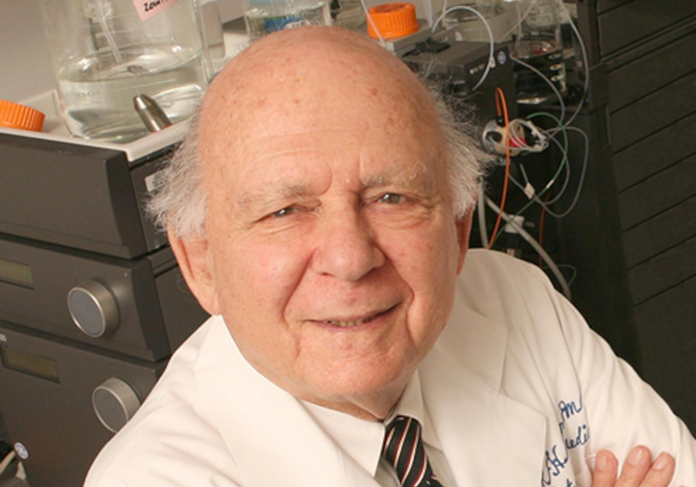
Historical scientist profile. No original interviews were conducted for this article.
For much of the twentieth century, the dominant explanation of diabetes centered on insulin. The hormone was missing, insufficient or unable to do its job. Roger H. Unger, an endocrinologist who spent 64 years at UT Southwestern Medical Center in Dallas, argued that the explanation was incomplete. Another pancreatic hormone, glucagon, helped drive the body’s blood sugar in the opposite direction. Understanding diabetes meant studying both.
His argument did not begin with a new drug. It began with a measurement. In 1959, Unger and his colleagues reported an immunoassay for glucagon, opening a way to investigate a hormone that had been known for decades but remained difficult to measure in blood.
The consequences reached far beyond a laboratory test. Glucagon became central to understanding glucose regulation, diabetes and metabolic disease. Today, experimental obesity medicines such as retatrutide deliberately activate the glucagon receptor alongside other hormone receptors, a strategy that would have seemed counterintuitive when Unger was investigating the dangers of excess glucagon activity.
The connection is not that Unger designed those medicines. It is that he helped establish glucagon as a hormone too important to ignore.
A New York Physician Who Made Dallas His Scientific Home
Roger Unger was born in New York City on March 7, 1924. According to a biographical tribute published in the Journal of Clinical Investigation by Philipp Scherer and Christopher Newgard, he attended Yale University and earned his medical degree at Columbia University.
His move toward diabetes research was not inevitable. He practiced medicine and spent time at Bellevue Hospital before entering the U.S. Public Health Service in 1951. An assignment involving diabetes detection brought him to Dallas, where he became interested in the developing medical school that would eventually become UT Southwestern.
In 1956, Unger joined the faculty of UT Southwestern and the Dallas Veterans Affairs Medical Center. He would maintain his association with the institutions for the remainder of his professional life, combining laboratory research with clinical medicine.
At the time, insulin had already transformed diabetes treatment. Glucagon, another pancreatic hormone identified in the 1920s, was recognized for its ability to raise blood sugar, but its normal physiological role and its contribution to diabetes remained poorly understood.
One obstacle was technical. Scientists could administer glucagon and observe what happened, but accurately measuring the tiny concentrations circulating naturally in blood was considerably more difficult.
Without a reliable assay, glucagon’s behavior inside the human body remained hard to investigate.
The 1959 Glucagon Assay Changed What Researchers Could See
Unger recognized that progress would require a way to measure the hormone. His laboratory drew on emerging radioimmunoassay techniques being developed by Solomon Berson and Rosalyn Yalow, whose work on insulin measurement would become a landmark in endocrinology.
According to the JCI historical tribute, Unger consulted Berson about the challenge. Berson’s laboratory helped Unger’s group learn how to attach radioactive iodine to glucagon, while the Dallas researchers developed the antibodies needed for their assay.
The resulting paper, published in 1959, was authored by Roger Unger, Anna Eisentraut, M. S. McCall, Sue Keller, Henry Lanz and Leonard Madison. The title was Glucagon antibodies and their use for immunoassay for glucagon.
A fuller methodological account followed in the Journal of Clinical Investigation in 1961. The chronology matters because the 1959 publication established an important early assay approach, while subsequent research improved the ability to measure circulating glucagon reliably.
The general principle was powerful. Antibodies that bind a hormone, combined with a detectable radioactive label, make it possible to estimate concentrations far below what many earlier biological tests could measure.
The method belonged to a broader revolution in hormone measurement. As we explained in our profile of Rosalyn Yalow and radioimmunoassay, these methods changed the questions scientists could ask about peptide hormones.
For Unger, the assay created an experimental foundation for investigating glucagon secretion during feeding, fasting, diabetes and other metabolic states.
Once glucagon could be measured, it became harder to dismiss as a minor participant in glucose regulation.

Diabetes Became an Insulin-and-Glucagon Problem
Insulin and glucagon perform opposing but coordinated roles in glucose metabolism. Insulin helps the body store and use nutrients and suppresses glucose production by the liver. Glucagon, released from pancreatic alpha cells, helps maintain blood glucose by stimulating hepatic glucose production, particularly when food is unavailable.
Unger and his collaborators showed that the relationship between these hormones mattered. Rather than viewing diabetes exclusively as a failure of insulin, they argued that excessive or inadequately suppressed glucagon could contribute substantially to hyperglycemia.
The concept became known as the bihormonal hypothesis of diabetes. The ratio of glucagon to insulin was part of the physiological signal determining how the body handled energy and circulating glucose.
This did not mean insulin was unimportant. In type 1 diabetes, insulin deficiency remains fundamental and requires insulin replacement. Unger’s argument was that insulin deficiency alone did not fully describe the metabolic abnormalities researchers observed.
A particularly revealing human experiment appeared in 1978. Working with Philip Raskin, Unger studied four people with type 1 diabetes who were receiving continuous insulin infusions. The researchers added somatostatin, a hormone that suppresses glucagon secretion, and observed marked improvements in blood glucose control.
Mean glucose concentrations fell substantially when glucagon was suppressed alongside the continuing insulin treatment. The experiment provided evidence that abnormal glucagon secretion contributed to hyperglycemia, even when insulin administration was being maintained.
It was a small, controlled physiological study, not a demonstration that somatostatin could replace insulin or become a practical standard treatment for diabetes.
Its significance was conceptual. Glucagon was not merely responding to metabolic disease. In the conditions Unger studied, it was contributing to the glucose abnormalities that defined it.
The medical establishment increasingly recognized the importance of this work. Unger received the American Diabetes Association’s Lilly Award in 1964 and its Banting Medal in 1975, followed by other international honors.
From Glucagon to Lipotoxicity: A Broader View of Metabolic Disease
Unger did not spend the rest of his career studying only glucagon. His research broadened into pancreatic islet biology, lipid metabolism, leptin and the mechanisms connecting obesity to type 2 diabetes.
In 1986, he helped establish the Touchstone Center for Diabetes Research at UT Southwestern, working with colleagues including Daniel Foster and J. Denis McGarry. The center brought new molecular and cellular techniques into the investigation of metabolic disease.
That same year, Unger was elected to the U.S. National Academy of Sciences.
One influential development came in 1995, when Unger published a review examining lipotoxicity in obesity-related diabetes. The concept described how excessive exposure to fatty acids and abnormal lipid accumulation could damage tissues, including pancreatic beta cells.
The work helped expand diabetes research beyond circulating glucose alone. The disease involved complex interactions among pancreatic function, fuel storage, liver metabolism and the effects of excess fat on tissues.
Unger also investigated leptin, the hormone involved in regulating energy balance and fat storage, and explored its effects on tissue lipid accumulation and pancreatic islet biology in experimental models.
These investigations did not establish a single universal explanation for diabetes. They contributed to a broader understanding in which metabolic disease involves several interconnected pathways, rather than one missing hormone or one malfunctioning organ.
He directed the Touchstone Center until 2007 and continued his research afterward. According to UT Southwestern, he retired in July 2020 and died on August 22 of that year, aged 96.
Glucagon’s Strange Second Act in Modern Obesity Drugs
There is an irony in the current generation of obesity medicines. Unger spent decades demonstrating why excessive glucagon activity could worsen high blood sugar. Some of today’s investigational medicines deliberately activate the same receptor.
Retatrutide, developed by Eli Lilly, is a triple-receptor agonist designed to activate GLP-1, GIP and glucagon receptors. Its development reflects an attempt to combine appetite and glucose-regulating effects with additional metabolic actions involving glucagon signaling.
Another investigational compound, survodutide, combines GLP-1 and glucagon receptor agonism. Both represent efforts to use glucagon signaling in a carefully balanced pharmacological setting rather than simply suppressing it.
The distinction is important. Glucagon can increase blood glucose, but its actions are not restricted to glucose production. Researchers are investigating whether glucagon receptor activation, when combined with other metabolic signals, can contribute to weight reduction, changes in energy expenditure and liver metabolism.
GLP-1 activity can counter some of glucagon’s glucose-raising effects, helping make the combination pharmacologically plausible. However, the contribution of each receptor to a multi-agonist drug’s overall clinical effect is difficult to separate, and safety and efficacy must be established for each medicine.
Our explainer on retatrutide’s triple-agonist science examines why researchers are combining these hormone pathways rather than targeting GLP-1 alone.
The historical connection received an unusual echo in 2026. Twelve years after Unger received the Rolf Luft Award, the same honor went to Richard DiMarchi and Matthias Tschöp for scientific advances involving peptide chemistry and dual- and triple-receptor agonists.
That does not establish a direct line from Unger’s laboratory to the design of those medicines. Their development reflects many decades of additional research by numerous scientists. But the shared scientific subject is striking: glucagon, once difficult even to measure, has become a deliberate target in advanced metabolic drug development.
The hormone that Unger argued could help drive diabetes is now also being investigated as one component of strategies to treat obesity.
What Roger Unger’s Legacy Can and Cannot Tell Us
Modern diabetes care is more complicated than any single historical hypothesis. Insulin resistance, beta-cell dysfunction, abnormal glucagon regulation, kidney glucose handling and other mechanisms all contribute to the disease.
The bihormonal hypothesis was influential, but it was not a complete explanation of every form of diabetes. Similarly, the fact that modern obesity candidates activate glucagon receptors does not prove that every glucagon-related therapeutic strategy will succeed.
Clinical results, tolerability, long-term outcomes and regulatory review remain the tests that determine whether investigational medicines become established treatments.
Unger was a scientist working within a larger community. The glucagon assay depended on collaborators in Dallas and methodological contributions from researchers studying insulin radioimmunoassay. The development of the bihormonal model and later metabolic research involved generations of colleagues, trainees and independent investigators.
This historical profile is based on original scientific publications, institutional records and published tributes. Grey Pepper did not interview Unger, his colleagues or his family, and it does not attempt to reconstruct undocumented private conversations or motives.
What the record establishes is substantial. Unger helped turn glucagon from a poorly measured hormone into a central subject of experimental endocrinology. His research changed how scientists understood diabetes, and his later work on lipotoxicity helped broaden the questions asked about metabolic disease.
His career also illustrates something more fundamental about scientific progress. A theory can remain incomplete without being unimportant. A molecule can have harmful effects in one context and become a therapeutic target in another. And a measurement technique can change medicine long before anyone knows what drugs will eventually emerge from the knowledge it provides.
Roger Unger’s lasting contribution was not simply arguing that glucagon mattered. It was helping give researchers the means to investigate how much it mattered, when it mattered and why.
Sources
- Unger RH, Eisentraut AM, McCall MS, Keller S, Lanz HC, Madison LL. Glucagon antibodies and their use for immunoassay for glucagon. Proceedings of the Society for Experimental Biology and Medicine. 1959;102:621–623.
- Unger RH, Eisentraut AM, McCall MS, Madison LL. Glucagon antibodies and an immunoassay for glucagon. Journal of Clinical Investigation. 1961;40(7):1280–1289.
- Raskin P, Unger RH. Hyperglucagonemia and Its Suppression — Importance in the Metabolic Control of Diabetes. New England Journal of Medicine. 1978;299:433–436.
- Unger RH. Lipotoxicity in the pathogenesis of obesity-dependent NIDDM. Diabetes. 1995;44(8):863–870.
- Scherer PE, Newgard CB. A tribute to Roger H. Unger (1924–2020). Journal of Clinical Investigation. December 1, 2020.
- UT Southwestern Medical Center. Roger H. Unger, M.D., visionary endocrinologist and preeminent authority on diabetes: 1924–2020. September 1, 2020.
- Luft Diabetes Foundation. Winners of Rolf Luft Award 2026: Richard DiMarchi and Matthias Tschöp. January 13, 2026.
- Jastreboff AM, et al. Retatrutide, a Triple Hormone Receptor Agonist, for Treatment of Obesity. New England Journal of Medicine. September 29, 2026.


