
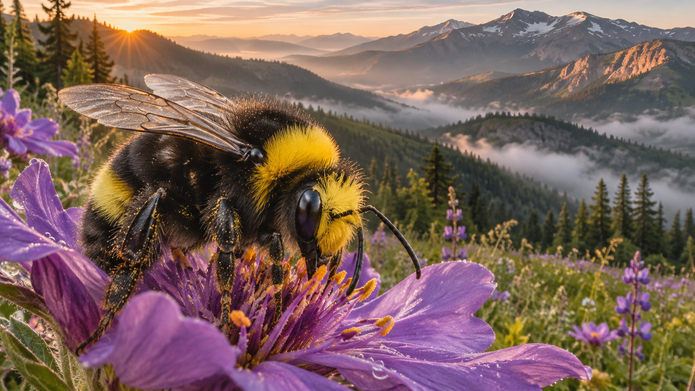
Anyone who has felt a bumble bee sting knows the venom works. What almost nobody asks is whether it is the same venom everywhere.
A study published November 4, 2026, in Proceedings of the Royal Society B suggests it is not.
Researchers sampled the yellow-faced bumble bee, Bombus vosnesenskii, along an elevation gradient in Oregon and found that the venom of wild bees differed between low and high elevations. One of the strongest differences involved a small antimicrobial peptide related to bombolitin, a distinctive component of bumble bee venom.
Then came the twist.
When researchers raised colonies derived from the same regional populations under shared laboratory conditions, the comparable elevation-associated pattern was no longer detectable.
This was an insect venom-composition study, not a medical experiment. Researchers did not test the venom’s clinical effects, measure how painful the different stings were or investigate a treatment.
What the findings do challenge is an assumption behind venom research: that a sample collected from a captive animal necessarily represents the chemical mixture that the same species produces in the wild.
The full paper also reveals an important complication. The wild bees and laboratory colonies were sampled in different years. That means the researchers cannot definitively attribute the disappearance of the elevation pattern to laboratory rearing alone.
The result is still intriguing. It simply deserves a more careful interpretation than saying altitude changes venom and captivity reverses it.
What Is in a Bumble Bee Sting?
Bee venom is not a single substance. It is a mixture of enzymes, proteins and peptides that contribute to the animal’s defensive system.
In honey bees, the best-known venom peptide is melittin, a membrane-disrupting molecule that has attracted decades of laboratory research.
Bumble bees carry their own family of short peptides known as bombolitins. These molecules are associated with membrane activity and antimicrobial effects, although the biological consequences depend on the specific peptide and experimental conditions.
The new study involved an 11-member research team led by N. Pinar Barkan, with researchers affiliated with The Ohio State University, the University of Alabama, the University of Wyoming and other institutions.
They used liquid chromatography coupled with tandem mass spectrometry, or LC-MS/MS, to investigate the chemical composition of venom collected from Bombus vosnesenskii.
The technique separates complex mixtures and identifies proteins and peptides through patterns produced when their molecular fragments are measured.
Rather than searching for a single toxin, the researchers examined many components of the venom simultaneously.
The full analysis identified hundreds of proteins and peptides, with approximately 40 components classified as venom toxins or putative toxins across the wild and captive samples.
Among them were phospholipase A2, hyaluronidase, venom proteases and a peptide initially identified by the software as melittin-like.
Because its sequence resembled previously characterized bumble bee bombolitins, the researchers considered the melittin-like classification misleading and referred to the molecule as bombolitin-like.
That peptide turned out to be one of the clearest signals separating wild bees from different elevations.
The same species can carry a measurably different venom mixture depending on where its populations live.
Wild Bumble Bees Varied by Elevation. Laboratory Colonies Did Not Show the Same Pattern.
The study began with wild yellow-faced bumble bees collected from eight sites in Oregon during July and August 2022.
Four sites were at low elevation, ranging from 9 to 122 meters above sea level. Four were at higher elevations, ranging from 1,311 to 1,633 meters.
Researchers collected 30 worker bees at each site, producing a total of 240 wild workers.
The bees were frozen after collection and transported for venom analysis. Investigators removed the venom reservoirs and pooled material from the 30 workers at each site into one sample.
That pooling matters statistically. The researchers had four pooled biological samples representing each elevation group, rather than 120 independent venom measurements in each group.
The comparison revealed a clear elevation-associated pattern.
In low-elevation wild populations, proteins classified as venom toxins accounted for 64.8% of the total measured proteomic spectral counts. In high-elevation populations, the corresponding share was 53.4%.
That is an 11.4-percentage-point difference in the relative share of identified toxin-related material, not proof that high-elevation bees produce 11.4% less venom or have weaker stings.
Seven venom-associated toxins showed lower measured abundance at higher elevations using the study’s initial statistical threshold.
Of those, the bombolitin-like peptide stood out. Its abundance difference remained statistically significant after correction for multiple comparisons, with an adjusted p-value of 0.010.
The other six declining toxins did not meet that stricter corrected significance threshold.
Next, the researchers used an ecological approach known as a common-garden experiment.
They collected prospective queens, or gynes, from low- and high-elevation Oregon populations in 2023 and established laboratory colonies under standardized conditions.
The colonies were reared at controlled temperatures and humidity, with shared feeding conditions.
Workers from eight captive colonies were sampled, again using 30 workers per colony, creating another 240-bee comparison.
But the same elevation-associated venom signature was not evident in the captive colonies.
The toxin-related spectral-count shares were 63.9% in captive colonies originating from low elevations and 66.3% in those originating from high elevations.
The researchers also found no statistically significant elevation-associated changes among the individually examined venom toxins in the captive comparison.
The contrast suggests that conditions outside the laboratory may contribute to the venom differences observed in wild populations.
It does not establish which environmental factor matters most, or exclude smaller inherited differences that the study might not have been able to detect.
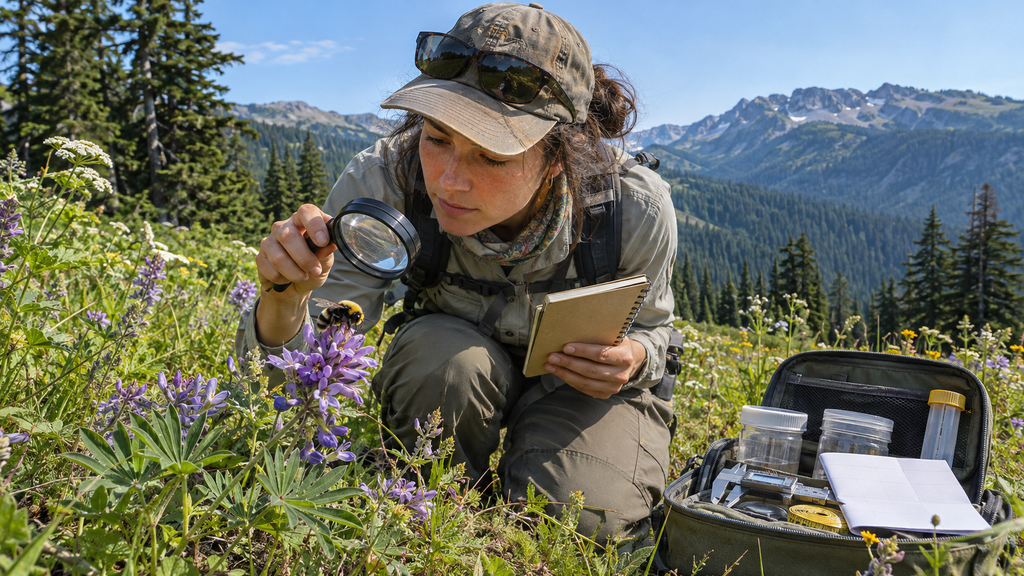
A venom profile measured in a controlled laboratory may not capture the same variation found across natural habitats.
This Has Happened Before in the Swiss Alps
The Oregon study has an important predecessor.
In a paper published online in December 2019 in Toxins, Barkan and colleagues investigated venom composition in the common carder bee, Bombus pascuorum, across an elevation gradient in the western Swiss Alps.
They compared specimens from locations at approximately 930 and 1,700 meters, using proteomic methods to identify differences in venom components.
One of the main findings concerned a phospholipase A2-like protein, a prominent component of bumble bee venom.
Its relative abundance declined with elevation, reaching approximately 42% of its low-elevation level at the highest site.
The earlier researchers suggested that environmental conditions might influence defensive venom composition.
But their results came from wild populations. They could not separate environmental influences from inherited population differences.
The new Oregon paper builds on that question by comparing wild populations with captive colonies raised under shared conditions.
The studies concern different bumble bee species on different continents, so their individual toxin results should not be treated as interchangeable.
Nevertheless, both support a broader observation: venom composition within a bee species may vary across landscapes rather than following a single fixed biochemical recipe.
The new study strengthens the argument that researchers should account for the ecological setting in which venom-producing animals develop.
That is especially relevant when comparing samples obtained from wild populations with those collected from animals maintained in captivity.
Why Venom Peptide Scientists Should Care
The broader lesson is methodological, and it reaches beyond bumble bees.
Venom research has contributed to the discovery of biologically active molecules with pharmaceutical potential.
A peptide discovered through research on Brazilian pit viper venom helped inspire the development of the blood-pressure medicine captopril, a story Grey Pepper examined in its profile of Sérgio Ferreira and the bradykinin-potentiating peptides.
Research on exendin-4, a peptide found in Gila monster saliva, also contributed to the development of exenatide, the first approved GLP-1 receptor agonist.
Neither example means bumble bee venom is a promising treatment. The Oregon paper does not investigate drug development or demonstrate therapeutic activity.
Its relevance is to the way researchers obtain and interpret biological samples.
Venomous animals are frequently kept in captivity because repeated sampling can be easier under controlled conditions.
Yet captivity changes the environment an animal experiences.
Diet, temperature, humidity, microbial exposure and interactions with other species may differ considerably from natural habitats.
If some venom components respond to those conditions, a laboratory-derived sample may provide an incomplete picture of the chemical variation found in the wild.
A compound that is abundant in one environment might be less prominent under another set of conditions.
That matters when scientists decide which molecules to isolate, characterize and investigate further.
It also matters when interpreting proteins and peptides with antimicrobial properties.
Antimicrobial peptides are widely studied as components of innate immune defenses, and their activity can depend on molecular structure and the biological environment.
Grey Pepper previously explored another example of insect peptide biology in our report on the fruit-fly peptide nemuri and its antimicrobial activity.
For the bombolitin-like peptide in the Oregon study, the evidence is narrower.
The researchers measured differences in relative abundance. They did not isolate the peptide to compare antimicrobial potency between high- and low-elevation populations.
Nor did they determine whether those chemical differences make one population’s sting more painful or more dangerous than another’s.
Those questions require functional experiments, not just protein identification.
Finding more or less of a venom peptide is not the same thing as proving a stronger or weaker sting.
What the Study Cannot Prove About Altitude and Venom
The biggest uncertainty concerns the cause of the differences.
Common-garden experiments are designed to help researchers distinguish inherited traits from characteristics influenced by the environment.
But this experiment cannot conclusively establish that the laboratory environment caused the elevation pattern to disappear.
The wild specimens were collected in 2022, while the captive colonies were established and sampled in 2023.
As the authors acknowledge, seasonal or year-specific environmental conditions cannot be fully separated from the effects of standardized rearing.
The study also cannot determine whether temperature, food availability, microbial exposure, predation pressure or another ecological factor explains the venom differences.
Those possibilities remain hypotheses.
Worker age and developmental stage may also affect venom composition. The researchers attempted to reduce some of these differences through their sampling strategy, but they could not eliminate every potential source of variation.
Another unresolved issue concerns venom replenishment.
A bee that has recently used some of its venom may have a different reservoir composition from one that has not.
Consequently, a lower measured abundance of a toxin does not necessarily mean the bee produces less of it throughout its life.
The use of pooled samples may reduce the influence of individual variation, but it also limits what researchers can conclude about the distribution of toxin abundance among individual bees.
The authors say future research should investigate venom-gland gene expression and conduct functional tests of toxicity, antimicrobial activity and defensive effects.
Such experiments could reveal whether the changes detected through proteomics have consequences for the animals themselves or for the organisms they encounter.
Until then, there is no evidence from this study that high-elevation bumble bees have weaker stings, that low-elevation bees are more dangerous or that their venom peptides have different medical properties.
The findings concern the composition of venom collected from bee reservoirs, not the effects of those venoms when delivered through a sting.
That distinction should remain central to how the results are reported.
Still, the research offers an interesting view of something often treated as biologically fixed.
A bumble bee species does not necessarily produce exactly the same detectable venom mixture across every environment it occupies.
And the chemical profile observed in a laboratory may not fully reproduce the variation found in natural populations.
For venom science, that is a useful reminder that the animal’s surroundings matter alongside the molecules themselves.
The finding does not provide a new medicine, a safer sting or a definitive explanation for how altitude affects venom.
It provides something more basic: evidence that the biological sample itself can depend on the conditions under which the animal lived.
For scientists searching animal venoms for interesting peptides, the question is not only what the sample contains. It is also where the animal came from, and whether captivity changed what researchers were able to find.
Sources and Further Reading
- Barkan NP, et al. Elevation-associated variation in bumble bee venom composition is not retained under common-garden conditions. Proceedings of the Royal Society B. November 2026. Full open-access research paper.
- Proceedings of the Royal Society B. Original research publication. DOI: 10.1098/rspb.2026.2191.
- PubMed. Elevation-associated variation in bumble bee venom composition is not retained under common-garden conditions. PMID: 43008822.
- Barkan NP, Chevalier M, Pradervand JN, Guisan A. Alteration of Bumblebee Venom Composition toward Higher Elevation. Toxins. Published online December 19, 2019; 12(1):4.
- Barkan and colleagues. Proteomic Data and Analytical R Code for the 2026 Bumble Bee Venom Elevation Study. Zenodo research dataset.