
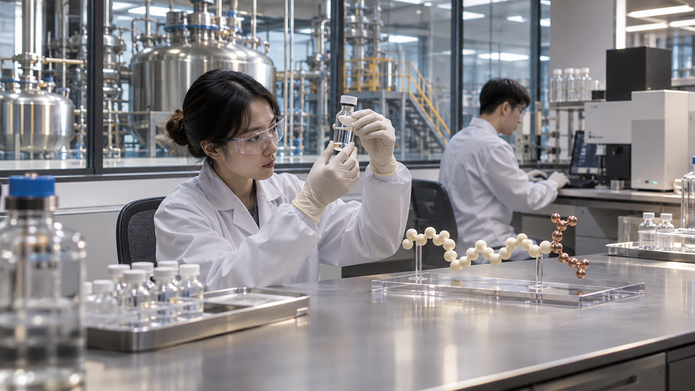
Every GLP-1 injection starts as a manufacturing decision. A peptide drug is a chain of amino acids, and there are two major ways to make one at industrial scale: persuade living cells to build its backbone, or have chemists assemble it from individual amino acids and smaller fragments. The two biggest obesity drugs on the market sit on opposite sides of that choice, and understanding peptide synthesis helps explain why supply, cost and generic competition look the way they do.
Semaglutide, the active ingredient in Ozempic and Wegovy, starts in yeast and finishes with chemistry. Tirzepatide, the active ingredient in Mounjaro and Zepbound, is built through chemical synthesis. Neither route is simply better. Each trades cost, flexibility, manufacturing complexity and waste in different ways.
The Semaglutide Route: Start in Yeast, Finish With Chemistry
The European Medicines Agency’s assessment report for Ozempic describes semaglutide as a GLP-1 analogue produced using recombinant DNA technology in Saccharomyces cerevisiae, the species commonly known as baker’s yeast, followed by chemical modification. The manufacturing process begins with fermentation in engineered yeast cells. Manufacturers then recover and purify the peptide precursor before chemically modifying it and purifying the resulting active substance.
That distinction matters. Yeast does not produce the complete finished drug on its own. It supplies a peptide backbone that can be modified to include structural features difficult for ordinary living cells to manufacture.
As a May 2026 analysis by DeciBio explains, Novo Nordisk’s process is a hybrid of biological expression and chemical synthesis. The recombinant backbone is modified using a fragment containing a nonstandard amino acid and a fatty-acid-bearing side chain.
That fatty acid is not decoration. The EMA describes binding to albumin, an abundant protein in blood, as the principal mechanism that extends semaglutide’s half-life to approximately one week. It helps protect the molecule from rapid elimination, allowing a once-weekly injection rather than the frequent administration that would be necessary with native GLP-1.
Recombinant expression can be attractive at enormous production volumes. Engineered microbes already manufacture much of the world’s insulin. But living cells are naturally equipped to assemble ordinary biological amino acids, not every unusual building block pharmaceutical chemists want in a drug. Specialized engineering can extend their capabilities, but chemical modification remains an important way to add those features.
Cells can make the backbone at scale. Chemistry adds the features that make the hormone last.
The Tirzepatide Route: Solid-Phase Peptide Synthesis and Fragments
Tirzepatide takes the chemical route. Unlike semaglutide’s recombinant starting material, tirzepatide is assembled from synthetic peptide fragments using methods that let chemists introduce nonstandard amino acids and other structural modifications with precision.
The DeciBio analysis identifies four separately synthesized fragments that are joined together. More directly, a peer-reviewed paper by researchers at Eli Lilly, published in Angewandte Chemie International Edition, describes a four-fragment convergent hybrid strategy combining solid-phase peptide synthesis, or SPPS, with liquid-phase peptide synthesis, or LPPS. It uses techniques including flow chemistry for fragment coupling and filtration methods for purification.
The paper describes this strategy as developed to enable commercial synthesis of tirzepatide. The researchers also report work on an alternative two-fragment route using native chemical ligation, illustrating how manufacturers continue searching for more efficient ways to assemble the same drug.
The chemistry offers flexibility. Tirzepatide incorporates two nonstandard amino acids, compared with one in semaglutide, and a lipid-bearing side chain. Chemical synthesis allows these features to be introduced through carefully controlled reactions. The number of unusual amino acids helps explain the attraction of a chemical route, although it does not by itself prove why Lilly selected its manufacturing strategy.
The foundational technique behind this field earned Bruce Merrifield the 1984 Nobel Prize in Chemistry. In solid-phase peptide synthesis, an amino acid is attached to an insoluble polymer resin. Chemists extend the chain by adding protected amino acids, removing temporary protective groups and repeating the process. Excess reagents and reaction byproducts can be washed away while the growing peptide remains anchored to its support.
Before solid-phase synthesis, peptide assembly often required repeated isolation and purification of intermediate products. Merrifield’s method made the process more practical and easier to automate. His research group went on to synthesize increasingly complex peptides and eventually the enzyme ribonuclease A.
The arithmetic explains why small improvements in individual reactions matter so much. If a hypothetical synthesis preserved 90% of its material at each of 100 successive steps, the overall yield would fall to roughly 0.003%. Raise the yield of each step to 99.5%, and the theoretical result climbs to about 61%. Those are illustrative calculations, not measured yields from modern semaglutide or tirzepatide factories, and actual fragment-based manufacturing does not necessarily follow one continuous 100-step sequence.
The method lends itself to automation, but it still requires exacting control over chemical reactions, impurities, fragment assembly and purification. Modern peptide manufacturing uses industrial reactors, specialized resins and analytical systems rather than the enormous physical molecular chains familiar from illustrations.

The Hidden Costs of Building Peptides by Hand
Solid-phase synthesis is precise, but it is not cheap. Protected amino acids, coupling reagents and specialized resins all carry costs. Longer sequences can become particularly difficult because incomplete reactions and unwanted side products accumulate as a chain grows.
That is one reason manufacturers use fragment-based strategies rather than simply extending every peptide from beginning to end. Smaller sections can be synthesized and purified separately, then joined through carefully designed reactions. The approach can shorten production cycles and improve throughput, although it introduces additional chemistry and purification challenges of its own.
Solvent consumption is another constraint. A 2020 critical review in Green Chemistry identified extensive washing between synthesis steps as a major environmental issue. The commonly used solvents include dimethylformamide, N-methyl-2-pyrrolidone and dichloromethane, substances with significant health or environmental concerns.
Researchers have been investigating alternative solvents and methods that reduce waste without undermining product quality. Lilly’s published work on tirzepatide also describes process innovations intended to improve purification efficiency. Such improvements matter when production moves from laboratory batches to the quantities needed for a major chronic-disease medicine.
The washing step that made peptide synthesis practical is also one reason industrial peptide plants consume so much solvent.
Scale is the other constraint. Contract manufacturers have expanded capacity in response to demand for GLP-1 medicines. Fierce Pharma reported that CordenPharma plans to increase annual solid-phase peptide synthesis reactor capacity at its Boulder, Colorado facility to more than 42,000 liters by 2028, alongside investment in a new Swiss peptide-manufacturing plant.
The supply chain also reaches upstream to the specialized resins used to assemble peptide chains. Grey Pepper has covered Laurus Labs’ investment in peptide-manufacturing resins and Cambrex’s manufacturing expansion. The attention paid to these less glamorous materials reflects how much infrastructure sits behind a single finished injection.
Why the Manufacturing Route Shapes Generics
The distinction between biological and chemical peptide production also matters to regulators. A company developing a generic version of a peptide drug may seek to use a different manufacturing process from that of the original manufacturer. But producing a molecule with the same intended sequence is not enough by itself. The manufacturer must demonstrate that the product meets the applicable regulatory requirements for sameness, quality, impurity control and bioequivalence.
The FDA’s position on this issue changed in 2026. In May 2021, the agency issued guidance addressing abbreviated new drug applications for certain highly purified synthetic peptides that reference drugs originally made using recombinant DNA technology. That guidance specifically discussed glucagon, liraglutide, nesiritide, teriparatide and teduglutide.
But on July 28, 2026, the FDA withdrew the 2021 guidance, stating that it no longer reflected the agency’s current scientific thinking. On the same day, it published 17 revised draft product-specific guidances covering several peptide medicines, including Ozempic, Wegovy, Mounjaro and Zepbound.
The revised recommendations address synthetic, recombinant and semisynthetic peptide manufacturing routes. They also examine peptide-related impurities, higher-order structure, biological activity and the risk of immune responses. The product-specific guidances were issued as drafts, with the FDA explaining that they would describe the agency’s current thinking once finalized.
For generic manufacturers, that matters. A company seeking to make semaglutide does not necessarily need to reproduce Novo Nordisk’s yeast-fermentation process. A chemically synthesized or semisynthetic route may be acceptable if the resulting drug meets the requirements for an approved generic. What the company cannot do is assume that matching the amino-acid sequence alone establishes equivalence.
The regulatory route is separate from the commercial and intellectual-property questions. A manufacturer must still navigate applicable patents, obtain approval in the market where it intends to sell and build enough capacity to produce a consistently high-quality medicine. Manufacturing flexibility does not automatically create a legally marketable generic.
That is why peptide synthesis will keep resurfacing as semaglutide patents expire at different times in different countries. The opportunity is not simply to copy a molecular structure. It is to make that structure reliably, at scale, with a defensible impurity profile and a regulatory dossier that can survive scrutiny.
What Remains Uncertain
Drug companies rarely publish every operational detail of their commercial manufacturing processes. Regulatory reports, patents and scientific papers provide valuable evidence, but they do not necessarily disclose every reactor configuration, reagent, purification method or optimization currently used in a particular production plant.
The broad comparison is well documented: semaglutide relies on a recombinant starting material followed by chemistry, while tirzepatide relies on chemical peptide synthesis. The finer details can evolve as manufacturers improve yields, reduce waste and expand production capacity.
Nor is the industry standing still. Hybrid biological and chemical approaches are improving, and chemical manufacturers are experimenting with new solvents, reaction systems and purification techniques. A manufacturing route that looks expensive today may become more economical with better technology or greater scale.
The molecule gets the headlines. The manufacturing route helps decide who can make it.
For patients, none of this is visible on the injection pen. For manufacturers, it influences production cost, capacity, waste, consistency and competition. The next obesity medicines will be judged first on what they do inside the body, but whether they can be manufactured efficiently at enormous scale will help determine how widely they become available.
Sources
- European Medicines Agency — Ozempic EPAR Assessment Report, December 2017, pp. 12–14. Details of recombinant yeast fermentation, purification and chemical modification.
- DeciBio — Chemical vs. Recombinant: The Manufacturing Decisions Behind Blockbuster Peptide Drugs, May 20, 2026.
- Jalan et al. — A Convergent Hybrid Gram-Scale Synthesis of Tirzepatide, Angewandte Chemie International Edition, first published December 23, 2025; 2026 journal issue.
- Eli Lilly — US12304938B2: Processes and Intermediates for Preparing Tirzepatide, granted May 20, 2025.
- NobelPrize.org — The Nobel Prize in Chemistry 1984: Robert Bruce Merrifield.
- Al Musaimi, de la Torre and Albericio — Greening Fmoc/tBu Solid-Phase Peptide Synthesis, Green Chemistry, January 2020.
- Fierce Pharma — CordenPharma’s Swiss Peptide Plant and Boulder Capacity Expansion.
- U.S. FDA — FDA Publishes Revised Draft Product-Specific Guidances for Certain Generic Peptide Products, July 28, 2026. Also confirms withdrawal of May 2021 guidance.