

Historical profile. On May 26, 1959, a 37-year-old chemist at the Rockefeller Institute in New York wrote an idea into his laboratory notebook. Bruce Merrifield proposed a new way to build peptides: anchor the first amino acid to an insoluble support, add the next one, wash away the excess chemicals, and repeat. Instead of repeatedly isolating and purifying a growing molecular chain, he would keep it attached to a solid material until the synthesis was complete.
The idea became solid phase peptide synthesis. Many established peptide chemists initially rejected the approach. Some thought it violated the basic rules of careful organic chemistry. Others worried about impure products and incomplete reactions. Merrifield kept working. His laboratory eventually built a functioning enzyme with the technique, and in 1984 he won the Nobel Prize in Chemistry.
More than six decades after that notebook entry, solid phase peptide synthesis remains a predominant method for producing synthetic peptide medicines. It also creates an enormous material-use problem that the pharmaceutical industry is now trying to solve.
A Chemist Who Moved a Lot
Robert Bruce Merrifield was born in Fort Worth, Texas, on July 15, 1921. His family moved to California in 1923, and he attended nine grade schools and two high schools before graduating from Montebello High School in 1939, according to his Nobel autobiography.
He studied at Pasadena Junior College before transferring to the University of California, Los Angeles, where he completed his undergraduate chemistry degree and later his doctorate in 1949. That same year he married Elizabeth “Libby” Furlong, a biologist. They went on to have six children, and she later worked alongside him in his Rockefeller laboratory.
In 1949 Merrifield joined the Rockefeller Institute for Medical Research in New York, working with the biochemist D.W. Woolley. Much of his early research required peptides, short chains of amino acids that could be used to study hormones and other biological molecules.
Making them was painfully slow. Conventional solution-phase chemistry required protecting reactive parts of amino acids, joining the molecules together, and repeatedly isolating and purifying the intermediates before adding the next building block.
Every additional amino acid introduced another chemical reaction, another purification and another opportunity to lose material. For longer sequences, those losses compounded. A chain that looked straightforward on paper could demand months of work at the bench.
Merrifield began asking whether the growing peptide really needed to be purified after every step.
The Idea Behind Solid Phase Peptide Synthesis
The central insight was simple enough to fit in a notebook. Instead of keeping the growing peptide dissolved in a reaction mixture, Merrifield would attach it to an insoluble solid support. Chemicals that had not reacted could then be washed away while the peptide stayed in place.
He spent approximately three years experimenting with possible supports, including cellulose, polyvinyl alcohol and polyacrylamide, before settling on cross-linked polystyrene beads. These polymer materials could hold the growing molecular chain while allowing reagents to reach its reactive end.
The chemistry required careful control. The incoming amino acid needed a temporary protecting group to prevent unwanted reactions. Merrifield used the t-butoxycarbonyl, or Boc, protecting group and coupling chemistry involving dicyclohexylcarbodiimide.
Once one amino acid had been joined to the chain, the protecting group could be removed, the support washed, and another protected amino acid introduced. The sequence could grow through repeated cycles of coupling, deprotection and washing.
The trick was to stop purifying the growing chain and start washing the beads.
In 1962 Merrifield publicly described the successful solid-phase preparation of a tetrapeptide, a chain containing four amino acids. The full research paper appeared in the Journal of the American Chemical Society in 1963 under the title “Solid Phase Peptide Synthesis. I. The Synthesis of a Tetrapeptide.”
Four amino acids were not much of a protein, but they established that the concept could work. It was now possible to build a peptide without isolating every intermediate.
The next challenge was making the process reliable enough for longer molecules. Merrifield had also recognized from the beginning that the repetitive steps were well suited to automation. A machine could perform the same sequence of operations without a chemist manually supervising every reaction.
Scoffing, Then a Machine
The skepticism was not imaginary. A historical assessment published in 2008 describes how established synthetic chemists resisted the idea of carrying out multistep synthesis without individually isolating, purifying and characterizing the intermediates.
That was how careful peptide chemistry had traditionally been done. A method that used large excesses of reagents and produced material that sometimes needed extensive final purification looked wasteful and potentially unreliable.
Some criticism continued even after Merrifield demonstrated that the approach could synthesize useful peptides. In 1971, chemist Eberhard Wünsch described what he regarded as the method’s inherent defects and questioned its suitability for synthesizing larger natural peptides.
Those objections reflected real technical limitations. Coupling reactions were not always complete, unwanted side reactions occurred, and longer sequences could accumulate impurities that were difficult to separate from the desired product.
Merrifield’s response was not simply to dismiss the criticism. He and his colleagues worked on improving the chemistry and automating the process.
Early synthesizers used mechanically programmed operations to deliver reagents, remove protecting groups and wash the resin. The machines transformed a sequence of repetitive laboratory tasks into a controlled series of steps.
The most striking demonstration came in 1969. Merrifield and colleague Bernd Gutte reported the total chemical synthesis of bovine pancreatic ribonuclease A, an enzyme containing 124 amino acids.
According to the American Chemical Society’s historical account, the project involved 369 chemical reactions and 11,931 mechanical operations. The synthetic protein was able to fold into a biologically active enzyme.
This was a major achievement, although it did not mean the process was flawless. The product required purification, and the work continued to expose weaknesses in the synthetic chemistry. But the essential point had been established: a working enzyme could be assembled chemically from its amino-acid building blocks using an automated solid-phase process.
A synthetic enzyme that actually worked was difficult to dismiss as a laboratory trick.
The achievement also mattered beyond peptide manufacturing. It demonstrated a practical route to studying how a protein’s amino-acid sequence relates to its structure and biological activity.
The Nobel and the Arithmetic
On October 17, 1984, the Royal Swedish Academy of Sciences announced that Bruce Merrifield would receive the Nobel Prize in Chemistry for his development of methodology for chemical synthesis on a solid matrix.
He received the prize alone, recognizing a method that had transformed the possibilities of peptide and protein chemistry. By then, automated peptide synthesizers were commercially available, thousands of peptides had been produced using solid supports, and similar principles had been adopted for making nucleic-acid fragments.
The importance of highly efficient reactions is best understood through arithmetic.
Imagine a synthesis requiring 100 consecutive steps. If each step retains 90% of the desired material, the theoretical overall yield falls to approximately 0.003%. Increase the efficiency of every step to 99.5%, however, and the theoretical overall yield rises to approximately 60.6%.
Those are illustrative calculations, not measured yields from a single Merrifield experiment. But they show why seemingly small improvements in coupling efficiency can transform the feasibility of synthesizing long peptides.
A fraction of a percentage point at each step can become the difference between almost nothing and a usable product.
Merrifield had already received the Albert Lasker Basic Medical Research Award in 1969 and had been elected to the National Academy of Sciences in 1972. The Nobel completed the recognition of a career built around a deceptively simple laboratory idea.
He continued his association with Rockefeller University after becoming emeritus in 1992. He died on May 14, 2006, at the age of 84.
Why It Still Matters, and What It Costs
Six decades after Merrifield’s first tetrapeptide, solid-phase peptide synthesis remains a foundation of modern synthetic peptide manufacturing.
A 2024 analysis in the Journal of Organic Chemistry, prepared by scientists representing 14 member companies of the American Chemical Society’s Green Chemistry Institute Pharmaceutical Roundtable, described solid-phase synthesis as the predominant platform technology for synthetic peptides.
Researchers from companies including Eli Lilly, Novo Nordisk, Bachem and Asymchem contributed to the project. Together, the group examined process mass intensity across 40 synthetic peptide manufacturing processes at different development stages.
Solid-phase chemistry remains attractive because it is well established, can be automated and offers manufacturers a reliable route to complex peptides. Liquid-phase methods, hybrid synthesis and recombinant approaches also play important roles, particularly when a molecule’s structure or production scale makes them more suitable.
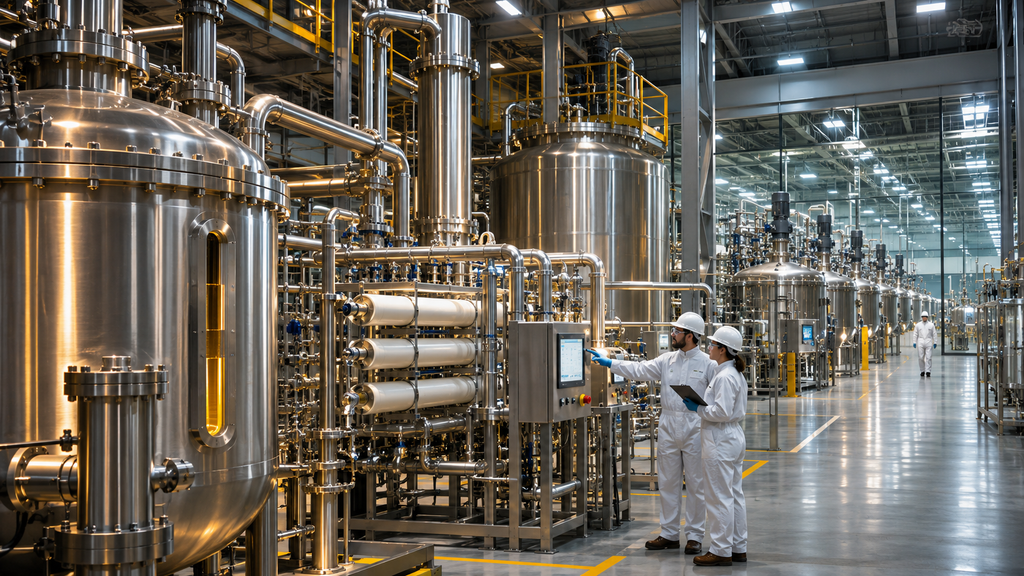
The environmental drawback is the other half of Merrifield’s bargain. Solid-phase synthesis relies on repeated chemical reactions, excess reagents and extensive washing. Those operations can consume very large quantities of solvents and other materials relative to the mass of peptide produced.
The 2024 analysis calculated an average process mass intensity, or PMI, of approximately 13,000 for solid-phase peptide synthesis. That means roughly 13,000 kilograms of material inputs were used per kilogram of final product across the processes represented by that average.
For comparison, the authors cited typical small-molecule pharmaceutical PMI values of 168 to 308 and an average of approximately 8,300 for biopharmaceuticals.
The metric needs careful interpretation. PMI measures material consumption, including solvents, reagents and other inputs. It is not an exact measurement of waste generated, nor does it directly capture energy use, upstream manufacturing impacts or the toxicity of different materials.
Even with those limitations, the figures make the challenge clear. The same repeated washing and excess reagent strategy that helped turn peptide synthesis into a practical technology remains a major driver of material consumption.
The excess that made the method practical is now one of the industry’s largest sustainability problems.
As demand for peptide medicines increases, manufacturers are investing in ways to reduce solvent consumption, improve coupling efficiency and recover materials. Changes to the resin supply chain have also become commercially significant, as Grey Pepper examined in its coverage of Laurus Labs’ acquisition of a peptide resin business.
None of this means solid-phase synthesis was a mistake. It means that a manufacturing method optimized to overcome one problem, the difficulty of assembling peptides reliably, is now being optimized to address another: the environmental and material cost of doing so at industrial scale.
A Bargain That Still Holds
Merrifield exchanged one kind of chemical discipline for another. Instead of carefully purifying every intermediate, he developed a system in which the growing chain remained attached to a solid support while repeated reactions and washes built the desired sequence.
The objections were not entirely wrong. Impurities, incomplete reactions and wasteful material consumption were genuine problems. But the critics who believed those problems made the approach fundamentally unsuitable underestimated how much the chemistry could improve.
Later researchers expanded what could be synthesized and introduced complementary techniques for longer or more difficult molecules. One important advance was native chemical ligation, associated with Philip Dawson and his colleagues, which made it possible to join separately prepared peptide fragments into larger structures.
Merrifield did not solve every problem in peptide manufacturing. He changed which problems chemists were able to work on.
In 1959, the challenge was building a long peptide at all. Today, the challenge is often building millions of doses reliably, economically and with less material consumption.
The tools have improved, the chemistry has evolved and the economics have changed. But much of modern synthetic peptide manufacturing still rests on that first idea: hold the growing molecule on a solid support, add the next amino acid, wash, and repeat.
What once looked like an improper shortcut became an industrial standard. The next revolution may be making Merrifield’s shortcut less wasteful.
Sources
- Rockefeller University — Bruce Merrifield’s Notebook. Archival record of May 26, 1959.
- NobelPrize.org — Bruce Merrifield: Biographical. 1984.
- NobelPrize.org — The Nobel Prize in Chemistry 1984: Press Release. October 17, 1984.
- American Chemical Society — Nucleic Acid and Protein Research at Rockefeller University. National Historic Chemical Landmark.
- Merrifield RB. Solid Phase Peptide Synthesis. I. The Synthesis of a Tetrapeptide. Journal of the American Chemical Society. 1963.
- Gutte B, Merrifield RB. Total Synthesis of an Enzyme with Ribonuclease A Activity. Journal of the American Chemical Society. 1969.
- Mitchell AR. Bruce Merrifield and Solid-Phase Peptide Synthesis: A Historical Assessment. Biopolymers. 2008.
- Chemistry World — Merrifield’s Resin. Historical commentary on the invention and early criticism.
- Kekessie I, et al. Process Mass Intensity (PMI): A Holistic Analysis of Current Peptide Manufacturing Processes Informs Sustainability in Peptide Synthesis. Journal of Organic Chemistry. March 20, 2024.