
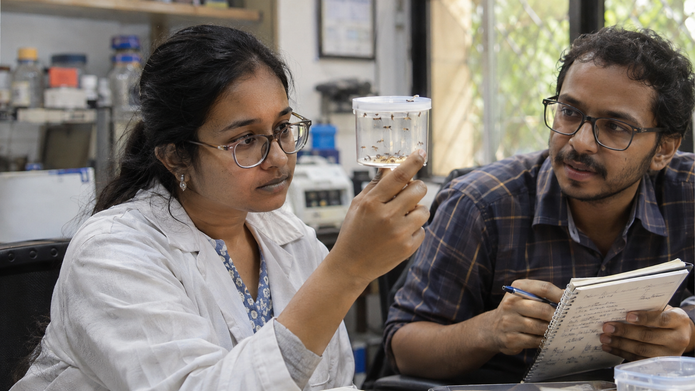
Antimicrobial peptides are supposed to be the body’s bouncers. When a fruit fly picks up an infection, its fat body floods the bloodstream with a battery of short, germ-fighting molecules with names like Cecropin, Attacin and Drosomycin. A new study in PLOS Genetics suggests some of those same peptides have a second job that has nothing obvious to do with bacteria or fungi: they help regulate how much a fly sleeps, how easily it wakes, and whether it can still learn while short on rest. All of the evidence comes from fruit flies. None of it establishes that the same mechanisms work in people.
The work, led by Krishna Melnattur’s group at Ashoka University in India and published on November 13, 2026, takes an old observation in sleep science and pushes it into new territory. In mammals, immune signals such as the cytokines TNF-alpha and interleukin-1 beta are known to promote sleep, which helps explain why infection often makes people drowsy. Flies have different immune signaling machinery, but they also produce antimicrobial peptides in large quantities after infection. The researchers asked a simple question: what happens to sleep when the genes for these peptides are deleted?
What the Researchers Did With Antimicrobial Peptide Mutants
The group studied fruit fly strains with deletions affecting several families of antimicrobial peptides. These included mutants missing combinations of peptides from the Cecropin, Defensin, Attacin, Diptericin and Drosocin families, a strain lacking multiple Bomanin genes, and a group missing two antifungal peptides, Metchnikowin and Drosomycin. That last strain, which the authors call Group C, would produce the study’s most unexpected result.
The researchers tracked sleep with automated activity monitors, using periods of sustained inactivity as a behavioral measure of sleep. They also tested how easily flies woke, how they responded to overnight sleep deprivation, and what happened when sleep was encouraged by social grouping or gentle rocking. A separate set of experiments measured learning and memory.
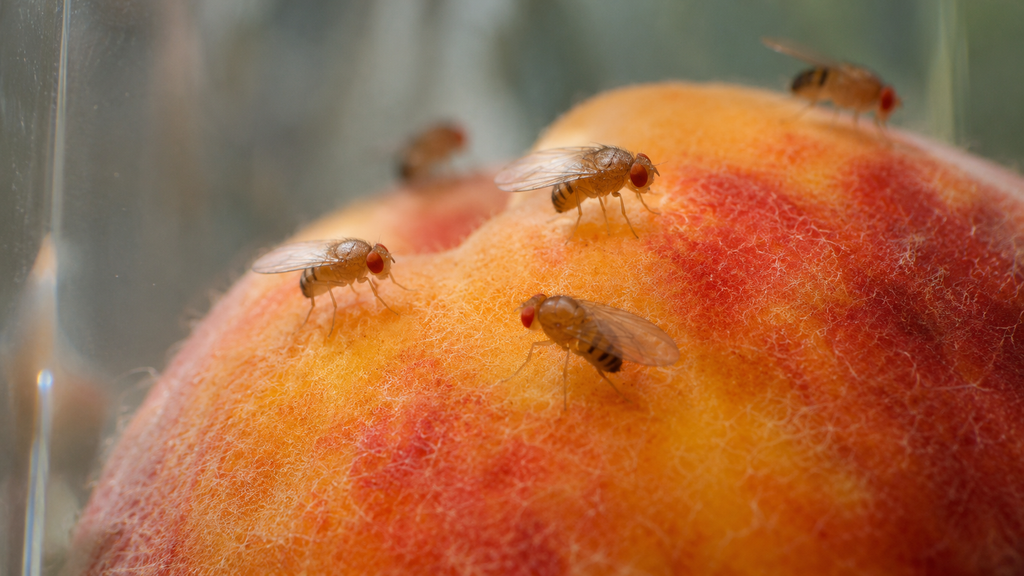
The general pattern was clear. Many of the antimicrobial peptide mutants slept less than control flies, particularly at night. They took longer to fall asleep and were easier to rouse. The most pronounced changes appeared in Group C, whose flies lacked Metchnikowin and Drosomycin.
Their response to forced wakefulness was especially unusual. After a night of sleep deprivation, control flies recovered approximately half of their lost sleep across the following 48 hours. Group C mutants recovered about 91%. The precise biological reason for that exaggerated rebound remains unresolved, but the finding suggests that the two missing peptides influence more than baseline sleep duration.
The mutants with the worst sleep deficit showed the strongest recovery response. Their memory presented an even stranger picture.
The Surprise: Short Sleepers With Normal Memory
Sleep researchers generally expect insufficient sleep to interfere with learning and memory, and most of the mutants followed that pattern. Flies in Groups A and B, along with those missing Bomanin genes, performed poorly on an aversive learning task. In the assay, flies learn to avoid extending their proboscis, a feeding organ, toward sugar when it is paired with bitter quinine.
Group C was the exception. The flies missing Metchnikowin and Drosomycin slept the least yet retained normal performance on the learning and memory measures tested. Their results were not detectably worse than those of the controls.
That finding does not mean the flies remembered everything, nor that they no longer needed sleep. It means that in the particular behavioral assays used by the researchers, the expected relationship between reduced sleep and impaired memory did not appear.
The team also examined the flies’ brains using staining for Bruchpilot, a protein associated with presynaptic active zones. Group C brains showed lower measured abundance of this synaptic marker than control brains. The result is compatible with the idea that processes related to synaptic regulation can occur despite less sleep, although Bruchpilot staining alone does not establish a precise count of anatomical synapses.
One influential idea in sleep research is that sleep helps regulate synaptic connections that have accumulated or strengthened during waking hours. The Group C findings raise the possibility that some aspects of this regulation can be separated from total sleep duration.
That is a more limited and more interesting conclusion than saying the flies function perfectly without sleep. Their sleep was clearly disrupted, and their exaggerated rebound suggests that the biological need to recover from sleep loss had not disappeared.
Sleep duration and performance on a memory test did not move together. In Group C, the two came apart.
The Peptides Appear to Act Through Glial Cells
One of the study’s most important mechanistic findings concerns where the peptides influence sleep. Antimicrobial peptides are commonly introduced as immune molecules produced in peripheral tissues, including the insect fat body. But their effects are not necessarily limited to fighting infections in the bloodstream.
The researchers selectively reduced Metchnikowin and Drosomycin expression in different cell types. When they knocked down the genes in glia, the brain’s support cells, the flies developed sleep abnormalities resembling those of the Group C deletion mutants. Comparable neuronal or fat-body manipulations did not reproduce the same complete pattern in the tested conditions.
The team also reported that restoring Drosomycin expression in glia improved the mutant sleep phenotype. Together, the knockdown and rescue experiments support the conclusion that these genes act through glial cells to influence sleep.
The distinction is important. It suggests that molecules best known for immune defense can have localized functions in the nervous system that are not simply a response to infection elsewhere in the body. It does not yet explain the precise molecular pathway connecting those peptides to sleep circuits.
The researchers also tested whether the sleep effects reflected changes in the flies’ microbial environment. Their experiments with flies raised without their usual microbes suggested that altered microbial exposure was not sufficient to explain the observed sleep phenotype.
Restoring Sleep Also Restored Learning
Group C retained learning and memory despite short sleep. Other antimicrobial peptide mutants did not. To determine whether the cognitive deficits in those flies were reversible, the team focused on strains missing multiple Bomanin genes.
One approach was pharmacological. Researchers used gaboxadol, a sleep-promoting compound frequently employed in experimental fly sleep studies, to increase sleep in the Bomanin mutants. The flies subsequently performed better on learning and memory tests.
The investigators also used a behavioral intervention that changed the flies’ sleep opportunity and helped consolidate sleep. That approach likewise improved performance.
These results support the interpretation that some of the observed memory deficits were related to disrupted sleep rather than being unavoidable direct consequences of losing the peptide genes. The experiments do not establish that every cognitive effect of antimicrobial peptide deletion operates through sleep.
The distinction matters because the study is not presenting one simple pathway running from immune peptides to sleep to memory. Different peptide families produced different combinations of behavioral effects. Some mutants responded unusually to social enrichment or rocking, while others did not. Sleep duration, sleep recovery and learning were related, but they were not interchangeable measurements.
Some flies lost learning performance alongside sleep. Increasing their sleep helped bring that performance back.
Why Antimicrobial Peptides Keep Turning Up Outside Immunity
This is not the first time fruit fly antimicrobial peptides have been found performing work outside conventional infection defense. Earlier researchers identified nemuri, a sleep-promoting protein with antimicrobial activity, and later work examined antimicrobial peptides derived from nemuri and their effects on bacterial ribosomes.
The new paper adds a broader view. Rather than focusing on one sleep-linked immune molecule, Kumar and colleagues tested multiple classes of antimicrobial peptides and found that several influenced sleep. Different genetic deletions had different consequences for sleep recovery, learning, memory and responses to environmental cues.
For a publication that follows peptide biology and drug discovery, the lesson is about biological complexity rather than an immediate treatment opportunity. Molecules named for one function may carry out other functions in different tissues. The same broad field is producing antimicrobial discoveries from sources as varied as marine bacteria, including the pobacilamide peptides studied for antibiotic activity, while basic research keeps uncovering unexpected roles for peptides inside living animals.
A peptide’s name describes what researchers first recognized about it. It does not necessarily describe everything the molecule does.
What the Study Cannot Tell Us
The boundaries are substantial. The experiments were conducted in Drosophila melanogaster, not humans. The particular antimicrobial peptides deleted in these flies should not be assumed to have direct human counterparts with identical neurological functions.
Several mutant strains also lacked multiple genes at once. That design is useful for examining broad functional groups, but it makes it harder to assign every observed change to a single peptide. The effects of individual genes remain incompletely resolved, particularly where the researchers could not test every available single-gene mutation or perform every desired rescue experiment.
The study’s sleep measurement is also behavioral. Extended inactivity is a standard method of identifying fly sleep, but it is not a direct measurement of every underlying neurological process. Likewise, a normal result in one learning task does not establish that every form of memory or cognitive function remains intact.
Lower Bruchpilot abundance offers a clue about synaptic regulation, not a complete molecular account of how sleep functions were preserved. The researchers have not established exactly how Metchnikowin and Drosomycin alter synaptic biology, produce exaggerated rebound sleep or influence the relevant glial signaling pathways.
None of this provides evidence that taking antimicrobial peptides, including research-grade products, improves human sleep or prevents memory problems. There is no clinical treatment implication established by these experiments.
Why the Result Matters
The most interesting finding is not simply that immune peptides affect sleep. Previous research had already linked immune signaling to sleep regulation. The advance here is that different classes of fly antimicrobial peptides produced different relationships between sleep quantity and sleep-dependent behavior.
One mutant group slept exceptionally little, showed an exaggerated recovery response and still performed normally on a tested memory task. Other mutants slept less and performed worse, but their deficits improved when sleep was increased. Those outcomes suggest that the mechanisms controlling sleep duration are not necessarily identical to those supporting every function associated with sleep.
That is a useful direction for basic neuroscience. It may help researchers separate the signals that determine when an animal sleeps from the cellular processes associated with the benefits of sleep.
It also leaves the central question unresolved. If the Group C flies can maintain some learning and synaptic outcomes while sleeping much less, what is different about the work their brains perform during the hours they remain awake?
The answer is not a shortcut to better human sleep. It is a reminder that even the simplest animals can separate biological processes we tend to treat as one. A molecule that evolved as part of immune defense may also help decide when the brain rests, and what happens when it does not.
Sources
- Kumar R, Madhav G, Balasubramanian P, et al. Mutations in antimicrobial peptides differently affect sleep and plasticity. PLOS Genetics. November 13, 2026. DOI: 10.1371/journal.pgen.1012363.
- PubMed — Kumar et al., publication record and abstract. PMID: 43024642.
- Brain, Behavior, and Immunity — Differential activation of immune factors in neurons and glia contribute to individual differences in resilience/vulnerability to sleep disruption. Published 2015.
- Grey Pepper — A Sleep-Linked Fly Protein Became an Antibiotic Peptide That Freezes Bacterial Ribosomes. November 2, 2026.