
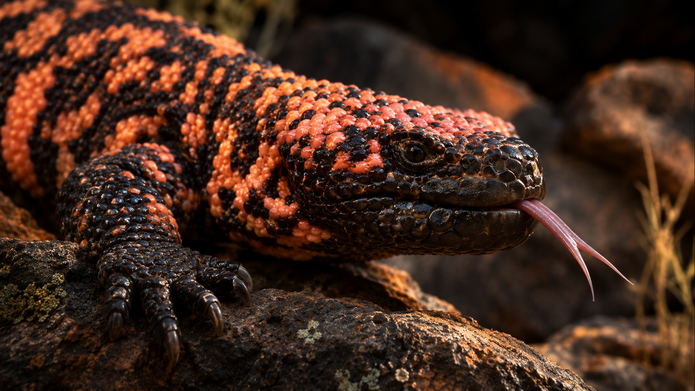
Search for “Gila monster Ozempic” and you will find a tidy legend: a lizard’s spit became the world’s favorite weight-loss shot.
The real story is stranger and more useful.
It belongs to John Eng, an endocrinologist at the Bronx Veterans Affairs Medical Center who went looking for new hormones in venom and found one that behaved like the human gut hormone GLP-1, only far more stubbornly.
The discovery was exendin-4, a 39-amino-acid peptide isolated from the venom of the Gila monster, a large, venomous lizard native to the southwestern United States and northwestern Mexico.
It eventually became the basis for exenatide, the first GLP-1 receptor agonist approved by the US Food and Drug Administration.
Ozempic came later, from a different molecular starting point.
The Gila monster did not supply Ozempic’s molecule. But it helped establish that targeting the GLP-1 receptor could work as a practical medicine.
Here is how a VA doctor, a desert lizard and a pharmaceutical company helped launch an entirely new chapter in diabetes treatment.
A Hormone Hunter in the Bronx
Eng worked as a physician and researcher at the Veterans Administration Medical Center in the Bronx, New York.
Earlier in his career, he worked under Rosalyn Yalow, the Nobel Prize-winning scientist who helped develop radioimmunoassay, a technique that made it possible to measure extremely small concentrations of hormones in biological samples.
Grey Pepper has examined that scientific breakthrough in its profile of Rosalyn Yalow and the measurement of insulin.
Eng’s work took that interest in detecting hormones in an unusual direction.
According to The Science Coalition, which honored him with a Golden Goose Award in 2013, Eng treated patients with diabetes and understood the complications that could follow prolonged exposure to high blood sugar.
He also followed research investigating how animal venoms affected the pancreas.
Earlier studies supported by the National Institutes of Health had found that substances in certain snake and lizard venoms could strongly stimulate pancreatic tissue.
Eng focused on the Gila monster, scientifically known as Heloderma suspectum.
The animal was an intriguing biological subject. It could survive extended periods between meals, and its venom contained substances with measurable effects on pancreatic function.
Those observations suggested there might be biologically active peptides worth investigating.
But there is an important distinction between the historical motivation and what was actually proved. The discovery did not establish that exendin-4 explained how the Gila monster regulated its own blood sugar during fasting.
Its physiological role in the animal remains incompletely understood.
What Eng could test was the chemistry.
Using methods developed to identify peptides with particular amino-acid characteristics, his research group examined venom samples for previously unidentified signaling molecules.
One of those molecules would become far more important to medicine than anyone initially expected.
What John Eng Found in Gila Monster Venom
The landmark scientific record appeared on April 15, 1992, in the Journal of Biological Chemistry.
The paper, authored by John Eng, Wayne Kleinman, Latika Singh, Gurcharn Singh and Jean-Pierre Raufman, described the isolation and characterization of exendin-4 from Gila monster venom.
The discovery was part of a broader investigation into venom-derived peptides, including a related molecule called exendin-3 identified in the Mexican beaded lizard.
Exendin-4 contained 39 amino acids and demonstrated biological activity in laboratory preparations of pancreatic tissue.
A second paper, published in Regulatory Peptides in September 1992, investigated its effects on rat pancreatic cells.
The early experiments were not human diabetes treatment trials. They established the existence and biological properties of the peptide, providing a starting point for later work.
What ultimately made exendin-4 medically interesting was its similarity to glucagon-like peptide-1, or GLP-1.
GLP-1 is a hormone released from the gut after eating. Among other effects, it helps the pancreas release insulin when blood glucose is elevated.
Researchers had already recognized its potential as a diabetes therapy.
The difficulty was durability.
Natural human GLP-1 is rapidly broken down by enzymes, including dipeptidyl peptidase-4, leaving it with a circulating half-life of approximately two minutes.
That made ordinary GLP-1 difficult to administer as a convenient, sustained treatment.
Exendin-4 was different. It activated the GLP-1 receptor but resisted the same rapid enzymatic breakdown.
The synthetic medicine based on it, exenatide, had a terminal half-life of approximately 2.4 hours after injection, supporting a twice-daily treatment regimen.
That was still a short duration compared with the weekly injections developed years later, but it represented an important practical advance.
Human GLP-1 disappeared from circulation within minutes. The lizard-derived peptide offered a way to keep the same therapeutic receptor active for much longer.
There was another important property: insulin secretion was stimulated primarily when blood glucose was elevated, making the mechanism different from simply injecting insulin into the bloodstream.
It was a promising approach. But demonstrating an effect in laboratory experiments was only the beginning.
The Patent Nobody Wanted
A promising molecule is not a medicine.
It must be manufactured reliably, tested for toxicity, studied in humans and reviewed by regulators. Those steps require substantial financial resources and can take many years.
Eng believed his discovery had commercial potential. But the path toward development was anything but straightforward.
According to contemporaneous reporting by the Los Angeles Times in April 2005, Eng approached the Veterans Administration about patenting the discovery, but the agency declined.
Eng pursued a patent himself.
The newspaper reported that he spent approximately $8,000 obtaining patent protection while earning about $40,000 a year at the time.
The FDA’s original exenatide application also identified Eng as the owner of US patent number 5,424,286, which covered a method of use related to the drug.
He then needed someone willing to turn the discovery into a pharmaceutical product.
That search took several years.
In 1996, Eng presented his work at a medical meeting, where Amylin Pharmaceuticals became interested in the molecule.
The Science Coalition describes how he set up a booth at an American Diabetes Association annual meeting to attract attention to the discovery.
Amylin, then a comparatively small biotechnology company, took on development of the synthetic peptide.
It eventually partnered with Eli Lilly, which brought additional financial and commercial resources to the program.
The patent story has a financial detail often omitted from retellings.
In 2005, Eng told the Los Angeles Times that his compensation included a royalty amounting to a low-single-digit percentage of Byetta sales.
That provides some evidence about the arrangement, although it does not establish his total lifetime earnings from the invention.
On April 28, 2005, the FDA approved exenatide for improving blood glucose control in adults with type 2 diabetes who had not achieved adequate control with specified oral medicines.
The drug was marketed as Byetta and became the first approved GLP-1 receptor agonist.
Its original formulation required injections twice a day. A once-weekly extended-release version, Bydureon, received US approval in 2012.
The original Byetta brand was later discontinued in the United States for commercial reasons, and its new drug application was withdrawn in 2025. According to the FDA, generic exenatide remained marketed as of November 2026.
That later commercial change does not diminish the historical first.
Exenatide demonstrated that a GLP-1 receptor agonist could make the journey from a laboratory finding to an approved treatment used by patients.

The VA declined the patent. Eng pursued it himself, then spent years finding a company willing to develop the molecule.
The Gila Monster Ozempic Myth
Is Ozempic made from Gila monster venom?
No.
This is where the familiar story becomes misleading.
Exenatide is a synthetic version of exendin-4, the peptide identified in Gila monster venom.
Ozempic contains semaglutide, which was developed by Novo Nordisk through chemical modification of human GLP-1 rather than by copying exendin-4.
Semaglutide was designed to resist enzymatic breakdown and bind to albumin, a protein circulating in the blood.
Those structural modifications extend its half-life to approximately one week, making weekly administration possible.
Grey Pepper has explained those changes in why semaglutide lasts a week when natural GLP-1 lasts minutes.
The historical link is real, but indirect.
Exenatide helped establish the GLP-1 receptor as a practical therapeutic target. Later medicines were developed using a range of different molecular engineering strategies.
Liraglutide, marketed as Victoza, gained US approval in 2010. Ozempic followed in 2017, and Wegovy in 2021.
Those medicines belonged to a drug class that exenatide had helped open to clinical practice.
But it would also be inaccurate to suggest that John Eng invented GLP-1 biology.
Other researchers were already studying the human hormone, its receptors and its possible use in diabetes treatment before exenatide reached the market.
The Gila monster discovery was an important parallel route into the same therapeutic system.
Its significance was not that every future GLP-1 medicine descended chemically from the lizard.
It was that an unusual venom peptide helped show how an otherwise short-lived hormonal signal could be turned into a treatment patients could realistically use.
The lizard did not supply Ozempic’s molecule. It helped prove that the GLP-1 receptor could be targeted with an effective drug.
Why a Lizard Story Still Matters
In 2013, John Eng received a Golden Goose Award.
The prize recognizes federally supported research that initially appeared unusual, obscure or difficult to justify, but ultimately delivered significant benefits to society.
Eng’s work was an unusually strong example.
A physician working in a government medical center had investigated the venom of a desert reptile and identified a peptide that would become the basis of a new diabetes medicine.
The story is not without historical complications.
The National Institute on Aging places the discovery in 1990, while The Science Coalition dates it to 1992. The VA’s own retrospective account refers to the mid-1990s even though it cites the original 1992 publication.
What the primary scientific record establishes is that Eng and his colleagues had isolated and characterized exendin-4 by April 1992.
The research also involved more people than a single name. Kleinman, the two Singhs, Raufman and later scientific teams contributed to the pathway from isolation to pharmaceutical development.
Nor can anyone prove that drugs such as Ozempic would never have existed without Eng’s work. Human GLP-1 research was already advancing independently.
The defensible conclusion is more precise: exenatide was the first GLP-1 receptor agonist to gain regulatory approval, and its origins can be traced to Eng’s investigation of Gila monster venom.
There is a broader lesson here about scientific research.
Studies involving unusual animals, obscure hormones and apparently impractical biological compounds can be easy to dismiss when their immediate applications are unclear.
But the distance from a scientific observation to a useful medicine is often measured in decades.
Exendin-4 was described in the scientific literature in 1992. Its synthetic counterpart reached US pharmacies in 2005.
More than thirteen years separated the published discovery from the first approved drug.
Eng pursued the discovery even after the VA declined patent protection, and the compound eventually entered development through a biotechnology company willing to take the risk.
It is a story about persistence, but also about the value of basic research whose eventual application cannot be predicted.
The next important medical discovery may not begin with an obvious drug target. It may begin with a strange animal, a laboratory assay and a scientist who notices something other people overlooked.
The Gila monster never made Ozempic. But a peptide hidden in its venom helped turn an improbable biological observation into the first medicine of an important drug class.
Sources and Further Reading
- Eng J, Kleinman WA, Singh L, Singh G, Raufman JP. Isolation and characterization of exendin-4, an exendin-3 analogue, from Heloderma suspectum venom. Journal of Biological Chemistry, April 15, 1992.
- Malhotra R, Singh L, Eng J, Raufman JP. Exendin-4, a new peptide from Heloderma suspectum venom, potentiates cholecystokinin-induced amylase release from rat pancreatic acini. Regulatory Peptides, September 22, 1992.
- The Science Coalition — Dr. John Eng to Receive Golden Goose Award, July 30, 2013.
- US Department of Veterans Affairs, Office of Research and Development — Diabetes Drug from Gila Monster Venom, May 7, 2019.
- Los Angeles Times — Lizard Is Source of Newest Diabetes Drug, April 30, 2005. Contemporary reporting on Eng’s patent and royalty arrangement.
- National Institute on Aging — Exendin-4: From Lizard to Laboratory…and Beyond.
- Biotech Academy — The Gila Monster and the Story Behind Byetta. Educational historical account.
- Amylin Pharmaceuticals and Eli Lilly — FDA Approval of Byetta (Exenatide), April 29, 2005.
- US Food and Drug Administration — GLP-1 Receptor Agonist Drug-Class Summary, November 9, 2026. Approval history and Byetta marketing-status clarification.