
The most uncomfortable fact about modern obesity drugs is what happens when treatment stops. People often regain a substantial share of the weight they lost.
That has turned the GLP-1 maintenance dose into one of the field’s most practical research questions. Once someone has lost weight, how little medication, delivered how infrequently, can keep it off?
China’s Gan & Lee Pharmaceuticals has offered one possible answer, at least on paper.
On November 4, 2026, the company announced positive topline results from GRADUAL-3, a Phase 3b study examining whether its investigational GLP-1 receptor agonist bofanglutide could maintain previous weight loss with an injection every four weeks.
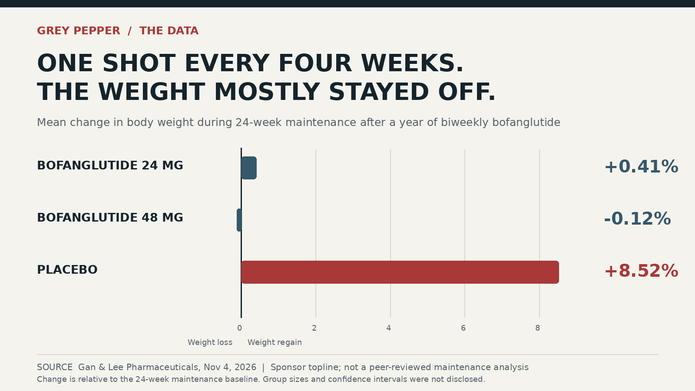
The participants had already completed 52 weeks of bofanglutide treatment given every two weeks. During another 24 weeks, those who continued with monthly bofanglutide essentially maintained their weight, while the placebo group regained an average of 8.52%.
The mean body-weight changes were +0.41% with monthly bofanglutide 24 mg and −0.12% with monthly 48 mg.
Both treatment comparisons against placebo were reported as statistically significant, with P values below 0.0001.
The distinction is important: these percentages describe change during the maintenance period, not total weight loss from the beginning of the original treatment program.
The caveat is equally important. These are company-announced topline figures. Gan & Lee has not disclosed the number of patients analyzed in each maintenance group, confidence intervals, dropout rates or the full statistical methods.
The result is promising. It is not yet a peer-reviewed account of the full trial.
What the Monthly Bofanglutide Maintenance Trial Tested
GRADUAL-3 was designed as an extension of GRADUAL-1, an earlier Phase 3 trial of bofanglutide, also known by its development code GZR18.
The original study evaluated treatment administered once every two weeks for 52 weeks in Chinese adults with obesity or overweight.
Patients who completed the initial study and met additional eligibility criteria could enter the maintenance extension.
That detail matters. GRADUAL-3 did not enroll a new group of patients beginning obesity treatment. It studied selected participants who had already completed approximately a year in the earlier trial.
Participants were randomized according to their previous treatment dose to receive bofanglutide or placebo administered once every four weeks for an additional 24 weeks.
The company’s November announcement reports results for monthly bofanglutide at 24 mg and 48 mg, alongside placebo.
The primary endpoint was percentage change in body weight from the maintenance-study baseline to week 24.
According to the sponsor, participants receiving 24 mg gained an average of 0.41% of their body weight, while those receiving 48 mg lost another 0.12%.
Participants receiving placebo gained an average of 8.52%.
These figures suggest that continued bofanglutide exposure at a lower dosing frequency helped preserve previous weight loss over the six-month maintenance window.
They do not establish that monthly injections are equivalent to continuing treatment every two weeks. GRADUAL-3 did not include a reported comparison arm that remained on the original biweekly schedule.
Nor do the topline figures establish that 48 mg is superior to 24 mg for maintenance. The company has not published a formal comparison supporting that conclusion.
Gan & Lee also reported that improvements in waist circumference, blood pressure and lipid measurements were maintained during monthly treatment.
Gastrointestinal adverse events were described as the most common side effects, generally mild to moderate and transient.
The company reported no new safety signals. It did not provide a detailed safety table in the announcement.
One injection every four weeks, and average body weight stayed close to the maintenance baseline. That is the finding. The full dataset is still missing.
Where the Starting Line Was
The maintenance result only makes sense alongside the weight loss that preceded it.
GRADUAL-1 was a randomized, double-blind, placebo-controlled Phase 3 trial involving 640 Chinese adults with obesity or overweight.
Participants had an average starting body weight of 93.71 kilograms and an average body mass index of 33.28.
Patients were assigned to bofanglutide 24 mg, bofanglutide 48 mg or placebo, administered every two weeks over 52 weeks.
In topline results announced in 2026, Gan & Lee reported average body-weight reductions of 15.12% in the 24 mg group and 18.54% in the 48 mg group.
Participants receiving placebo lost an average of 1.11%.
At least 5% weight reduction was achieved by 91.8% of participants in the 24 mg group and 98.1% in the 48 mg group, according to the company’s analysis.
These were substantial weight-loss results from the original treatment study. GRADUAL-3 then asked a different question: after that intensive phase, could patients retain their progress with less frequent injections?
The distinction between the two studies is central to interpreting the announcement.
The 18.54% figure describes average weight loss during GRADUAL-1. The −0.12% figure describes additional average weight change during GRADUAL-3’s maintenance period.
They should not be added together as though the same unchanged population had been followed continuously under one analysis.
Gan & Lee also reported results from a separate U.S. Phase 2 study involving 326 adults with obesity or overweight and weight-related conditions, excluding type 2 diabetes.
At 36 weeks, the company reported average weight loss of 15.18% for bofanglutide 48 mg every two weeks and 16.93% for once-weekly tirzepatide 15 mg.
That trial included randomized treatment groups, but tirzepatide was administered as an open-label comparator, and the cited topline results came from a per-protocol analysis.
The reported percentages do not establish statistical equivalence, superiority or noninferiority between bofanglutide and tirzepatide.
A separate Phase 3 trial, GRADUAL-2, is evaluating bofanglutide against semaglutide 2.4 mg in approximately 471 Chinese adults. That study’s comparison should not be confused with the maintenance findings from GRADUAL-3.
Why the GLP-1 Maintenance Dose Question Matters
For patients who have already lost substantial weight, the practical appeal of fewer injections is obvious.
A treatment administered every four weeks instead of every two weeks would halve the number of scheduled injections over the same period.
That could reduce treatment burden, simplify routines and make long-term treatment more convenient.
But convenience is not the same as demonstrated adherence. GRADUAL-3 has not yet published evidence that monthly dosing improves persistence in routine medical care.
Nor does halving injection frequency automatically mean halving cost, reducing adverse events or achieving equivalent drug exposure.
Those outcomes depend on formulation, dose, pharmacokinetics, pricing, tolerability and how patients actually use the medicine.

Gan & Lee is not the only company studying whether obesity treatment can move to less frequent maintenance dosing.
Viking Therapeutics reported initial results from a maintenance study of its investigational dual GLP-1/GIP receptor agonist VK2735 in September 2026.
In that study, participants transitioned from weekly injections to a variety of less frequent regimens. The company reported retention of up to 90% of prior weight loss after 12 weeks of monthly dosing, compared with 61% in a placebo group.
That finding gives the maintenance question an important competitor. Grey Pepper has previously covered Viking’s VK2735 monthly maintenance development.
However, the two programs are not directly comparable.
Viking reported the proportion of previously achieved weight loss retained after a shorter maintenance period. Gan & Lee reported percentage body-weight change from the new maintenance baseline over 24 weeks.
Different drugs, treatment populations, induction schedules and endpoint definitions prevent a reliable ranking based on those headline figures.
Amgen’s MariTide program is also investigating extended dosing intervals, although its molecular design and clinical strategy differ substantially from bofanglutide.
The broader trend is increasingly clear. Developers are examining whether the initial weight-loss phase and the long-term maintenance phase need the same dose or injection schedule.
For GRADUAL-3, the placebo arm provides a particularly important reminder.
Participants who switched away from active treatment regained an average of 8.52% of body weight during the maintenance period.
That does not mean every participant regained that amount, nor does it establish how much of the original weight loss was recovered.
It does show a substantial average difference between continued monthly medication and placebo over six months.
The placebo group is the most uncomfortable part of the result: after substantial earlier weight loss, stopping active treatment was followed by meaningful weight regain.
What the GRADUAL-3 Topline Does Not Tell Us
A topline announcement is a company’s summary of its own clinical trial. It can report genuinely important results while leaving out information needed for independent interpretation.
GRADUAL-3 has several important gaps.
The company has not disclosed how many participants were randomized into the reported maintenance groups.
The trial registry includes an estimated enrollment target, but that is not a substitute for the actual randomized and analyzed population.
The announcement also omits how many participants discontinued treatment, how many completed all 24 weeks and how missing body-weight measurements were handled.
Those details are especially important in a maintenance study because the central question is whether patients can continue a treatment regimen successfully over time.
The release does not provide confidence intervals around the reported weight changes.
Without them, readers cannot assess the precision of the mean differences or reliably compare the two active maintenance doses.
The company also has not disclosed the full distribution of weight changes among participants.
An average near zero could reflect relatively uniform weight stability, or a combination of patients who gained and lost weight. The topline alone cannot distinguish those patterns.
It remains unclear how much weight participants in each GRADUAL-3 group had lost before entering the maintenance study.
That information matters because patients with different initial responses may experience different patterns of later regain.
Selection is another limitation.
The study did not include everyone who began the original year-long treatment trial. Participants had to complete the earlier study and satisfy additional requirements before entering GRADUAL-3.
People who were unable to complete the original treatment may have different outcomes, tolerability problems or levels of treatment persistence.
The study also evaluated Chinese adults. Findings may be relevant to other populations, but differences in clinical characteristics, treatment access and healthcare systems mean generalizability cannot simply be assumed.
The 24-week observation period is also short relative to the years of ongoing care that many people with obesity may require.
Finally, the safety summary is incomplete.
Gan & Lee describes gastrointestinal events as generally mild to moderate and reports no new safety signals, but the announcement does not provide full adverse-event frequencies, serious adverse-event counts or detailed discontinuation data.
A reported absence of new safety signals is not evidence that a new dosing schedule has no risks.
These limitations do not erase the favorable results. They define the questions that a full scientific presentation and peer-reviewed report need to answer.
The Engineering Behind a Monthly Peptide
Bofanglutide is a modified peptide designed to activate the GLP-1 receptor for an extended period.
Its molecular engineering is not entirely undisclosed.
Peer-reviewed research published in 2026 describes the compound as a modified human GLP-1 analog incorporating a 22-carbon fatty-diacid side chain.
The modification promotes reversible binding to serum albumin, helping extend the peptide’s circulation time and reduce how quickly the active molecule is cleared.
Published pharmacokinetic research describes a half-life of approximately one week, with absorption characteristics supporting its development as an every-two-week injection.
Those properties help explain why researchers began testing bofanglutide with longer dosing intervals.
They do not, by themselves, prove that monthly administration is effective. The pharmacological effect of stretching a dosing interval must be demonstrated through clinical outcomes.
That is the contribution GRADUAL-3 is intended to make.
Gan & Lee is also developing a separate ultra-long-acting oral peptide GLP-1 candidate, GZC8072, which entered human testing in September 2026.
Grey Pepper previously covered GZC8072 and its proposed once-weekly oral dosing approach.
The two programs share an interest in less frequent GLP-1 treatment, but they are different drug candidates using different administration routes.
Bofanglutide has also progressed beyond early research as a commercial development program.
In September 2026, Gan & Lee announced that China’s drug regulator had accepted a marketing application for the biweekly formulation.
That is a regulatory review milestone, not an approval, and it does not establish approval for the investigational monthly maintenance schedule.
The company has also entered a licensing agreement with Menarini for potential registration and commercialization in 39 European countries.
Those developments demonstrate commercial interest in the molecule, but the long-term monthly maintenance claim still depends on the complete GRADUAL-3 evidence.
For now, the company has reported a specific and potentially valuable result: eligible patients who completed a year of biweekly bofanglutide maintained approximately stable average weight after switching to injections every four weeks, while patients receiving placebo regained substantially more weight.
The next questions are how many participants achieved that outcome, whether the effect persists beyond six months, how tolerability compares with continued biweekly treatment and whether the practical benefits extend beyond a clinical trial.
GRADUAL-3 makes monthly GLP-1 maintenance look possible. It does not yet establish the best dose, the long-term safety profile or whether less frequent injections produce better real-world treatment persistence.
Until the full results are published, the finding remains a promising company-reported result rather than a new standard of obesity care.
Sources and Further Reading
- Gan & Lee Pharmaceuticals. Once-Monthly Bofanglutide Maintenance Therapy Delivers Positive Results in GRADUAL-3. Official company topline announcement, November 4, 2026.
- ClinicalTrials.gov. Extension Study of the Phase 3 Clinical Study of GZR18 Injection for Weight Loss. NCT07292441.
- Gan & Lee Pharmaceuticals. Initiation of GRADUAL-3, Evaluating Once-Monthly Bofanglutide for Weight Maintenance. November 27, 2025.
- Gan & Lee Pharmaceuticals. GRADUAL-1 Phase 3 and U.S. Phase 2 Bofanglutide Topline Results. June 12, 2026.
- Ji L, et al. Efficacy and Safety of Bofanglutide, a GLP-1 Receptor Agonist, in Chinese Adults With Overweight or Obesity: A Randomized Phase 2b Trial. Signal Transduction and Targeted Therapy, February 27, 2026.
- GZR18, a GLP-1 Analog With Once-Weekly or Biweekly Dosing for Body-Weight Management: A Randomized Phase 1b/2a Trial. Cell Reports Medicine, 2026.
- Viking Therapeutics. Positive Topline Results From VK2735 Maintenance Dosing Study. September 22, 2026.
- Menarini Group. Gan & Lee and Menarini Partner to Advance Bofanglutide in Europe. September 3, 2026.


