
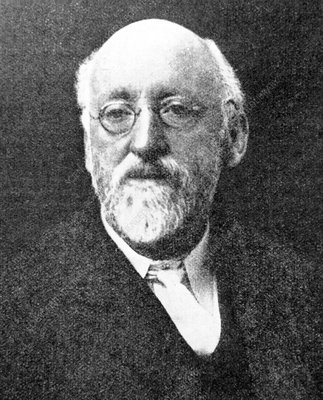
By Grey Pepper Editorial
Every GLP-1 drug, every insulin pen and every peptide hormone test belongs to a medical world built around an idea so familiar it hardly seems like a discovery: organs send chemical messages through the blood.
In January 1902, the full significance of that idea was still emerging. Two physiologists at University College London, William Maddock Bayliss and Ernest Henry Starling, helped change that with an anaesthetized dog, an isolated loop of intestine and a crude tissue extract.
The substance they found became known as secretin. Their experiment established a powerful example of chemical communication between organs, and three years later Starling introduced the word that would give such messengers a common name: hormone.
A 2000 historical review in the Scandinavian Journal of Clinical and Laboratory Investigation describes secretin as the first hormone. This historical profile follows the experiment, the word it inspired and the remarkable afterlife of the peptide.
Two Brothers-in-Law at University College London
William Maddock Bayliss was born in 1860. Ernest Henry Starling was born in London on April 17, 1866. They were family as well as colleagues: Bayliss married Starling’s sister Gertrude in 1893.
Starling qualified in medicine from Guy’s Hospital in 1889 and became Jodrell Professor of Physiology at University College London in 1899. Bayliss and Starling had already established a productive research partnership, investigating the nervous control and movements of the intestine.
The next question concerned the pancreas.
When acidic, partly digested food passes from the stomach into the small intestine, the pancreas releases bicarbonate-rich digestive fluid that helps neutralize the acid.
At the time, an influential explanation emphasized nervous reflexes. The intestine detected acid and, through its nerves, signaled the pancreas to release pancreatic juice.
Bayliss and Starling wanted to know whether nervous communication was the whole story.
Their experimental approach was direct. If they interrupted the nerve supply to a section of intestine but preserved its blood circulation, would the pancreatic response disappear?
What happened instead would challenge a central assumption about how organs communicate.
The nerves supplying the intestinal loop were severed. The pancreas still responded.
January 16, 1902: The Experiment That Found Secretin
The pivotal experiment took place at University College London on January 16, 1902.
Its details are preserved in a firsthand account by Charles James Martin, who was present, and in a later historical analysis published in The Journal of Physiology.
Bayliss and Starling worked with an anaesthetized dog. They isolated a loop of jejunum, part of the small intestine, tied it off at both ends and divided the nerves supplying it.
The loop remained connected to the animal through its blood vessels.
First, the investigators introduced weak hydrochloric acid into the duodenum. The pancreas responded by producing digestive fluid, as expected.
After that response subsided, they introduced acid into the denervated jejunal loop.
The pancreas responded again.
This was the critical observation. The nerve supply to the experimental intestinal segment had been interrupted, yet the pancreatic response remained.
The result pointed toward a signal carried through the blood rather than through the severed intestinal nerves.
Martin later recalled Starling’s immediate interpretation: “Then it must be a chemical reflex.”
Starling then carried out another experiment to test the explanation more directly.
He took another piece of jejunal tissue, treated its lining with weak acid and sand, filtered the resulting extract and injected the filtrate into the animal’s jugular vein.
The pancreas responded with an even greater secretion.
Whatever stimulated the pancreas could be extracted from the intestinal lining and delivered through the circulation.
The researchers named the active substance secretin.
They communicated their discovery to the Royal Society shortly afterward and published their detailed findings in The Journal of Physiology on September 12, 1902, under the title The Mechanism of Pancreatic Secretion.
Modern physiology explains the process more precisely. Acid entering the duodenum stimulates specialized intestinal S cells to release secretin into the bloodstream. Secretin then acts on the pancreas, promoting bicarbonate-rich fluid secretion.
The experiment had demonstrated something larger than one digestive response.
An organ could influence another organ through a circulating chemical messenger without requiring the nerve pathway previously thought essential.
1905: A Dinner Conversation Names a Field
The discovery of secretin created a conceptual problem. Physiology now had compelling evidence of substances that traveled through the blood and regulated the activities of distant organs.
But what should those substances be called?
In 1904, Bayliss and Starling discussed their work on secretin in the Croonian Lecture delivered to the Royal Society.
The following year, Starling gave a separate series of Croonian Lectures at the Royal College of Physicians in London.
During those June 1905 lectures, he introduced the term “hormone,” derived from a Greek verb meaning to excite or arouse.
The word has its own unusual history.
According to a tradition recorded in later historical accounts, the name emerged from a conversation involving the Cambridge biologist W. B. Hardy and the classical scholar W. T. Vesey at Gonville and Caius College.
Vesey reportedly suggested the Greek root that Starling subsequently used. The exact date and full circumstances of the conversation remain uncertain, so the account is best understood as a historical recollection rather than a verbatim record.
The significance of the word, however, is not in doubt.
Hormone gave researchers a shared term for chemical messengers that could travel through the body and affect distant tissues.

The name did not mean that no one had previously observed chemical effects between organs. Earlier investigators had demonstrated important physiological actions of substances such as adrenal extracts.
What Bayliss and Starling had supplied was a particularly convincing experimental example of a blood-borne messenger linking a physiological stimulus to a distant organ response.
The idea helped bring seemingly separate discoveries into a coherent scientific framework.
A substance discovered in an intestinal experiment helped give insulin, glucagon and countless other messengers a common scientific name.
From Crude Extract to an FDA-Approved Peptide
Discovering secretin’s biological action was only the beginning. Understanding its chemical structure took far longer.
The 2000 historical review describes how secretin was isolated and subsequently synthesized during the 1960s, opening the way for more precise biochemical and immunological investigations.
Radioimmunoassay methods developed during the following decade helped investigators measure the hormone and establish its role in normal physiology.
By the 1990s, molecular biology had clarified the structure of the secretin precursor, characteristics of its receptor and its evolutionary relationship to other gastrointestinal peptides.
This was a recurring pattern in the history of hormone science.
Researchers first observed a biological effect, then identified the responsible substance, determined its structure and eventually developed methods to measure or reproduce its activity.
Similar developments shaped the scientific history of glucagon, explored in Grey Pepper’s profile of Roger Unger and diabetes research, and insulin, whose molecular structure became the subject of decades of work by Dorothy Hodgkin.
Secretin also eventually became a medicine, though its approved role is diagnostic rather than a treatment for everyday digestive disorders.
ChiRhoStim, a synthetic human secretin product, received its initial U.S. marketing approval on April 9, 2004, according to FDA records.
The medicine contains a 27-amino-acid peptide with a sequence identical to naturally occurring human secretin.
Its approved uses involve stimulating pancreatic secretions to help diagnose exocrine pancreatic dysfunction, stimulating gastrin release to help diagnose gastrinoma, and facilitating the identification of pancreatic duct openings during endoscopic procedures.
The connection to 1902 is remarkable.
Bayliss and Starling discovered secretin by demonstrating that an intestinal chemical could stimulate pancreatic secretion. More than a century later, physicians could administer a synthetic version of the same hormone to investigate pancreatic function.
What the First Hormone Still Teaches
The historical record deserves some care. Details of the January experiment appear in the original scientific publication and in recollections recorded years afterward.
Those sources establish the major sequence of events, but dramatic dialogue and the emotions of the afternoon should be attributed to the witnesses who remembered them rather than presented as a complete laboratory transcript.
There is also a deeper scientific qualification to the phrase “first hormone.”
Secretin occupies that place in the history of endocrinology because its discovery provided a decisive demonstration of chemical regulation between organs and helped inspire the modern hormone concept.
It was not the first biologically active substance ever observed, nor did its discovery mean that researchers suddenly understood every form of chemical signaling.
The 2000 historical review ends by acknowledging that understanding of secretin remained incomplete even after almost a century of research.
Starling went on to other landmarks in physiology, including his investigations of cardiovascular function and the principle that became known as the law of the heart.
Bayliss died in 1924. Starling died in 1927 aboard a steamship arriving at Kingston, Jamaica.
Their experiment outlived them both.
The modern study of peptide hormones, from insulin and glucagon to gastrointestinal signaling and GLP-1 medicines, builds on the recognition that tissues communicate through specific molecules acting at specific targets.
Bayliss and Starling did not invent every part of that understanding. They supplied one of its defining experiments.
On January 16, 1902, an intestinal loop continued communicating with the pancreas even after its nerve supply was interrupted.
What remained was the blood, carrying a message the researchers would call secretin.
From that experiment came an enduring principle: the body communicates in chemicals, and peptides are among the molecules that carry its messages.
Sources and Further Reading
- Bayliss WM, Starling EH. The Mechanism of Pancreatic Secretion. The Journal of Physiology. September 12, 1902.
- Hirst BH. Secretin and the Exposition of Hormonal Control. The Journal of Physiology. 2004.
- Secretin, Its Discovery, and the Introduction of the Hormone Concept. Scandinavian Journal of Clinical and Laboratory Investigation. 2000.
- Society for Endocrinology. The Birth of Endocrinology and Neuroendocrinology. 2021.
- Pearce JMS. Ernest Henry Starling and the Birth of English Physiology. Hektoen International. 2020.
- U.S. Food and Drug Administration. ChiRhoStim: Orphan Drug Designation and Marketing Approval Record. April 9, 2004.
- DailyMed. ChiRhoStim (Human Secretin) Full Prescribing Information.


